Showing posts with label San Joaquin Valley Paleontology Foundation. Show all posts

Saturday, October 2, 2010

Fossil Discovery Center in Madera County is Opening!

Painting by David Douglas for the Fossil Discovery Center

If you live anywhere near the geographical center of California, there is some exciting paleontology news! Since the early 1990's Fairmead Landfill has been the source of thousands of specimens of a diverse Pleistocene fauna, including horses, camels, mammoths, sabertooth cats, giant ground sloths and many other fascinating inhabitants of the Central Valley thousands of years ago (I've posted several items about the excavations here and here). For years the San Joaquin Valley Paleontology Foundation has been planning to develop a center where students and visitors can learn about the intriguing history of our valley. And their plans are coming to fruition.

The San Joaquin Valley Paleontology Foundation is sponsoring the Grand Opening Celebration of the Fossil Discovery Center of Madera County. The journey began in 1993 with the discovery of a seven-foot mammoth tusk. Today their expedition into a pre-historic era continues, opening the past to students, scientists and community. Come and be a part of this historical event.

Wednesday, October 13, 2010

Ribbon Cutting -10:00 a.m.

Reception—5:30 p.m. to 7:30 p.m.

Fossil Discovery Center of Madera County
19450 Avenue 21 ½
Chowchilla, CA 93610
Take the Hwy 99 Exit 164, SW corner of Road 19 ½ & Avenue 21 ½

Refreshments will be served & tours provided.
--
San Joaquin Valley Paleontology Foundation
Board of Directors
sjvpaleo@gmail.com
http://www.maderamammoths.org/

Come and check it out!

Monday, April 19, 2010

The Other California: Mammoths and Sabertooths rise from the Prairies again!


Painting for the San Joaquin Valley Paleontology Foundation by David Douglas

Sometime back, I talked about the rich paleontological discoveries being made at the Madera County Landfill at Fairmead near the center of California's Great Valley. I mentioned the efforts to build a visitor facility, the Fossil Discovery Center, but also mentioned that I had not had the opportunity to visit the site yet. That changed today, and I am happy to report that the facility is rapidly becoming a reality. It is expected to be open for business in June.
The Fossil Discovery Center is on the corner of Road 21 1/2 and Road 19 a short distance from Highway 99, near the town of Fairmead. As can be seen, the exterior of the building is essentially complete, and when I stopped by, workers were busy putting in the high-tech connections, and working on the interior labs and classroom. I was pleased to have the opportunity to talk to Grady Billington, the President of the Board of the Directors of the San Joaquin Valley Paleontology Foundation. He kindly provided me a tour of the facility and discussed their plans for introducing valley residents to the fascinating prehistory of the region.
A full-sized mammoth skull has been hung in the central atrium. More than three dozen species of animals have been discovered at the landfill, including mammoths, mastodons, sloths, camels, horses, dire wolves, smilodon sabertooths, and short-faced bears. Skeletons of most of these animals will be part of the display when it is complete.

The original environment where the animals lived and died was a prairie with ponds and rivers flowing out of the adjacent Sierra Nevada. An outdoor pond has been constructed to recreate some of the conditions present when the Pleistocene animals were roaming the area. The hill in the background of the photo is the landfill site where the fossils were uncovered.

For more information, check out the website for the San Joaquin Valley Paleontology Foundation, or look for almost daily updates on the Fossil Discovery Center of Madera County site on Facebook.

For those who are new to Geotripper, the "Other California" is my long-running web series on the fascinating geological places in my fine state that don't usually show up on the postcards. Thanks for reading!

Friday, January 1, 2010

The Other California: The Prairies of the Past

Photo from the San Joaquin Valley Paleontology Foundation

A colleague of mine in an earlier phase of my life at Santa Barbara City College was fond of saying to field trippers that "I wouldn't take you JUST anywhere!" And a great Peanuts cartoon talked about a field trip the kids went on, and how they went and saw...a field. And that's what we have today: not just anyplace, and it is ... a field. And not just a field, it's a real dump. Well, ok, more like a municipal solid waste landfill.

My home, the Great Valley geomorphic province, is, well, a field. A really BIG field, about 400 miles long, and roughly 50 miles wide. It ranges from sea level to at most a few hundred feet above sea level, and it is exceedingly flat. I wasn't too thrilled when I first moved here; we geologists like to have some kind of topography in sight. Little remains of the original landscape, maybe 5%; most has been altered by agriculture and urban development. I discussed some of the remaining grasslands in the original post of this series.

When Europeans first came upon the valley in the 1700's, they found a prairie/ savannah environment with tule elk, deer, pronghorn antelopes, wolves, coyotes, and grizzly bears. It could actually be dangerous to be out and about without weaponry. Today the big danger is to avoid getting run over by a tractor/combine on the isolated country roads.

I always tell my students that the geological story of your home is fascinating, no matter where you live. I was challenged to make our Great Valley interesting, but just like people, the most interesting aspect is inside, beneath the surface.

In 1993, Madera county was excavating a landfill at Fairmead (about 20 miles northwest of Madera) when the big shovels uncovered bone fragments at a depth of 40 or so feet beneath the surface. Because of state regulations, a paleontologist was called in, and an intriguing story unfolded. During the ice ages around 500,000-700,000 years ago, this landscape was cooler, with a more humid climate, and shallow rivers coursed across the grasslands. And a host of wonderful and strange animals lived out their lives here. In the last 17 years, some 14,000 bones, representing 37 species have been found at the site. Numerous horse and camel species, pronghorn, giant ground sloths (three species),and Columbian mammoths are included among the plant-eaters. The carnivores include coyotes, wolves, sabertooth cats, and the hulking short-faced bear. A wide variety of smaller rodents, fish, amphibians, and reptiles rounded out the ecosystem. It turned out to be the one of the most important Irvingtonian aged fossil assemblages to be found anywhere in California.

So what is a dump operator to do? Apparently, the right thing! A foundation has been established, the San Joaquin Valley Paleontology Foundation, and construction has begun on a Fossil Discovery Center at the landfill site that will serve as an education/research facility housing many of the specimens (most are currently at Berkeley and CSU Fresno). Science education opportunities are sorely lacking in the Great Valley, and this center will be a wonderful addition to the few resources that are currently available.

So, the next time you happen to pass through Madera or Fresno (presumably on your way to someplace else), check on the progress of the Fairmead Fossil Discovery Center. It's a unique part of the geological landscape of California.

Note: I haven't been there yet. All the photos are from the website for the San Joaquin Valley Paleontology Foundation and other online sources (credited below).
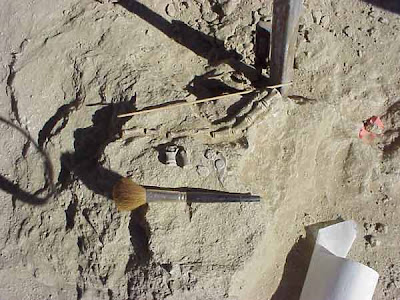

Camel bones at the Fairmead Landfill, photo from the California Integrated Waste Management Board


Painting by David Douglas for the San Joaquin Valley Paleontology Foundation

Resources:
Geology and stratigraphy information about the site: http://dundaspaleolab.com/index-4.html

Preliminary 1996 report on the site