Showing posts with label science education. Show all posts

Friday, April 3, 2020

Punctuated Equilibrium and the New Academic World That We Live In (along with the rest of society)

Catastrophe

Three weeks ago I was lecturing and running labs like a regular professor. I had never gotten around to learning Canvas or Blackboard, because my Excel program was working just fine for recording and posting grades. I never had use for Zoom, since all my classes were face-to-face in a physical classroom. Things were fine and there didn't seem to be any compelling reasons to spend weeks in training for something I wasn't planning on using.

I knew about online courses of course, and two decades ago I even taught some, after a fashion. At the time they were called telecourses, and they left me suspicious of the academic value of online instruction. In essence the students watched canned videos on geology, and needed to learn the geology for themselves by reading the textbook and answering review questions. It was very low-tech, and most students didn't retain much information in the particular learning environment. There were innovative people on our campus who were working hard to improve the process, but before the innovations could really improve that particular form of instruction, the recession put an end to all of the telecourses and I never really looked back. In the end, classes had met a need for certain students with special needs, such as lack of day-care, or medical issues that prevented them from coming on campus. But it didn't really help most of them.
Something doesn't feel right here...

Two weeks ago everything changed. As part of our state effort to control the COVID-19 pandemic we went remote. In an instant. I had my entire load, five classes and three labs, switched over to online  instruction. It's now what I do, using Canvas, Blackboard, and Zoom after a steep learning curve over the course of just a few days. I'm not complaining, mind you. I'm grateful to be working. I just can't believe how completely life changed, how the academic landscape was suddenly transformed. I'm functioning and the classes are continuing, but it wasn't a pretty process. There are lots of glitches, but it is happening.

Something about the process made me think about life. Not my life, or the lives of those around me, but the whole adventure of life on our planet. There was something familiar in the way events unfolded around me. And then it hit me: we had just survived a punctuated equilibrium evolutionary catastrophe. And I'm sure that requires a bit of explanation.

One of the greatest advances in biology and paleontology was the result of research by Charles Darwin and Alfred Wallace into evolutionary processes. Darwin is better known for describing the theory of natural selection, but Wallace had come to much the same conclusions from his independent research in Indonesia, and it is proper that both men be given equal credit. One of the expectations of the model is that evolution was a gradual process, and that eventually the fossil record would fill with all kinds of transitional species. This has come to be called phyletic gradualism. The problem is that as the decades rolled on, transitional species were found but not in the large numbers predicted by the theory. Most species just simply appear in the rocks as fully-formed separate species. It bothered many paleontologists.
Alfred Wallace (1823-1913)
In 1972, Niles Eldredge and Stephen Jay Gould proposed an alternative hypothesis that could explain the 'sudden' appearance of new species in the fossil record. Termed punctuated equilibrium, the model suggested that evolved species did not change much as long as the environment they inhabited didn't change either (stasis). But in the event of a catastrophe like an asteroid impact, or unusually intense period of volcanism, or the onset of an ice age, the environment would be severely impacted, and the species would have to change as well, or go extinct. This could involve a higher rate of evolution, but it could also involve long-term changes in peripheral isolates, organisms living at the edge of their environmental tolerances.

Think of coyotes, a widespread species across North America. Most live somewhere in the 'average' climate of the region, not too hot or cold, not too dry or humid. But to the north, there would be populations living in very cold environments at the edge of their tolerances. Over time natural selection would produce individuals with heavier coats of fur, and perhaps the ability to store more energy in the form of fat stores. They might not be numerous, and it would be unlikely that many of them would ever become part of the fossil record. But they could be considered a different species, especially if their range no longer merged with the average coyote. They are the fat furry coyotes.

But then a series of intense volcanic eruptions blocks out sunlight for several decades, and a climate feedback loop causes an ice age. In the suddenly cold conditions, the 'average' coyotes can't adapt, and they disappear. The fat furry coyotes from the far north are able to thrive and spread quickly into the former range of the 'average' coyotes. Much later on, the fossil record would then be filled with 'average' coyotes through many feet of sediments, but then they would appear to have been suddenly replaced by a new species, the fat, furry coyote. But in reality the fat-furrys were 'pre-adapted'.

So what happened to us?
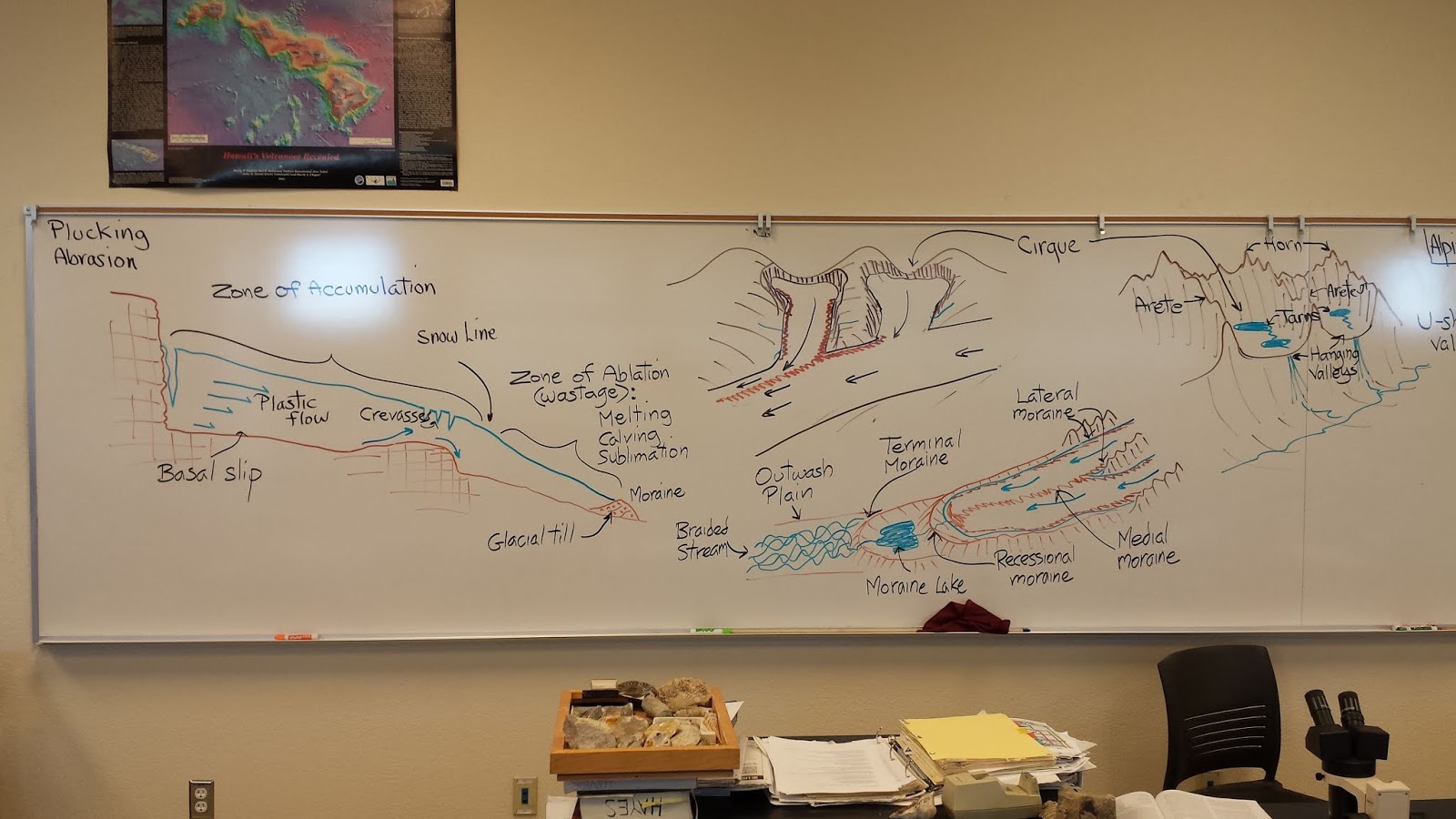
It's the old pre-catastrophe environment! The Paleozoic classroom.

We've been in a period of stasis for a long time. Professors professed. Classes passively took notes. There have been gradual transitions in teaching style; slide projectors have been replaced by PowerPoint presentations. Passive listening has often been replaced by group problem-solving. Note-taking has been replaced by voice-recording. But by and large, students work in the presence of a professor, and no one had any reason to think it would ever really change.

But out there in the periphery, some changes were taking place. Some teachers and administrators thought the technology had brought us to a place where teachers didn't have to be in the physical presence of their students. They trained for and taught courses remotely. Most acknowledged that remotely-taught courses provided valuable benefits for some students, but only a few underwent the rather rigorous training required to teach remote classes in an effective manner.

But then the catastrophe occurred. We've had catastrophes before on our campus. We shut down for two weeks a year or two ago because our wildfires had polluted the air far, far beyond healthy levels. But we didn't change anything. When the air cleared, we went back to our old ways. But almost no one was thinking of the possibility of a world-wide catastrophe that would require that nearly all human beings would need to isolate themselves for weeks and months at a time. It was inconceivable.

But it happened. And in the new academic environment, conditions dictated that the only form of instruction left to us was remote online education. In this new environment, the pre-adapted, the online instructors, thrived and flourished. The rest of us learned something else. Evolution is chaotic and imperfect.

Most species have organs and structural features that they don't really need or use. Humans have a tail. Many whale species have useless femurs embedded deep within their bodies. Embryonic birds often have teeth that disappear before hatching. They are deeply imperfect organisms, but they have enough adaptations in their genetic make-up that they are able to survive. This produces cobbled-together organisms with quirks and modifications that give them just enough of an edge to survive in their habitat. And sometimes those useless bits and pieces end up being an adaptation that allows survival after all. It gives us Duck-billed Platypuses, animals with a 'bird'-like beak which lay eggs like a reptile, but have hair like a mammal. And they get by.
Source: World Wildlife Fund
That's me right now. A duck-billed platypus. I have just enough of a skill in understanding computer key-boards that I was able to cobble together enough presentations and online quizzes and labs that we only lost a week or so instruction. And I'm learning to comb my hair and put on pants before sitting down for a zoom session with my students. And in a week I am taking 17 students to Yosemite National Park...in virtual reality.

It's been upsetting, and has required long hours to achieve any kind of success. There is a lot of uncertainty and fear. But we ARE adapting to the new normal that has been imposed on us, and I have to say I am really proud of my students. They are a bit more pre-adapted than I am to this learning style, and they have stepped up admirably to the new reality.

And I am an old platypus learning to fly...

To all my teaching friends: take care of your students, they're depending on you, but care of yourselves too. And to all the students: hang in there. We'll get through all this together. Stay healthy and safe. And to those who face true catastrophe in the coming weeks and months because of the corona virus, may you find hope and peace in tragedy.

Saturday, July 20, 2019

50th Anniversary of the Landing of Humans on the Moon, and the Human Adventure


The full Moon of July 16, 2019 
Today marks the 50th year since humans walked on the moon for the first time. The landing was an important part of my own life, and whenever I am reminded, I am taken back to my childhood. In 1969, I was at a scout camp high in the southern Sierra Nevada. I'm not sure whose screw-up it was that our troop was in the middle of nowhere at the moment of one of humanity's greatest achievements, but that was the way it was. I can remember walking through the pinyon forest between the dining hall and our campsite (they were pretty far apart). I was alone at the time, and I heard the camp loudspeakers crackle on (which was unusual; we usually only heard "taps" and other bugle calls, or the emergency alarm). I heard a scratchy voice say "That's one small step for a man, one giant leap for mankind", and I realized that humanity had just accomplished something big. Something that had never been done before. It had a profound effect on that scrawny kid in the pinyon forest at Circle B Scout Ranch.

I grew up in the early sixties fascinated by astronomy. But it was also frustrating that things were so distant and so unreachable by we earthbound humans. Our own moon seemed impossibly distant, despite the objective laid forth by JFK that we would reach it before 1970.
The other planets in our own Solar System were small disks in our best telescopes, and the moons that circled them mere points of light. At the time I had a postcard from the Palomar Observatory that had pictures of Jupiter and Saturn similar to those below. I spent hours staring at them with a hand lens and later on a microscope, hoping I could make out more detailed features to no avail. The other stars? They were so distant that even in our best telescopes they looked no different, just spots of light. The more I learned about the stars and galaxies of the cosmos, the more impossible it seemed that we could ever reach them. Neil Armstrong, Buzz Aldrin, and Michael Collins changed that. They are heroes of the best kind, courageous men who risked everything to do something that had never before been done.
Of course, Armstrong, Aldrin and Collins didn't build the Apollo Spacecraft, or the gigantic Saturn 5 rocket that sent them into space. They didn't navigate to the moon by themselves. There were thousands of engineers and scientists who did the calculations, designed the modules, and shepherded the spacecraft to the moon, and even more importantly, back home again. The vast majority of scientists and engineers were the product of an educational system that was the best the world had ever seen. And they were driven by a communal sense of purpose. They worked together towards a common goal, and their discoveries and innovations radically changed the world we live in.
Of course our cynicism allows us to point out that once we beat the Russians to the moon, the public pretty much lost interest in the space program. NASA started to fade from the public consciousness, but the system was in place that allowed a series of successful projects that have changed the way we view the cosmos and our place in it. We never sent astronauts to Mars, but we sent rovers. We sent the Voyagers to Jupiter, Saturn, Uranus and Neptune. In a wonderful case of over-engineering, the spacecraft outlived their expected missions by decades. Voyager 1 is in its 42nd year of operation...it is still sending data from 16.4 billion miles away (20 light-hours) with an onboard computer that is probably less powerful than one of those Commodore 64 models that I wrote my thesis on in 1985. It recently made a course correction using thrusters that hadn't been fired since 1980. Voyager 2 is also continuing to operate.
Today we see our Solar System in stunning detail, in a way that would have been unbelievable to that child of the sixties. We know the surface of Mars in more detail than we know the surface of our own planet. We've explored the moons of Jupiter and Saturn, discovering strange worlds with vast oceans hidden beneath icy crusts, volcanoes of molten sulfur, and lakes, rivers and oceans made of liquid methane. We've peered through the clouds of Venus, and just a few years ago, we photographed and analyzed the hidden side of Mercury that we missed on the first mission three decades ago. We saw Pluto up close for the first time only a few years ago, and we've orbited the two largest asteroids, Vesta and Ceres.
The Hubble Space Telescope was the other game-changer. It has shown us the rest of the Universe with a clarity that was unimaginable four decades ago. We can see star nurseries and nascent star systems that provide us visual evidence of how our own Solar System formed. The Hubble and other high-tech units have now seen objects that formed a mere half billion years after the origin of the Universe itself 14 billion years ago. And we are only a few years away from the launch of an even more powerful telescope, the Webb Space Telescope.

This is the heritage of a country that undertook an audacious program of exploration under the leadership of JFK, and which succeeded through the exploits of courageous men like Neil Armstrong, Buzz Aldrin, and Michael Collins. What do our children dream of today? Is our education system inspiring them to strive for incredible things, or is it teaching them to be unquestioning automatons in a factory or office? Are we teaching them to be curious about the world, or teaching them how to take a multiple-choice assessment test?

I had the privilege today of offering a lecture on "Space Rocks" at the public library in Hemet, California. The audience turned to be mostly young women 6 to 9 years of age, so I changed gears and made it more of a talk about the adventures of scientific research, and how anyone, including them, could be the vanguard of our next journeys into the unknown.
We are in a time of even greater challenges as humans. We are entering a dark age where the US government is retreating into willful ignorance instead of the leading the world in the face of a planetary crisis. We are now living with the consequences of climate change that were predicted thirty years ago, and we are spiraling into even worse consequences in the near future. There are days when I feel absolute despair at the stupidity and greed of those in charge, and profound sadness at the gullibility of those who blindly accept the deceptions and lies of the present administration. I can't accept that our explorations are ending in a morass of corruption and lies.

In the words of the immortal folksinger Lee Hays (and no doubt others), all things, like a kidney stone, will pass. I believe that adventure still awaits us as a people. As I start a new school year next month, I am as excited as I have ever been to have the opportunity to introduce my students to an incredible Universe. And almost every teacher I know feels the same way.
This is a highly abridged and updated version of a post from August 25, 2012 marking the passing of astronaut Neil Armstrong.

Thursday, December 6, 2018

Wait a Minute...What Happened to the Rocks I Picked Out?

Something kind of extraordinary happened on campus this week. I was pausing between classes and saw a large truck and a crane downstairs in the staging area for the Great Valley Outdoor Nature Lab. The crane was dumping gigantic rocks onto the ground. "My" rock collection had arrived!! You might remember that early last month I went 'rock collecting' in the Sierra Nevada foothills for the rocks that will be part of the displays and landscaping of the outdoor. All 60 tons or so...
Source: https://media.giphy.com/media/12ScDYWbP4yoBq/giphy.gif
My response about their arrival on campus was predictable...

But if you remember the scene in "Elf" when Buddy thought Santa was in the store only to discover he was a fake, well, I had that moment too. I saw that something was off about the rocks I had selected. Something was different about them. Below was the rock that I selected a month ago, when it was 85 degrees out, and rain had not fallen in months...
And here (below) is the rock they claim I picked out. This after nearly two weeks of rain and cooler temperatures. This rock is clearly on a PALLET of LIES!

Well, okay, maybe it isn't on a pallet like the others, and maybe it is the same rock I picked out. But you can now see one of the main reasons I picked it, and why it will be sitting in a position of honor by the entrance sign to the outdoor nature lab. Not only is it a unique rock that is found in our region (the latite of Table Mountain), it is also a miniature ecosystem of mosses, lichens, grass, and other organisms. To see it, just add water!
In any case, we now have an astounding variety of the rocks that are found in our region. There is marble from the Calaveras Complex, the host rock of the many caverns that are found in the Sierra Nevada foothills.
There is a gigantic chunk of the quartz from the Mother Lode veins, the source of the gold that played such a huge (and devastating) part in the history of California. Sorry, no visible gold (although I'll keep looking).
One of the most striking rocks are the "tombstone rocks" of the Foothills Terrane, large fins of slate and phyllite that were once mud and silt on the ocean floor. The rocks were crushed against the western edge of North America, metamorphosed, and tilted vertically. We'll be putting them in the ground in the same vertical orientation. It will be a dramatic sight at the southern entrance to the lab.

The next step comes at the end of the week. I'll get to help direct the placement of the rocks! I'll try not to be insufferably picky..."Could you rotate that one about four inches? Great! Wait...I liked it better the way it was...". An update will follow.

Friday, November 2, 2018

I Went Rock Collecting Today...For Really, Really Big Rocks

I'm thinking how many times I've been on a field trip looking at a massive boulder composed of some kind of interesting rock and making a joke about how we would need a crane to get the thing back to school. I'll be darned if that very thing didn't come true today.

I was up in the Sierra Nevada foothills, choosing out some really big rocks, and we may very well be using a crane to move them back to campus. At least one of them weighs about 3 1/2 tons, and in total there will be about 60 tons of them. So yes, maybe my rock collecting habit has gotten out of hand. I need professional help.
Well, I might need professional help for something, but it's not for a colossal rock-collecting habit. I was selecting rocks representative of the geology of the Sierra Nevada foothills to become part of the landscaping of our new Great Valley Outdoor Nature Lab that is being constructed right now adjacent to the Great Valley Museum at Modesto Junior College.
At this particular quarry near Knight's Ferry on the Stanislaus River I was selecting boulders of Table Mountain latite (a volcanic rock broadly similar to basalt). These are the rocks that make up the dramatic inverted stream that winds its way among the towns of Sonora and Jamestown along Highway 108. I was also picking out some large granite and greenstone boulders to representing the bedrock found in the Sierra Nevada. We'll also be choosing some of the unique metamorphic "tombstone" rocks that stick out of the ground across the Mother Lode.

Meanwhile back on the campus of Modesto Junior College the outdoor nature lab is starting to take shape. We live in a flat valley, but the lab will have some topography, some small hills at the east end to represent the foothills. They will be planted with native trees and shrubs, and the trails and pathways will be lined with the rocks and boulders that we selected today. One of these days, the lab might look something like the scene below (which is actually at the quarry; they're showcasing what can be done with their rocks). It's incredible that the lab is finally happening. The science faculty at MJC have been fighting for an outdoor lab for three decades. It's been hard to be patient!

Tuesday, September 4, 2018

Isn't All Geology in the Field? Well, Here's an Exciting Field


There's an ugly vacant lot adjacent to the Science Community Center at Modesto Junior College (the science lab and museum where I work). It's been collecting weeds and litter for years, and some administration officials a few years ago wanted to plant it with grass, and some even suggested making it a parking lot. Maybe there is a little bit of logic to that, given the impacted parking situation at our school, but we, the science faculty and museum staff at MJC had other plans.

More than a decade ago, the people of our county had a marvelous vision of the future, and passed Measure E, a bond issue for almost a billion dollars that would be used to modernize the antiquated buildings at Modesto Junior College. Around $80 million was used to construct the Science Community Center, a gigantic boon to science teaching in our region that includes a planetarium, a research-level observatory, a natural history museum (the Great Valley Museum), and the labs and classrooms for our courses in biology, physics, chemistry, astronomy, and the earth sciences. It is now one of the finest teaching facilities in the state, but it wasn't finished.

For more than three decades the science faculty and museum staff have been trying to put together an outdoor nature laboratory that would complement the science labs and museum experience. Over and over the proposals were made, and time after time we were told there was no budget available to complete such a project. With the passage of Measure E, it looked like the dream might actually come to fruition. But it wasn't an easy road. There were many proposals, and one by one the highest priority projects were constructed. The pool of available funds dwindled to the last few million dollars, and there were still another dozen or so proposals competing for the last of the funds. We went through several presidents during that time, and some supported our proposal and some didn't. The possibility of ever getting an outdoor education laboratory seemed to be dwindling.

But finally word came out that the project had been approved! The planning process then needed to start, and I served on the committee that designed the lab. We came up with what we thought would be the best blueprint, and it went out to bid. The bids came in high, so we went back to work with a modified proposal. I may have missed a memo, because a bid was finally accepted and when I walked into my office this morning a construction crew was beginning to bulldoze and survey the field! It's an exciting moment for our community.
When it is completed, this empty field will have a greenhouse and a collection of native vegetation of the Great Valley and the surrounding foothills. There will be outcrops of the important rocks of the Sierra Nevada foothills, including granite, the "tombstone rocks" of Mother Lode slate, the volcanic rocks of Table Mountain, and others. There will be a vernal pool, a biological oddity that is practically unique to the Great Valley. There will also be a simulated paleontology excavation pit that will allow school children to experience what it is like to dig for the fossils that have been found in our region. The children who visit our Great Valley Museum will have the opportunity to see exhibits about the natural history of the region, and then they will be able to go outdoors and experience the natural environment directly. Our long-term dream is finally becoming a reality.

POSTSCRIPT:
Wow, that was fast. I finished my morning classes and look out over the work area and the perimeter fencing is already up.
 And after my lunch, there's a bulldozer already scraping off the surface weeds. Fast moving!


Friday, July 20, 2018

49th Anniversary of the Landing of Humans on the Moon: Science, History, and the Doing of Big Things

The Moon tonight, July 20th, 2018

Today marks the 49th year since humans walked on the moon for the first time. The landing was an important part of my own life, and whenever I am reminded, I am taken back to my childhood. In 1969, I was at a scout camp high in the southern Sierra Nevada. I'm not sure whose screw-up it was that our troop was in the middle of nowhere at the moment of one of humanity's greatest achievements, but that was the way it was. I can remember walking through the pinyon forest between the dining hall and our campsite (they were pretty far apart). I was alone at the time, and I heard the camp loudspeakers crackle on (which was unusual; we usually only heard "taps" and other bugle calls, or the emergency alarm). I heard a scratchy voice say "That's one small step for a man, one giant leap for mankind", and I realized that humanity had just accomplished something big. Something that had never been done before. It had a profound effect on that scrawny kid in the pinyon forest at Circle B Scout Ranch.
I grew up in the early sixties fascinated by astronomy. But it was also frustrating that things were so distant and so unreachable by we earthbound humans. Our own moon seemed impossibly distant, despite the objective laid forth by JFK that we would reach it before 1970.
The other planets in our own Solar System were small disks in our best telescopes, and the moons that circled them mere points of light. At the time I had a postcard from the Palomar Observatory that had pictures of Jupiter and Saturn similar to those below. I spent hours staring at them with a hand lens and later on a microscope, hoping I could make out more detailed features to no avail. The other stars? They were so distant that even in our best telescopes they looked no different, just spots of light. The more I learned about the stars and galaxies of the cosmos, the more impossible it seemed that we could ever reach them. Neil Armstrong, Buzz Aldrin, and Michael Collins changed that. They are heroes of the best kind, courageous men who risked everything to do something that had never before been done.
Of course, Armstrong, Aldrin and Collins didn't build the Apollo Spacecraft, or the gigantic Saturn 5 rocket that sent them into space. They didn't navigate to the moon by themselves. There were thousands of engineers and scientists who did the calculations, designed the modules, and shepherded the spacecraft to the moon, and even more importantly, back home again. The vast majority of scientists and engineers were the product of an educational system that was the best the world had ever seen. And they were driven by a communal sense of purpose. They worked together towards a common goal, and their discoveries and innovations radically changed the world we live in.
Of course our cynicism allows us to point out that once we beat the Russians to the moon, the public pretty much lost interest in the space program. NASA started to fade from the public consciousness, but the system was in place that allowed a series of successful projects that have changed the way we view the cosmos and our place in it. We never sent astronauts to Mars, but we sent rovers. We sent the Voyagers to Jupiter, Saturn, Uranus and Neptune (in a wonderful case of over-engineering, the spacecraft outlived their expected missions by decades). Not even two weeks ago, Voyager 2 passed its 41th year of operation...it is still sending data from 9 billion miles away with an onboard computer that is probably less powerful than one of those Commodore 64 models that I wrote my thesis on in 1985. Voyager 1 is also continuing to operate.
Today we see our Solar System in stunning detail, in a way that would have been unbelievable to that child of the sixties. We know the surface of Mars in more detail than we know the surface of our own planet. We've explored the moons of Jupiter and Saturn, discovering strange worlds with vast oceans hidden beneath icy crusts, volcanoes of molten sulfur, and lakes, rivers and oceans made of liquid methane. We've peered through the clouds of Venus, and just a few years ago, we photographed and analyzed the hidden side of Mercury that we missed on the first mission three decades ago. We saw Pluto up close for the first time only two years ago, and we've orbited the two largest asteroids, Vesta and Ceres.
The Hubble Space Telescope was the other game-changer. It has shown us the rest of the Universe with a clarity that was unimaginable four decades ago. We can see star nurseries and nascent star systems that provide us visual evidence of how our own Solar System formed. The Hubble and other high-tech units have now seen objects that formed a mere half billion years after the origin of the Universe itself 14 billion years ago. And we are only a few years away from the launch of an even more powerful telescope, the Webb Space Telescope.

This is the heritage of a country that undertook an audacious program of exploration under the leadership of JFK, and which succeeded through the exploits of courageous men like Neil Armstrong, Buzz Aldrin, and Michael Collins. What do our children dream of today? Is our education system inspiring them to strive for incredible things, or is it teaching them to be unquestioning automatons in a factory or office? Are we teaching them to be curious about the world, or teaching them how to take a multiple-choice assessment test?
Our teachers and professors are working in a toxic environment these days. How else to explain things like a political party in Texas in 2012 that added a plank in their platform that says "We oppose the teaching of Higher Order Thinking Skills, critical thinking skills and similar programs that are simply a relabeling of Outcome-Based Education which focus on behavior modification and have the purpose of challenging the student’s fixed beliefs and undermining parental authority."?  Is that what we have come to?

I refuse to believe that. I believe that adventure still awaits us as a people. As I start a new school year next month, I am as excited as I have ever been to have the opportunity to introduce my students to an incredible Universe. And almost every teacher I know feels the same way.

It is a sense of adventure that Neil Armstrong would have understood...
This is an abridged and updated version of a post from August 25, 2012 marking the passing of astronaut Neil Armstrong.

Sunday, March 4, 2018

The Sounds of Science (with apologies to Paul Simon): Kids are More Talented Than You Think

Strange things were afoot on Saturday at Modesto Junior College, where I've been teaching for the last thirty years. There was a Tyrannosaur flipping burgers, and a very cool Triceratops taking orders for Brontoburgers and Raptor dogs.
There was a constant barrage of earthquakes recorded on our seismometer upstairs on the third floor. There was some sort of harmonic tremor going on, visible on the bottom row of the monitor below. Was a volcano about to erupt under our campus? Were we in the grips of an earthquake swarm? Nah, nothing like that. It was instead that time of year for the sounds of science to take place at our institution: the Science Olympiad.
Forty-six junior- and senior-high schools from Stanislaus County, many hundreds of students, had gathered to compete in a series of science-related events. The winning schools from our competition would advance to state-level competition.

Our county is economically moribund. It takes a long time for economic recoveries to reach our region, which regularly has an unemployment rate that is twice the national average. Recessions hit us first (we reached close to 20% unemployment in 2011). The money for education is limited to say the least. And it often seems that science is not a very high priority when budgets are proposed. But the funny thing is, our residents have better priorities than our political leaders. When we had a chance to vote for a bond issue to upgrade our community college campus, including the construction of a Science Community Center, the county voted for it. Since the center opened in 2015, with the planetarium and the Great Valley Museum of Natural History, tens of thousands of kids (and their parents) have paid a visit. Our county knows that support of science is a key to a secure economic future.
And so we witnessed the genius of our best and brightest students competing for glory in laboratories instead of football fields. There were more than forty events. I was in charge of the competition in Rock and Mineral identification, and some of the student teams had scores that rivaled those of my first- and second-year geology students.
If you are wondering about why a T-rex and a Triceratops were involved, well, what can I say? 700 or 800 hungry students were on campus, and our Geology Club stood ready to provide them sustenance to help raise funds for our field studies program.

I've been participating in the Science Olympiad now for nearly three decades. It is a privilege and an inspiration to see these very talented students in action. It gives me hope for the future.

Monday, May 1, 2017

The Hawai'i That Was: Waimea Canyon, the View You "Have" to Earn...

You may be utterly surprised by this, but I was kind of a strange kid. I loved the outdoors of course, and was absolutely fascinated by geography, and when I learned about topographic maps in the scouts, I had found my calling. I liked seeing the big picture and climbed every mountain I could get to through my teen years, always looking for the better view. And I developed kind of an odd ethos...I figured the quality of the view was directly in proportion to the effort required to achieve it.

Take for example the classic scene from the classic cinema experience that is "National Lampoon's Vacation". Clark Griswold appears to have not appreciated the incredible scene before him at the Grand Canyon. Now it's true that he technically just robbed the hotel and he's a wanted man, but still one feels that maybe his life would have been enriched if he had taken a few moments to explore the rim, take a trail down a little ways, maybe purchase a book that explained something of the geology (with the cash that he stole). Well, maybe that's not the best example...
Let's try this example instead. When I was a teen in the scouts, we did a backpacking trip to Santa Anita Canyon, and after we established our camp at Spruce Grove I and a few buddies started the long climb to the summit of Mt. Wilson, one of the significant peaks in the San Gabriel Mountains. We struggled up the mountain for hours, carefully making our way around snowbanks and trudging up switchbacks. We made it to the summit and the view was breathtaking. It was a rare smogless day and the entirety of the Los Angeles Basin lay at our feet. We could even see Catalina Island out on the horizon. We were enthralled, despite being teenaged boys (parents weren't there so we didn't have to act up). It was about then that we noticed that we were in a parking lot and we were surrounded by bored-looking people. They had driven up the Angeles Crest Highway and were visiting the observatory and the small theme park that used to be up there. Hardly anyone seemed to be taking in the view.
What does that have to do with Hawai'i, you ask? As some of you may recall, I spent a fair part of the summer and fall working on a series about the Hawai'i That Was. It was an exploration of the geology and anthropology of the Big Island and Kaua'i, and it was going just fine until I got distracted the 2017 Deluge that engulfed California, as well as our journey to Death Valley. I wasn't that far from finishing the main part of the series, but it has been several months since I posted anything. So we come to today's post.
We had been talking about the oldest of the main islands of Hawai'i, Kaua'i. We had explored the shoreline roads and the hike to the Alaka'i Swamp, but I was saving the best part for last. When one runs through the stereotypes of Hawai'i, there are the beaches, the palms, the volcanoes and all that stuff, but one doesn't normally think of incredible deep and rugged canyons. But that's what is present on the relatively small island of Kaua'i: a canyon so scenic and deep that it has been called the Grand Canyon of the Pacific. Geologically, it shouldn't be there.

What's that all about? All of the islands grew as large basaltic shield volcanoes, and as they moved off the hot spots the islands subsided and underwent severe erosion. Sometimes large landslides erased large portions of the islands, and started a sequence of erosion that produced rugged canyons, but there is nowhere in the islands that is anything like Waimea Canyon. In places it is 3,000 feet deep, almost 60% of the depth of the "real" Grand Canyon in Arizona. On such a small island it can't be very long, only ten miles or so, but the exposures are spectacular. But it tells a strange story.
The original volcano grew to an elevation of perhaps 8,000 feet, and would have been a relatively circular edifice. It emerged from the waves about 5 million years ago, but about 4 million years ago the volcano destabilized and much of the summit, perhaps two-thirds of the entire volcano slipped, but did not collapse into the sea. It simply shifted a few thousand feet and stopped. Water courses that used to flow west towards the ocean were shifted to the south instead, along the fault. The canyon grew despite the growth of another shield, and eventually Waimea Canyon emerged as one of the deepest island canyons in the world.

There is a paved highway that leads to several spectacular overlooks, but there was a stubborn part in my psyche that insisted that I had to earn a view of the incredible gorge. I missed doing the hike on a previous trip because one of my students broke a finger and needed to be transported to a medical facility. This trip, it was finally going to happen, but I had strained a ligament or tendon in my foot, and I was, much to my chagrin limping badly. I actually had a cane, but it wasn't going to stop me. I was going to hike to the Waimea Canyon Overlook. I started hiking with Rebecca and Thomas (most of the other students opted to go shopping or snorkeling one of the coral reefs). It was a fascinating journey through the high altitude rainforest. We saw some of the native birds and vegetation, aa well as some non-native invaders, the goats (I'm just glad it wasn't one of the wild boars). The goats and boars have done immeasurable damage to the forest and their control is a continuing problem.

I stumbled into a clearing and had a view down the canyon where we could see the basaltic lava flows (originally black but weathered red and brown because of the high iron content. In places we could see the vertical dikes of basalt that once fed eruptions at the surface.
Little vegetation covered the slopes, as they were so steep that soil couldn't form quickly enough to support plants before being eroded down the canyon.
The forest ended abruptly, and the world fell away before us. I briefly forgot my aching foot to take in the incredible sight. True to my teenage ethos, I had (painfully) earned this view! Now maybe you can't get to islands, or maybe a disability might prevent you from doing a hike like this, but one can earn a view in a different way: education. Learning the reason for the landscape provides a richness to the experience of seeing it. It's not just colors that lie before you. It's a long history of one eruption after another, followed by earthquakes, faulting, landsliding, weathering and erosion. Research into the native legends provides a human perspective to this natural wonder.

And that means that you, dear reader, have earned the view at last (this is because you still happen to be reading)! This is Waimea Canyon on Kaua'i, the so-called "Grand Canyon of the Pacific", one of the most stunning places on planet Earth (as far as I am concerned). We first see the view towards the horizon to the south in the lower reaches of the canyon.

Then we see the dark gorge that lies at our feet.
Now, it's true that our panorama is limited somewhat because I wasn't able to go any farther because of the foot pain. Another half mile would have put us at the top of a stunning waterfall, but that will be something to look forward to next time.

Mrs. Geotripper and I made one more trip to Waimea Canyon before we ended our journey to the islands, and we saw awesomeness. Those pictures will be the subject of the next post