Showing posts with label Science Olympiad. Show all posts

Sunday, March 4, 2018

The Sounds of Science (with apologies to Paul Simon): Kids are More Talented Than You Think

Strange things were afoot on Saturday at Modesto Junior College, where I've been teaching for the last thirty years. There was a Tyrannosaur flipping burgers, and a very cool Triceratops taking orders for Brontoburgers and Raptor dogs.
There was a constant barrage of earthquakes recorded on our seismometer upstairs on the third floor. There was some sort of harmonic tremor going on, visible on the bottom row of the monitor below. Was a volcano about to erupt under our campus? Were we in the grips of an earthquake swarm? Nah, nothing like that. It was instead that time of year for the sounds of science to take place at our institution: the Science Olympiad.
Forty-six junior- and senior-high schools from Stanislaus County, many hundreds of students, had gathered to compete in a series of science-related events. The winning schools from our competition would advance to state-level competition.

Our county is economically moribund. It takes a long time for economic recoveries to reach our region, which regularly has an unemployment rate that is twice the national average. Recessions hit us first (we reached close to 20% unemployment in 2011). The money for education is limited to say the least. And it often seems that science is not a very high priority when budgets are proposed. But the funny thing is, our residents have better priorities than our political leaders. When we had a chance to vote for a bond issue to upgrade our community college campus, including the construction of a Science Community Center, the county voted for it. Since the center opened in 2015, with the planetarium and the Great Valley Museum of Natural History, tens of thousands of kids (and their parents) have paid a visit. Our county knows that support of science is a key to a secure economic future.
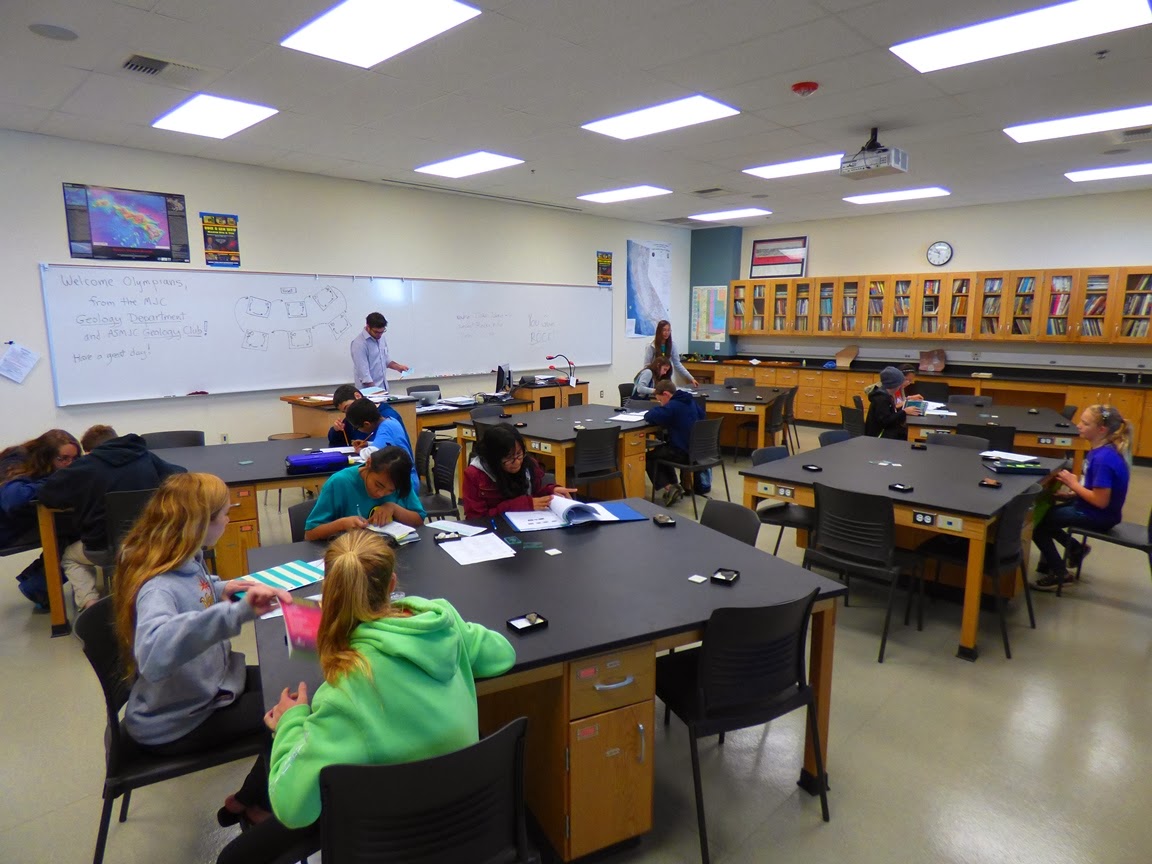
And so we witnessed the genius of our best and brightest students competing for glory in laboratories instead of football fields. There were more than forty events. I was in charge of the competition in Rock and Mineral identification, and some of the student teams had scores that rivaled those of my first- and second-year geology students.
If you are wondering about why a T-rex and a Triceratops were involved, well, what can I say? 700 or 800 hungry students were on campus, and our Geology Club stood ready to provide them sustenance to help raise funds for our field studies program.

I've been participating in the Science Olympiad now for nearly three decades. It is a privilege and an inspiration to see these very talented students in action. It gives me hope for the future.

Saturday, March 7, 2015

Harmonic Tremor? Volcanoes under Modesto? Nah, It's Kids and Science


Earthquakes? Volcanoes? Not this time, anyway...
The seismometer on our campus was going crazy today. Usually such high levels of seismic activity are cause for great concern, due to the rapid movement of magma in the crust, or an impending "big one". But there was no such concern today. The seismic action was due to kids running back and forth down the hallways of our Science Community Center. And they were doing science!
Our campus has been invaded...
Today's Science Olympiad brought together hundreds of students and adult volunteers in a competitive event that drew on all the fields of science: physics, chemistry, earth science, geography, geology, anatomy, biology, engineering, and more. Local junior high and senior high schools fielded teams competing for the chance to move up to the statewide meet. Few football games provide the level of intensity that I saw today.

Admittedly I didn't see a heck of a lot. I was responsible for hosting the "Fossils" event, which had teams competing in all four time slots during the morning and early afternoon. It left me no opportunity to wander through some of the other events, or the newly opening Great Valley Museum, or the Planetarium shows. But I did get to see some intense trench competition among the students in my event. To explain, there are glamor events like robot building or bottle rockets that garner lots of attention. The students in events like mine are the quiet ones who make up the bulk of the teams, and earn most of the points for their schools. The competition is not won or lost in the handful of big events, but in the many "lesser" topics. What's nice about it? The quiet kids, the introverted kids, they get to be heroes at times like this. An unexpected win in an event like Fossils may be the ticket for their school to advance to the state level.
Yes, this is trench competition...
Such events are not possible without the work of many dozens of volunteers. Each school has coaches, teachers and aides who have taken on the extra work of coaching their school's teams. There are the event coordinators and judges, experts in their different fields who design and conduct the competitive events. There are the many others who tabulate the results and organize the food and equipment for the other volunteers. There were hosts for the museum tours and planetarium shows. The picture below from the morning meeting gives a small hint of how many people are involved.
It takes a community to raise a community up.
I can't end this without mentioning our campus Geology Club. They were out in force today running a barbecue selling "Brontoburgers", "Fernburgers", and "Raptor Dogs" to the hungry kids. They were raising money to help anthropology and geology students attend our summer field studies course this year.

I'm so proud of my school and community, that they continue to sponsor the Science Olympiad year after year, despite recessions and limited resources. The county office of education continues to devote resources to the event as well. Do I sound like a cheerleader? I am. If we are to provide for a secure future for our county, state and country, we need to promote and encourage events like this. I was glad to be a part.

Saturday, March 1, 2014

Action on our Seismometer Today: Earthquake Swarm or Volcanic Harmonic Tremor? (hint: no...)

 Frankly, if we lived next to a major fault zone or an active volcano, the seismic record above on our department seismometer would be worrisome beyond measure. Earthquake after earthquake usually means very bad things, the harmonic tremor leading to a major volcanic eruption or the buildup to a huge earthquake. Fortunately, I live in the Great Valley of California and such outcomes are unlikely. No, this seismometer is recording something much more positive: Science!

Or more to the point, it's the pounding footfalls of 500 or so enthusiastic future scientists running up and down the halls of our Science Community Center competing in the annual Regional Science Olympiad. The event brought teams from several dozen junior and senior schools to compete in 24 different events designed to test the creativity and rigor of the student's education in a variety of disciplines.
The competition is as intense as any football game, and the stakes are high. The winning schools will compete in the Northern California Science Olympiad, and the winners there will compete nationally. The enthusiasm of the students is palpable, even in the "secondary" events like Rocks and Minerals and Dynamic Planet that were conducted by the members of our campus geology club. I call them "secondary" because they don't always get the attention of glamour events like the bots, helicopters, and bottle rockets. What I and the coaches know, though, is that the competition is won and lost in these events, the trenches of scientific competition.
What that means is that unlike the football quarterbacks and receivers who get called heroes for bouncing an odd-shaped ball about, is that the geeks and nerds get the recognition and appreciation of their fellow students for bringing glory and victory to their schools. And since it takes a few dozen students to put a winning team together, they share richly in the accolades. That quiet kid in the back of the classroom who never says much but always has a few minerals in his or her backpack and a book on geology can be the winner of an event that puts their school over the top. He or she will never forget the moment.

And the best part? When they go on, they won't reach middle age with bad knees and constantly sore backs with faded memories of glory on the athletic fields. They will instead be the real heroes of society, being the doctors and scientists who bring about positive change in the world.
And that's not all. There are other heroes...there are the coaches and volunteers who put these teams together at the different schools and organize and train the students. There are the event judges, volunteers all, who design and conduct the various events. There are dozens and dozens of volunteers from the community who support the judges. Our county board of education has to be commended for their ongoing support of the program, which has now extended over decades without a break. All in all, there are hundreds of people coming together to support the concept of science education in our community.
There was one more star today as well. As my usual readers know, we only recently opened up our Science Community Center at Modesto Junior College for operations, a wonderful facility that has modern laboratories, a museum, an observatory, and one of the finest planetariums in the country. This incredible learning center happened because our community decided to support science education with the passage of a bond act that paid for it. This was no state program, or national initiative. It was the decision of the people in our community, one of the poorest in the nation, to make things better for their children.
So yes, there were earthquakes today. It was the pounding of hundreds of feet of students who may have a better future because their community insisted on it. Modesto and Stanislaus County can be proud of what they've accomplished.

Saturday, March 2, 2013

What Was The Greatest Moment of Your Life?

In my imagination, I could see someone, doing a job that he obviously hates, working as a (fill in hated occupation here; I don't want to insult anyone's choices), talking about the greatest moment of his life. It was senior year of high school, and his football team was down by 4 with seconds left on the clock. The regional championship was on the line. He was headed down the sidelines when the quarterback's throw slipped and bobbled through the hands of the defender, and somehow he caught the ball, stayed in bounds, and made it into the end zone, saving the day. He would remember that day forever, the greatest moment of his life.

And then what? Sports competition is great, and for some it is even fun, but for most it ends when high school does. Some go on in college, but it isn't all that often that sports competition leads to a satisfying career.

I was watching and participating in a different kind of competition today. It was a bit less noisy (except for the awards ceremony), but there was every bit as much intensity and emotion as any football game. And winners and losers alike could look forward to continuing doing what they love for the rest of their lives. There is no glowing moment of victory followed by a lifetime of wistful memories. These kids could go on to bigger and better discoveries throughout their careers. Lives full of possibilities.

The Science Olympiad is a competition for middle-schoolers and high-schoolers that challenges students in physics, chemistry, engineering, geology, and biology. It's the kind of competition that brings out the creativity and intuition in a kid. I've been judging events for our local olympiad for 24 years now, and I never get tired of seeing the excitement and intensity with these young adults. I know for a fact that many of them continue on to careers in science, because quite a few of them show up in my geology classes a few years later, and they talk about how the olympiad (and other science competitions) inspired them.

If you are a science educator, and your district or region doesn't have an olympiad, organize one! If they do and your school doesn't compete, organize a team. You can always start small. It will mean a lot to your students.

I was a bit hard on sports there at the beginning, and frankly, one of the greatest moments of my life did in fact involve a winning moment in track and field back in high school. And one of the finest earth science educators I know is also a coach, and as such is an inspiration to his students in kinesthetic intelligence as well as all of the intelligences that are utilized in the sciences (intrapersonal, interpersonal, logical, mathematical, spatial and naturalist). But I can never regret the decisions in my life that led to a career in the sciences.

Saturday, March 7, 2009

What is it With Kids Today?

Actually, this isn't a rant, it's a compliment. I just got back from judging the "Fossils" event of our regional Science Olympiad, and as always, I am comforted about the future by seeing hundreds of our local junior and senior high school students competing not for a football or basketball championship, but for a SCIENCE trophy. And they work hard for their laurels, designing bridges out of toothpicks or straws, miniature cars, bottle rockets, and egg drop contraptions. A lot of the students compete in the trenches, in those events that don't get a lot of attention, but require a lot of scientific discipline, like physics, chemistry, environmental science, geography, and in my discipline, geology (rocks and minerals, fossils). They don't always know all the answers, but they give it a huge effort. And they are enthusiastic: many of the teams produce team shirts and hats, and the cheers at the awards ceremony rival anything I've heard at any football game.

I also have to salute the hundred or more volunteers that make the Olympiad work; the event is supported by the local school districts, but the volunteers do the footwork, judging the events, tabulating the scores, providing lunches, and keeping things from descending into chaos. It's also a chance sometimes to see my former students in their present-day role as teachers and mentors to these students.

The top schools overall earn the chance to advance to the state finals, and then to the national finals. If only we had a "Science" section of our local paper, and that people recognized the value of scientific and academic competition as much as they do sports achievements.

Is there an Olympiad in your region? Do you volunteer? It would be great if all the students in the country had a chance to compete in this sort of thing. If you want to learn more, check out the National Science Olympiad Website.