Showing posts with label Mt. Baker. Show all posts

Thursday, September 19, 2019

Travels in Cascadia: The Southernmost Fjord in Western North America: Howe's that Sound?


Our journey through the Pacific Northwest and British Columbia continued. We had spent several days on Vancouver Island, exploring Goldstream Provincial Park, Mt. Douglas and the Mutton Rocks of Victoria, Sitting Woman Falls, and the gabbro oceanic crust of East Sooke Park. It was now time to head back to the mainland and our goal was to explore the geologic environments of Howe Sound, the southernmost glacial fjord in western North America.

We would spend several days looking at this fascinating geological environment. To get there we would need to take a ferry from Nanaimo on Vancouver Island back to the mainland at Horseshoe Bay inside Howe Sound. We just missed an earlier ferry, so we cooled our heels for a couple of hours in the tourist traps at the ferry terminal. Our attention was distracted by a pair of otters hiding out in the shade beneath the ferry building.

After a few hours we were underway, leaving behind the fairly muted glacial topography of Vancouver Island, and heading towards the decidedly more mountainous country of the mainland. The main contrast was that glacial ice sheets covered Vancouver Island, but the mountains rose above the glaciers on the mainland. We could see the city of Vancouver off to the south.

As we scanned the horizon from the upper deck of the ferry, we could see that we were still definitely in the land of volcanoes. Off to the east we could just make out the lower flanks of Mt. Garibaldi, one of the northernmost of the Cascades Volcanoes. Garibaldi is one of the most unusual of the Cascades because a large portion of the edifice was erupted onto a glacier. When the glacier melted away at the end of the ice age, the flank of the volcano collapsed into the adjacent valley in a series of huge debris flows.
Mt. Garibaldi, with Howe Sound in the foreground


The clouds were playing hide and seek, and mostly 'hide' with the summit of Mt. Baker off to the south in Washington. The glacier-covered peak of Mt. Baker is geologically young, and the mountain seemed on the verge of erupting back in 1975, but it fizzled out to the disappointment of geologists and to the relief of everyone else.
Mt. Baker, partly hidden by clouds, from Howe Sound


My favorite sight from the ferry ride was of the Black Tusk or t'ak't'ak mu'yin tl'a in7in'a'xe7en in the language of the Squamish people, who considered the strangely shaped peak to be the landing place of the Thunderbird, a principle figure in First Nations mythology. In geological terms, the mountain is a deeply eroded stratovolcano, once like Mt. Baker or Mt. Hood, but now a spikey remnant of the original cone
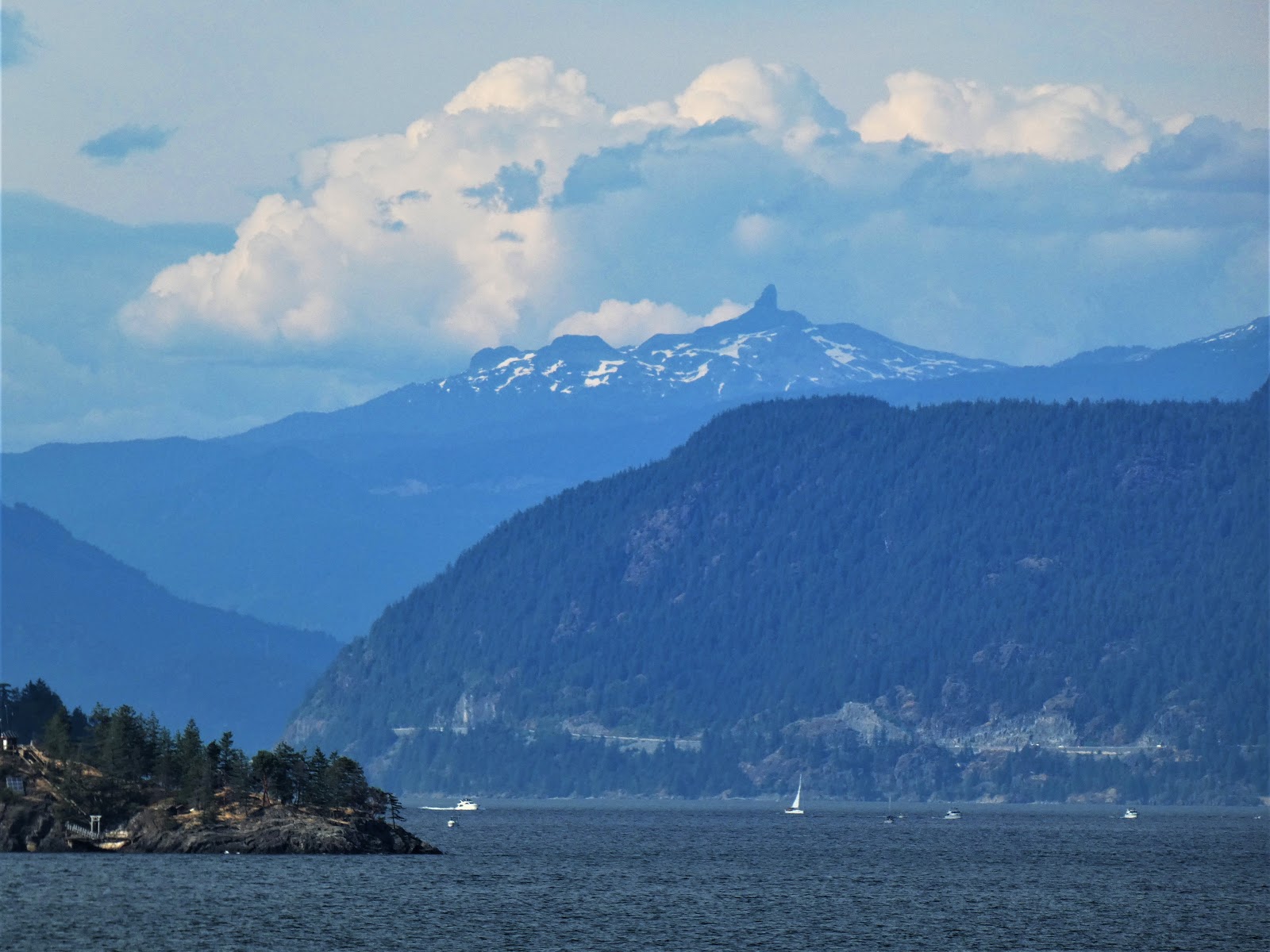
The Black Tusk from Howe Sound

As noted before, Howe Sound is a glacial fjord, a deep bay with steep flanks that was carved by glaciers. It is a bit difficult to pick out the entrance from the Strait of Georgia because it includes several islands. The sound is 26 miles long, ending at the town of Squamish at the upper end. The urban center of Vancouver is just south of Howe Sound where there is more level ground.

The sound is full of geological delights. We would spend the next four days in the immediate vicinity. That's where we'll pick up the story next time.

Saturday, January 20, 2018

A Look Back at Ten Years of Geotripping: Vagabonding on Dangerous Ground, an Exploration of Cascadia

In 2015 I wrote a blog series about driving through the "Most Dangerous Plate Boundary" in the world, but it was actually about driving through a fossil subduction zone that is exposed in the Coast Ranges, Great Valley and Sierra Nevada of Central California. In the summer of 2015, Mrs. Geotripper and I took a long journey along the entire length of a real "dangerous plate boundary", the Cascadia subduction zone, that extends from Northern California to British Columbia. The trip coincided with a media explosion over the very real possibility of a magnitude 9 earthquake along the Pacific Northwest coastline. This resulted in another blog series, Vagabonding on Dangerous Ground. Here is a compilation of the journey...

This was posted on September 13, 2015...

I've finished a new blog series on our exploration of the Cascadia Subduction Zone, so I've compiled all the posts in chronological order so you can get the story the correct sequence. Thanks for all the nice comments, responses, and corrections! Click on the orange titles for the post.

On the Road in the Pacific Northwest: The introduction and overview of the new blog series.

Following the Cascadia Subduction Zone on Highway 101: This post provided the geological background for understanding the hazards of living in the lands influenced by the Cascadia Subduction Zone.

In This Land of the Sasquatch There are Ancient Giants: The first leg of our journey took us through the range of the California Redwoods and the land of black bears that look suspiciously like walking ape-people.

The End is Coming (of the Cascadia Subduction Zone): The end of Cascadia is a slow process, but the zone is disappearing slowly, being replaced by the San Andreas fault. It's also a look at one of the loneliest beaches in California.

A Geologist Walks Onto a Bar in Cascadia: Exploring the unique baymouth bars along the Humboldt county coast.

Northern California's Tsunami Central: Crescent City has a tragic history of tsunamis, especially the one in 1964 that took a dozen lives and destroyed the marina and downtown areas.

This "Dismal Forest Prison" and other problems exploring the Northwest: The Pacific Northwest was particularly difficult to explore and map, at least if you weren't part of the indigenous culture. Here are some accounts of the discovery of Humboldt Bay by land.

Into the Land of Sand, and Exploding Whales: Between Coos Bay and Florence, Oregon, is the longest stretch of sand beaches and dunes in the Pacific Northwest. Yeah, and the whale thing...

Into the Realm of the Devil (and Sea Lions): There are a lot of things named for the devil on the Oregon coast for some reason. And some incredible sea caves occupied by sea lions.

Putting on a Happy Face at Dismal Nitch and Cape Disappointment: We reach the mouth of the Columbia River, where Lewis and Clark reached their goal. It's undergone a great many changes over the years.

Into the Rainforest, Seeing Something Strange...Rain: We explore the Hoh Rainforest in Olympic National Park for the first time, and encounter something strange, at least this year: rain. There was also a fire burning in the rainforest. That's not normal.

The Diverse Landscapes of Olympic National Park: Olympic is one of the most diverse of our national parks, with alpine glaciers, rainforests, and coastlines. It's spectacular.

The Salish Sea and the Strait of Juan de Fuca: Glaciers and tectonics combined to form a seaway east of Vancouver Island and the Olympic Peninsula. It's a unique ecosystem quite distinct from the Pacific Ocean just a few miles away.

Stone Rings, Glaciers, and "Dinosaurs" on the Coast of the Salish Sea: Desecrated burial mounds, avian dinosaurs, and glacial landscapes. Victoria on Vancouver is both a beautiful city and a fascinating place to explore.

Exploring North America's Southernmost Fjord: We take the ferry to the mainland, making landfall inside of the southernmost glacial fjord in North America, Howe Sound in British Columbia (defined here as on the mainland, but connected to the ocean; opinions differ!).

Landing Place of the Thunderbird and the Grimy One, the Volcanoes of British Columbia: Black Tusk and Mt. Garibaldi two of the northernmost volcanoes in the Cascade Range. I missed them last year in the rain, but saw them this time.

Controversial Stone People, Fire and Ice, and an Olympic Legacy: We made it to Whistler and the home of the 2010 Winter Olympics. The stone people were controversial, but the scenery was not. It was spectacular.

Seeing Volcanoes from the Inside Out at Siám' Smánit (Stawamus Chief): Glaciers and granite! Stawamus Chief is a dramatic granitic dome rising high above the end of Howe Sound. It was once the magma chamber of a volcano.

Our Tour of the Greatest National Park I Never Once Set Foot In: North Cascades National Park is a true primeval wilderness. No roads penetrate the park boundaries. But what incredible scenery!

The Geology that Explains Why North Cascades is a Park Divided: The Skagit River may be the most altered water course in the Pacific Northwest, but it provides 20% of Seattle's electricity. It splits a national park in two.

What's East of North (Cascades), A Brief Explore: North Cascades doesn't have all the scenery; the lands to the east are rather spectacular too, and offer some great geology.

Playing Hide and Seek with a Sleeping Monster: Mt. Baker is not the most active volcano in the Cascade Range, but it is capable of great mayhem. It even looked for awhile like it might blow back in 1975.


Danger Follows Us Home (As it does all of us): A Mt. Shasta drive-by (photo) shooting, and a wrap-up of the series. Danger is always with us no matter where we are. It's not to be feared, but respected and prepared for.

Sunday, September 13, 2015

Vagabonding on Dangerous Ground: A Compendium of Posts


I've finished a new blog series on our exploration of the Cascadia Subduction Zone, so I've compiled all the posts in chronological order so you can get the story the correct sequence. Thanks for all the nice comments, responses, and corrections! Click on the gray titles for the post.

On the Road in the Pacific Northwest: The introduction and overview of the new blog series.

Following the Cascadia Subduction Zone on Highway 101: This post provided the geological background for understanding the hazards of living in the lands influenced by the Cascadia Subduction Zone.

In This Land of the Sasquatch There are Ancient Giants: The first leg of our journey took us through the range of the California Redwoods and the land of black bears that look suspiciously like walking ape-people.

The End is Coming (of the Cascadia Subduction Zone): The end of Cascadia is a slow process, but the zone is disappearing slowly, being replaced by the San Andreas fault. It's also a look at one of the loneliest beaches in California.

A Geologist Walks Onto a Bar in Cascadia: Exploring the unique baymouth bars along the Humboldt county coast.

Northern California's Tsunami Central: Crescent City has a tragic history of tsunamis, especially the one in 1964 that took a dozen lives and destroyed the marina and downtown areas.

This "Dismal Forest Prison" and other problems exploring the Northwest: The Pacific Northwest was particularly difficult to explore and map, at least if you weren't part of the indigenous culture. Here are some accounts of the discovery of Humboldt Bay by land.

Into the Land of Sand, and Exploding Whales: Between Coos Bay and Florence, Oregon, is the longest stretch of sand beaches and dunes in the Pacific Northwest. Yeah, and the whale thing...

Into the Realm of the Devil (and Sea Lions): There are a lot of things named for the devil on the Oregon coast for some reason. And some incredible sea caves occupied by sea lions.

Putting on a Happy Face at Dismal Nitch and Cape Disappointment: We reach the mouth of the Columbia River, where Lewis and Clark reached their goal. It's undergone a great many changes over the years.

Into the Rainforest, Seeing Something Strange...Rain: We explore the Hoh Rainforest in Olympic National Park for the first time, and encounter something strange, at least this year: rain. There was also a fire burning in the rainforest. That's not normal.

The Diverse Landscapes of Olympic National Park: Olympic is one of the most diverse of our national parks, with alpine glaciers, rainforests, and coastlines. It's spectacular.

The Salish Sea and the Strait of Juan de Fuca: Glaciers and tectonics combined to form a seaway east of Vancouver Island and the Olympic Peninsula. It's a unique ecosystem quite distinct from the Pacific Ocean just a few miles away.

Stone Rings, Glaciers, and "Dinosaurs" on the Coast of the Salish Sea: Desecrated burial mounds, avian dinosaurs, and glacial landscapes. Victoria on Vancouver is both a beautiful city and a fascinating place to explore.

Exploring North America's Southernmost Fjord: We take the ferry to the mainland, making landfall inside of the southernmost glacial fjord in North America, Howe Sound in British Columbia (defined here as on the mainland, but connected to the ocean; opinions differ!).

Landing Place of the Thunderbird and the Grimy One, the Volcanoes of British Columbia: Black Tusk and Mt. Garibaldi two of the northernmost volcanoes in the Cascade Range. I missed them last year in the rain, but saw them this time.

Controversial Stone People, Fire and Ice, and an Olympic Legacy: We made it to Whistler and the home of the 2010 Winter Olympics. The stone people were controversial, but the scenery was not. It was spectacular.

Seeing Volcanoes from the Inside Out at Siám' Smánit (Stawamus Chief): Glaciers and granite! Stawamus Chief is a dramatic granitic dome rising high above the end of Howe Sound. It was once the magma chamber of a volcano.

Our Tour of the Greatest National Park I Never Once Set Foot In: North Cascades National Park is a true primeval wilderness. No roads penetrate the park boundaries. But what incredible scenery!

The Geology that Explains Why North Cascades is a Park Divided: The Skagit River may be the most altered water course in the Pacific Northwest, but it provides 20% of Seattle's electricity. It splits a national park in two.

What's East of North (Cascades), A Brief Explore: North Cascades doesn't have all the scenery; the lands to the east are rather spectacular too, and offer some great geology.

Playing Hide and Seek with a Sleeping Monster: Mt. Baker is not the most active volcano in the Cascade Range, but it is capable of great mayhem. It even looked for awhile like it might blow back in 1975.


Danger Follows Us Home (As it does all of us): A Mt. Shasta drive-by (photo) shooting, and a wrap-up of the series. Danger is always with us no matter where we are. It's not to be feared, but respected and prepared for.

Tuesday, September 8, 2015

Vagabonding on Dangerous Ground: Playing Hide and Seek with a Sleeping Monster

Mt. Baker and Boulder Creek upstream of Baker Lake Reservoir
There's something about traveling through the Pacific Northwest that I may never become accustomed too: the deep, deep forests. As a child in the scouts, living in arid Southern California, I was pretty good at orienteering with a compass and map, but that was predicated on the fact that I could see the mountains around me. That would have been tougher if I had grown up in a rainforest. Every view is of a tree!
And so the struggle to actually see Mt. Baker in the Cascade Range. We had actually traveled around three sides of the mountain in the last two days, but I never got much of a glimpse, either because of the deep forest, or, you know, having to pilot the car without plowing into a tree or a deer. We finally got serious about the effort by detouring onto Baker River Road as we left North Cascades National Park. The road would take us within six miles of the summit as the crow flies. If we couldn't see it from there, we didn't deserve to see it.
This web series was entitled Vagabonding on Dangerous Ground primarily because we happened to be following the coastal parts of the Cascadia Subduction Zone which had become newsworthy over the summer because of a New Yorker article detailing the probable damage from an expect magnitude 9 earthquake offshore. Shaking, tsunamis, landslides, power disruptions and many other frightening events were part of the article. Kind of lost in the whole media affair were the sleeping giants that have always been a visceral threat to those who live in the region: the volcanoes.

In Cascadia the subducting slab of cold oceanic crust and underlying solid mantle material (the lithosphere) are driven into the much hotter asthenosphere, a "mushy" layer in the mantle that is partly molten. The interaction of the slab, water from the oceans, and the hot mantle rocks causes melting of some of the continental crust, forming magma that rises through the crust as a series of plutons. When they cool before reaching the surface, they will form visibly crystalline rocks like granite or diorite. When they reach the surface in a molten state, magma mayhem ensues.
The molten flows of lava that Hollywood seems to love the best are often the least serious problem during an eruption of a Cascade volcano, if they occur at all. More often any lava flows will melt prodigious amounts of snow and ice, producing volcanic mudflows (lahars) that can flow for tens of miles, causing damage at great distances from cone. In ancient times lahars could strike without warning from an eruption that couldn't be seen from within distant downstream canyons.

Some lahars aren't even associated with volcanic eruptions. They can be triggered by landslides on the upper reaches of the steep cones, or by unusually high amounts of glacial melting (water trapped under the glacier may burst out all at once). Mt. Baker has the most snow and ice of any Cascades volcano except Mt. Rainier (and that's a big except, as Rainier has about 50% of all the ice in the lower 48 states). So lahars are the big danger from Mt. Baker.
The other dangers result from explosive eruptions that pulverize the magma and other rocks around the summit of the volcano. The fine dust that results is called volcanic ash. The ash can be so hot close to the volcano that it can be incandescent. Anyone or anything caught in the fast moving ash flows is doomed, plain and simple. An ash eruption hit the Martinique town of St. Pierre in 1902 and killed all but two of the town's 30,000 inhabitants. These hot ash flows are called pyroclastic flows, or nuée ardente, French for "fiery cloud". The good news in the case of Mt. Baker is that relatively few developments are close enough to the peak to be threatened. But there are some.

Hazard areas in and around Mt. Baker in northern Washington
We found great views of the volcano from the dam at Baker Lake, and from Boulder Creek. Boulder Creek also provided a nice view of some lahar deposits as well, possibly from events in 1843 or 1891.

Mt. Baker is one of the youngest of the Cascade volcanoes, having formed mostly in just the last 30,000 years. The last major eruptions took place around 6,600 years ago when large lahars swept down creek valley accompanied soon after by ash eruptions. The 1843 eruption was caused by a hydrovolcanic explosion (groundwater flashing to steam). That event left behind Sherman Crater. In 1975, there was a vast increase in the amount of thermal energy around the summit of the mountain, raising fears of an eruption. The heat subsided somewhat, and everyone forgot about Mt. Baker when Mt. St. Helens exploded just five years later.
Lahar deposits at Boulder Creek near Mt. Baker
We were seriously on the homeward path now. No meandering highways along beautiful coastlines for us anymore. Interstate 5 was going to be our pathway now as we pushed south. But the Cascadia Subduction Zone had one more beautiful surprise for us. We'll wrap up our journey in the final post soon!

Friday, July 17, 2015

Geotripper Finds Rocks in the Pacific Northwest! All is Well

Diablo Reservoir and Colonial Peak in North Cascades National Park
I admit to being just a little bit snarky in some of my recent posts concerning the paucity of rocks seen on my latest journey through the Pacific Northwest. Seeking out the rainforests was one of our main goals on this trip, and I thoroughly enjoyed my visits to Humboldt Redwoods, the Hoh Rainforest of Olympic National Park, and the forests of British Columbia. One the other hand, it is true that rocks were in short supply for the first part of our journey. That sure changed in the last few days!
Kangaroo and Vasiliki Ridges near Washington Pass, east of North Cascades National Park
I will probably write a series of blogs about our vagabonding across the Pacific Northwest, but one thing to point out is that we were attempting to explore new territory, and that included the North Cascades, a big mysterious blank area on the map of my personal geography. I've been around the mountains and seen them from a great distance, but before yesterday I had never seen them up close.
Early Winters Spires at Washington Pass east of North Cascades National Park
We pulled into the campground at Newhalem in North Cascades National Park, or more properly, Ross Lake National Recreational Area. The park itself is the remote wilderness in the peaks above the Skagit River. We then took a late afternoon driver to Washington Pass on the east side of the park. It was simply stunning! I've down a lot of traveling and seen many wonders, but my breath can still be taken away by an incredible view.
Mt. Baker and Boulder Creek (I wonder how the creek got its name?)
The next morning was a short exploration of the Baker Lake area, and one of the most interesting of the Cascades volcanoes, Mount Baker. It is one of the most active of the chain, with some minor eruptions in the 19th century. It is second only to Mt. Rainier in the volume of ice coating its summit.
The glaciers of Mt. Baker, lahars just waiting to be released.
It's been a fascinating trip (that isn't quite over yet). I'm looking forward to sharing some interesting geology in coming weeks.

Saturday, February 20, 2010

New Blog on Northwest U.S. Geology: Road Trips!


Are you interested in geology field guides for the northwestern United States? You might want to check out a new blog by Dave Tucker at Western Washington University: Northwest Geology Field Trips. It has a wealth of information and some fun looking trips; check it out!

Dave is also the director of the Mount Baker Volcano Research Center, which has a website here. For those who are less familiar with the volcanoes of the Pacific Northwest, Mt. Baker seemed to be on the verge of erupting in 1975-76, and has had a fair amount of activity in late Pleistocene and Holocene time. That's Mt. Baker in the photo above, as seen from Whidbey Island.