Showing posts with label Mercury. Show all posts

Monday, November 11, 2019

The Last Planetary Transit I'm Ever Likely to See: Mercury Today

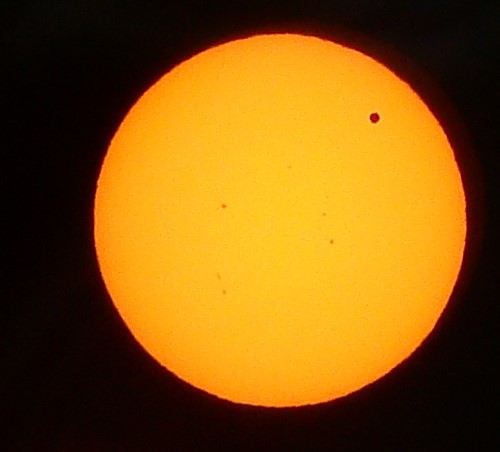
The Sun shown just a bit less brightly today, not that anyone could tell. The planet Mercury passed across the disk of the Sun over the space of a few hours this morning, presumably blocking a bit of sunlight from reaching Earth. It was probably the last time I'll ever see a planetary transit.
Today's transit of Mercury (it is just above the center of the Sun's disk).
One needed some special equipment to see the event, mainly a camera or telescope with enough magnification to see the planet, and filters powerful enough to keep the observer from burning out his/her retinas. Luckily, I was able to locate the camera filter I used to observe the solar eclipse in 2017, and my camera has a 60x zoom. In the picture above, Mercury is just above the center of the Sun's disk. When I looked again about 45 minutes later, the planet had clearly moved to the right across the Solar disk (below).
Today's transit of Mercury (it is in the upper right hand quadrant of the picture).
I've seen three transits in my life, today's, Mercury in 2016, and Venus in 2012 (below). The next transit of Mercury is in 2049, when I'll be 92 years old. I may or may not be paying attention then. The next transit of Venus will take place in 2117. I don't expect to be around for that one at all. I wondered whether there would ever be a simultaneous transit of both Mercury and Venus, and it turns out that one will take place on July 26, 69,163 AD. I think I'll let that one pass...
Transit of Venus in 2012

Mercury is the smallest of our "regular" planets, and is even smaller than it appears in the photographs because it is around thirty million miles closer to us than the sun. It's actually not all that much bigger than our own Moon. The planet has been a bit of a stranger for most of time because it is hard to see in the dusk or twilight, and we've only had two space probes come close. Luckily, one of the probes has been orbiting for the last several years, so we have a treasure store of data on the planet. It was the subject of one of my very first blog posts back in 2008.

Saturday, December 19, 2015

A Netherworld Incompatible with the Existence of Life: The Mantle Exposed at Del Puerto

Our journey into the interior of the Earth has reached a remarkable boundary, the base of the oceanic crust. Beyond the crust, underneath the Mohorovičić discontinuity, lies the mantle, a layer that extends halfway to the center of the Earth. We have been driving up Del Puerto Canyon, a scenic route that crosses the Diablo Range in the central part of California's Coast Ranges. The rocks at the headwaters of the canyon have formed a landscape unlike any other. It's a landscape of the underworld, the netherworld.
Serpentine in the upper canyon. Serpentine is highly altered mantle material.
The netherworld is a place in the mythology and religion many cultures, a dark and hot place deep within the Earth that is the habitation of death. It's no place that a human would ever want to be. And yet, here we were, on a sunny December afternoon. It's not necessarily a place of death, but at the same time the rocks were never really able to support life. They formed in an environment where life was impossible, and life at the surface is ill-adapted to survive in such rocks.
The Earth's mantle is composed of a variety of ultramafic rocks, rocks rich in iron and magnesium and a suite of elements not commonly found in the overlying crust: mercury, chromite, nickel, platinum and cobalt. The rocks found in the upper canyon include varieties of dunite and peridotite, which are olivine-rich rocks. In most places such rocks are quickly altered into serpentine, California's state rock, but in upper Del Puerto Canyon, you can find largely unaltered ultramafic rock.
The plant cover is strange, and quite unlike any found on "normal" crustal rocks. Grass is almost nonexistent, and the ubiquitous California oak trees are nowhere to be found. There are too many toxic substances in the soil, and not enough of needed nutrients. The few scattered plants that can survive on such soils include the California endemic Gray Pine and some species of manzanita. A great many wildflowers have adapted to these soils, and the slopes can be quite colorful in wet years.
The rocks have yielded economical amounts of mercury, chromite and mercury. Our stop at the head of the canyon was at an old chromite mine. Despite the obvious use to make cars sparkle and shine, chrome has more important uses in making stainless steel and armor. During peaceful times, chrome is cheaper from overseas sources, but in wartime, the ores in the canyon become valuable. They were last mined during World War II.
Mercury was sought for use during the Gold Rush as a way to separate gold from the ore. There are extensive deposits in the upper canyon and just beyond the pass at the head of the canyon. Mercury mining was lucrative, but deadly. Miners who absorbed mercury into their nervous system quickly developed symptoms and often died. Mercury continues to poison water and sediments in the Central Valley and San Francisco Bay.
Altered ultramafic rocks from the upper canyon
The upper canyon has numerous kinds of rocks to observe. The two pictures above show ultramafic rocks that were in the process of altering to serpentine. The core sections are composed of enstatite pyroxene (which I believe is also known as bronzite when slightly altered like this).
Chromite ore from the upper part of Del Puerto Canyon
It's not too difficult to find small metallic grains of chromite. It takes a bit more searching to find some relatively unaltered peridotite or dunite. It's a beautiful rock, with the rich green of the olivine, which is also known as the gemstone peridot. That's right, there are outcrops of gemstones in the upper canyon! If you are ever up that way, take a close look at the rocks near mile marker 18.
Peridotite from the upper reaches of Del Puerto Canyon
So, our journey into the interior of the Earth is pretty much done. The rocks of the core are just too deep to visit, even with unobtainium (movie reference! The Core, and Avatar). It's a pleasant way to spend an afternoon, exploring the netherworld in the bright light of day!

If you want to pay a visit to Del Puerto Canyon, it can best be accessed from the town of Patterson in the Central Valley southwest of Modesto. A road (Mines Road) reaches the area from Livermore, and a slow winding road travels over Mt. Hamilton and Lick Observatory from San Jose in the Bay Area. There is a campground and day use area in the upper canyon (Frank Raines Park and Minniear Day Use), but most of the rest of the canyon is private land. Stay on the road!

Tuesday, October 13, 2015

And Mercury Makes Four. Beautiful Gathering in the Morning Sky

There is still a beautiful show in the sky in the early morning this month. When I realized I missed Mercury in my Friday morning picture, I went out again this morning for another try, and caught it between the trees on the eastern horizon. It's only the fourth or fifth time that I've seen Mercury (mostly out of laziness because you have to know just where to look), and only the second time I've photographed it.
In all the excitement about Pluto and Ceres over the last few months, it might be good to remember that NASA and the European Space Agency have been on a real winning streak of late. There are the tireless surface vehicles on Mars, the Cassini exploration of Saturn, the Galileo mission to Jupiter, and the Messenger mission to Mercury that have given us an unprecedented look at our Solar System. It is simply stunning that we have in just 58 years of space travel that we have had such success in exploring our nearest neighbors in space, and that they have turned out to be places of the imagination. No one could have predicted in 1957 that the moons and planets of our Solar System could have been so strange and wonderful.

Friday, May 8, 2015

Driving Through the Most Dangerous Plate Boundary in the World: At the Portal of Hell in the Diablo Range

At the portal of hell? For the miners who once worked these tunnels, it was...


I miss the tabloids sometimes. Sure, there's the Onion, which gets mistaken for real news sometimes. But there was nothing like standing in the grocery store lines perusing headline after headline of "real" news, like Elvis sightings, UFO reports, and "Loch Ness Monster Meets Yeti" stories. On extended field trips when group morale was slipping a bit, I could pick up a copy of one of those tabloids and read stories around the campfire, and it worked like magic to bring a group out of the doldrums.


Source: http://www.snopes.com/religion/wellhell.asp
One story has stuck in my mind over the years, the one about the Russians (or Alaskans, or Norwegians) who were digging the world's deepest well on the Kola Peninsula in Russia (or on the North Slope, or in Scandinavia) and when they reached a depth of 7 miles (or 9 or 12), the drill started spinning wildly, and they measured temperatures of 2,000 degrees, but scariest of all, they lowered a microphone (into the 2,000 degrees...) and heard the unmistakeable sounds of screaming souls in Hell. In some versions, gases rose and took the form of the devil, and...well, you get the general picture. As can be seen from the link at the start of the paragraph, the story spread so widely that it merited a Snopes article. What does it tell you that some people (including one or two of my students) took this seriously?

In any case, we are back on our journey through the most dangerous plate boundary in the world, and when we finished our last episode we had passed through the Franciscan Complex, the rock unit that formed in the accretionary wedge of California's Mesozoic subduction zone. We are now making our way down the eastern margin of the Diablo Range through the gorge of Del Puerto Canyon. The association of "Diablo", and "Puerto" ("Devil" and "Portal") is what brought to mind the "screams of the damned" in the old tabloids.

The geologists were trying to dig a hole into the deep crust. They wanted perhaps to break through the continental crust and into the underlying mantle, a layer of peridotite and other ultramafic rocks that make up about 80% or so of the Earth's volume. They failed, but what an effort they made! The thing is, if one really wants to reach the mantle, there is an easier way: find the places where the mantle has risen to the Earth's surface. And that's what happened in Del Puerto Canyon.
Peridotite is composed largely of the mineral olivine (the gemstone peridot). The Earth's mantle is made of gemstones!

As we travel down this canyon we are going to do the literal equivalent of traveling from the Earth's mantle upwards through four or five miles of the oceanic crust, and then "climb" through 25,000 feet of oceanic sediments. All while coasting down a pleasant country avenue in one of the most scenic of the Coast Range's canyons. Along this journey we will also finally leave behind the accretionary wedge of the Franciscan subduction zone, and enter into the intriging forearc basin.

The ultramafic rocks of the upper canyon host a number of unusual minerals and ores. Among them are mercury and chromite. The mercury mined here was used in the process of separating gold from the tailings in the Mother Lode on the other side of the Great Valley. As I understand it, one could make very good wages mining the mercury, but you didn't last long at the job. The mines literally killed the miners. For them, the tunnels really were the portals of Hell. The mercury vapor in the air got into their nervous system, first destroying their minds, and then their bodies.
Chromite from upper Del Puerto Canyon

The chromite that was mined in the upper canyon was not nearly so dangerous. Chromite is of course the source of chrome, which most people associate with shiny car accessories. The most important use of the metal is much more pervasive: it is a major component of stainless steel. The United States usually imports cheap ores from overseas, but during periods of war domestic sources were exploited, and that's what happened in the upper part of Del Puerto Canyon. The road we are traveling was once a railway that serviced the mines.
The orange streaks in the ultramafic rocks of Del Puerto Canyon are slickensides, scratch marks left by faulting

There is a large quarry face in the upper canyon where the rocks can be readily observed. The unweathered rock is dark in color, but weathers readily into an iron oxide rich patina. The region came to be known as the Red Mountain Mining District. The ultramafic rocks are very poor in important in plant macronutrients, and also contain some toxic elements as well. The vegetation on the slopes reflects the difficulty of surviving in this poisonous chemical environment. A number of the species found here are endemic to California and the Coast Ranges. And few invasive species ever gain a roothold on these slopes.

Next, we'll see if we can find the oceanic crust, the rock sequence known as the Coast Range Ophiolite. Stay tuned...

Tuesday, February 12, 2013

The Winged Messenger: Appearing Now on Your Western Horizon!

I saw something I've only seen once before in my life last night: the planet Mercury. It's not that hard to see it, but being so close to the sun, it must be at the highest point in its orbit to avoid being lost in the glare of twilight. Basically, I've missed it over the years from sheer laziness.

On the other hand, it's there. It doesn't look like much in a telescope, especially the kind of scopes I've had access to over the years. And satellites had only visited the planet once while I was growing up, and the satellite was only able to map a bit less than half the planet. It doesn't have showy rings or moons.

Even last night, I took only a few pictures of Mercury, but spent most of my time capturing the beautiful crescent moon (below). Mercury is basically the poor stepchild when compared to the other terrestrial planets of Venus (bathed in cloudy mystery), Earth, and Mars (we are leaving tire marks all over it right now, looking for signs of water and/or past life).
This is the joy of living in the times we are, though. We are in the midst of a voyage of discovery that humans can only do once in our history: to explore our Solar System in detail for the first time. Mercury actually is an interesting planet, and it has offered up a few surprises, like complicated surface structures, including large fault scarps, and a magnetic field. It even has a few wispy bits of an atmosphere and possible ice deposits in the polar regions. We are learning about these things because we've had a second satellite, Messenger, that has been orbiting the planet for the last two years (it arrived in 2008, but it took a complicated series of passes to establish an orbit in 2011).
http://www.nasa.gov/mission_pages/messenger/multimedia/detail_first114075114076.html
All our planets have interesting stories, and it's more meaningful if you have actually made the effort to see the planets with your own eyes. Steven Schimmrich at Hudson Valley Geologist has a nice post on how to see Mercury over the next week or so (the post is what got me off my couch to have a look). To learn more about NASA's Messenger mission, check out this website.

Saturday, April 5, 2008

Journey to the Center of the Earth (well, the mantle at least)

Continuing our trip up Del Puerto Canyon (and into the earth's mantle; see Photo of the Day - Feeling Crushed?), we reached a huge pod of mantle peridotite and dunite in the upper canyon that had escaped the most extensive alteration during the long journey to the earth's surface (in most places the rock is serpentinized). A few unusual minerals are found in the area, including mercury (cinnabar) and chromite (shown above). The chromite crystals are dark and metallic-looking.

The United States imports almost all the chromium that it uses, but in wartime, imports are disrupted, so the mines in the upper canyon were utilized off and on during the two world wars. The mercury was considered far more valuable, given its role in the production of gold during California's Gold Rush of the 1850's. I've heard that the mercury miners could earn a much higher wage mining mercury than they could mining gold, but they also tended to go mad, and die a lot sooner. It's not as if the gold miners had such a great life expectancy, though. We make jokes and complain sometimes about workplace safety regulations, but it is a great deal safer in the mines today than it was 140 years ago. And sometimes, workers even get to enjoy some kind of retirement plan!

Wednesday, January 16, 2008

New side of Mercury Exposed!

The Messenger spacecraft completed the first pass of Mercury, and the first images are being posted here: http://messenger.jhuapl.edu/gallery/sciencePhotos/image.php?gallery_id=2&image_id=117. I remember back in the days of my childhood when telescopes were really cool, but planets were a bit of a disappointment because they were just little round disks, but the Voyager and Viking missions changed everything with their spectacular close-up images of the Mars, Jupiter, Saturn and many of their fascinating moons. Mercury was the subject of a fly-by in 1974-75, but only half the surface was imaged. And TODAY we get to see part of the missing half. Check it out!