Showing posts with label Dunite. Show all posts

Saturday, December 19, 2015

A Netherworld Incompatible with the Existence of Life: The Mantle Exposed at Del Puerto

Our journey into the interior of the Earth has reached a remarkable boundary, the base of the oceanic crust. Beyond the crust, underneath the Mohorovičić discontinuity, lies the mantle, a layer that extends halfway to the center of the Earth. We have been driving up Del Puerto Canyon, a scenic route that crosses the Diablo Range in the central part of California's Coast Ranges. The rocks at the headwaters of the canyon have formed a landscape unlike any other. It's a landscape of the underworld, the netherworld.
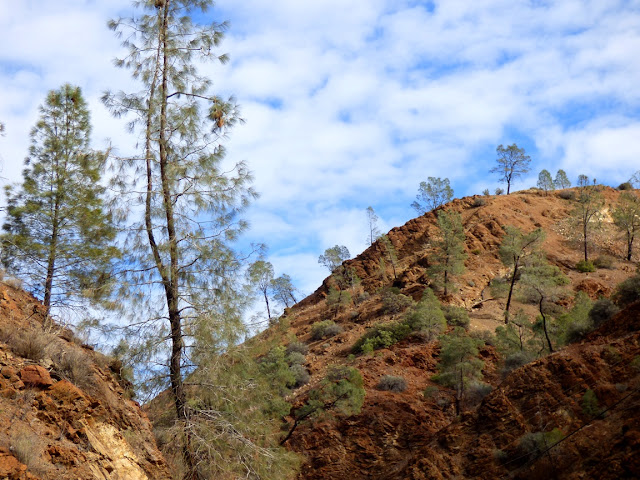
Serpentine in the upper canyon. Serpentine is highly altered mantle material.
The netherworld is a place in the mythology and religion many cultures, a dark and hot place deep within the Earth that is the habitation of death. It's no place that a human would ever want to be. And yet, here we were, on a sunny December afternoon. It's not necessarily a place of death, but at the same time the rocks were never really able to support life. They formed in an environment where life was impossible, and life at the surface is ill-adapted to survive in such rocks.
The Earth's mantle is composed of a variety of ultramafic rocks, rocks rich in iron and magnesium and a suite of elements not commonly found in the overlying crust: mercury, chromite, nickel, platinum and cobalt. The rocks found in the upper canyon include varieties of dunite and peridotite, which are olivine-rich rocks. In most places such rocks are quickly altered into serpentine, California's state rock, but in upper Del Puerto Canyon, you can find largely unaltered ultramafic rock.
The plant cover is strange, and quite unlike any found on "normal" crustal rocks. Grass is almost nonexistent, and the ubiquitous California oak trees are nowhere to be found. There are too many toxic substances in the soil, and not enough of needed nutrients. The few scattered plants that can survive on such soils include the California endemic Gray Pine and some species of manzanita. A great many wildflowers have adapted to these soils, and the slopes can be quite colorful in wet years.
The rocks have yielded economical amounts of mercury, chromite and mercury. Our stop at the head of the canyon was at an old chromite mine. Despite the obvious use to make cars sparkle and shine, chrome has more important uses in making stainless steel and armor. During peaceful times, chrome is cheaper from overseas sources, but in wartime, the ores in the canyon become valuable. They were last mined during World War II.
Mercury was sought for use during the Gold Rush as a way to separate gold from the ore. There are extensive deposits in the upper canyon and just beyond the pass at the head of the canyon. Mercury mining was lucrative, but deadly. Miners who absorbed mercury into their nervous system quickly developed symptoms and often died. Mercury continues to poison water and sediments in the Central Valley and San Francisco Bay.
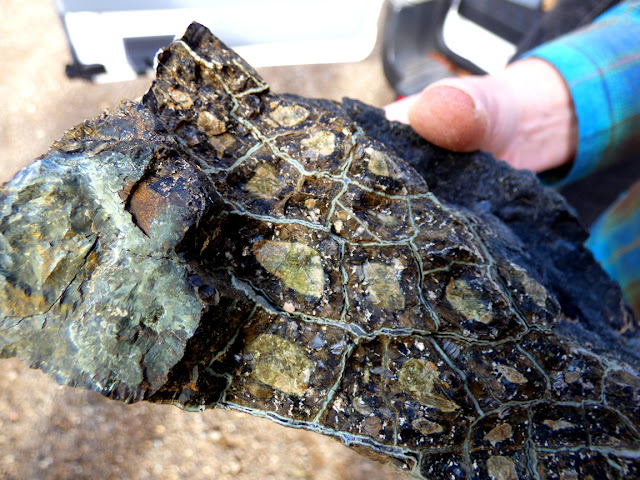
Altered ultramafic rocks from the upper canyon
The upper canyon has numerous kinds of rocks to observe. The two pictures above show ultramafic rocks that were in the process of altering to serpentine. The core sections are composed of enstatite pyroxene (which I believe is also known as bronzite when slightly altered like this).
Chromite ore from the upper part of Del Puerto Canyon
It's not too difficult to find small metallic grains of chromite. It takes a bit more searching to find some relatively unaltered peridotite or dunite. It's a beautiful rock, with the rich green of the olivine, which is also known as the gemstone peridot. That's right, there are outcrops of gemstones in the upper canyon! If you are ever up that way, take a close look at the rocks near mile marker 18.
Peridotite from the upper reaches of Del Puerto Canyon
So, our journey into the interior of the Earth is pretty much done. The rocks of the core are just too deep to visit, even with unobtainium (movie reference! The Core, and Avatar). It's a pleasant way to spend an afternoon, exploring the netherworld in the bright light of day!

If you want to pay a visit to Del Puerto Canyon, it can best be accessed from the town of Patterson in the Central Valley southwest of Modesto. A road (Mines Road) reaches the area from Livermore, and a slow winding road travels over Mt. Hamilton and Lick Observatory from San Jose in the Bay Area. There is a campground and day use area in the upper canyon (Frank Raines Park and Minniear Day Use), but most of the rest of the canyon is private land. Stay on the road!

Thursday, October 28, 2010

From hell's heart I stab at thee: Accretionary Wedge #28

"...to the last I grapple with thee; from hell's heart I stab at thee..."

The Accretionary Wedge challenge for the month is to show off a favorite "deskcrop", those beautiful and significant rocks and minerals that have won a coveted position on the desk of a geologist/teacher. The convergence of the wedge with Halloween added a layer of complexity by asking for spooky items. Well, I have a lot of deskcrops on my desk, so many that there is precious little room for books and office supplies and that sort of thing. It was hard to choose.

That "spooky" thing made it even harder, but what is Halloween about anyway? The day was co-opted by the Christian religion from earlier Celtic traditions, but the upshot of the cultural intermingling of meanings is that on All Saint's Day Eve there are spirits from the underworld set loose on Earth. So I looked for the deskcrop that best exemplifies the underworld, and I realized it could be nothing else but the walls of hell itself: olivine dunite xenoliths from the deep mantle, brought to the surface of the Earth by volcanic eruptions.
Olivine is a beautiful mineral, one of my favorites, with a glassy luster and bright green and yellow color which varies due to a substitution of iron and magnesium in the crystal structure. It is also known as the gemstone peridot, the August birthstone. The streets of Heaven are paved with gold, but the walls of hell are apparently lined with gemstones! The mineral is relatively unstable at the Earth's surface, and readily alters to serpentine when exposed to water in the upper crust.

As for the quote, it comes to us from Moby Dick by Herman Melville, although it was also a memorable quote from the movie Star Trek II: The Wrath of Khan (and I hate to admit that I first knew of it from the movie).

Thanks to Research at a Snail's Pace for hosting the Wedge this month!

Wednesday, March 31, 2010

The Other California: A Journey to the Center of the Earth (kind of...)

How many of you tried to dig a tunnel to China in the backyard when you were a kid? Given the soil conditions in the yard I grew up in, I'm probably lucky to be alive. I dug tunnels looking for buried treasures, gemstones, fossils and sometimes I was just curious what was down there. Geologists, I've found, are the kids who tried to find all those things, and never really grew up.

So how far do these overgrown kids get? It turns out that the deepest tunnels that humans have ever been able to dig reach depths of about 12,800 feet, a little over 2-1/2 miles. That might seem like a lot from our point of view, but the depth to the center of the Earth is around 4,000 miles. We've barely scratched the surface, yet the temperatures of the rock at these depths is well over 100 degrees, and the rocks are under so much pressure that explosions of rocks from the walls are a constant danger to the miners. Kids, there's got to be a better way to see what lies deep below. And there is, in the Other California, one of those places not found on the postcards. The adventure lies in the Klamath Mountains, and the most dangerous thing you have to face is slipping on a slick river rock, because geological processes have brought the rocks many miles up from the depths. You need only explore the rivers flowing off the mountains to see what the deep interior of the earth looks like.

The Klamath Mountains are a collection of bits and pieces of the earth's crust that have been carried great distances from their point of origin and slammed (at geologic speeds of inches per year) into the western edge of the North American continent. A huge variety of igneous and metamorphic rocks are found around the province, and some of the most interesting are those that once resided deep in the Earth's mantle, a layer that extends from just below the crust, from maybe 15 or 20 miles beneath our feet, to a depth of about 1,800 miles. Here are a couple of bits of the Earth's deep hidden places that I found on a short trip to the Eastern Klamath Terrane in the vicinity of Gazelle.

The oceanic crust is usually described as being made of basalt, but a few miles down in the crust the basaltic magma cools slowly to form a coarse-grained basaltic rock called gabbro. Sometimes, as can be seen above, the crystals that form are huge, with black hornblende and white feldspar crystals several inches long. Igneous rocks with such large crystals are called pegmatites.

Going even "deeper" into the interior, we pass the Mohorovicic Discontinuity, the dividing line between the crust and mantle. The upper part of the mantle is composed of olivine-rich rocks like dunite or peridotite. Olivine is best known to most people as the green gemstone peridot. That's right, much of the Earth's interior is made up of gems! The rock in the picture above is dunite, in part slightly altered to serpentine.

In many parts of the Klamath Mountains, the mantle rocks are completely altered to serpentine, the state rock of California. These ultramafic rocks are fairly rich in a number of unusual metal ores, including platinum, nickel, magnesium and mercury. One of the most important ores is chromite, which is the only significant source we have for chromium, the metal that puts the "stainless" in stainless steel. We import most of the chromium that we need from foreign sources, but in wartime (especially the two World Wars), the ores were mined domestically, and a number of operations were present in the Klamaths. The black semi-metallic crystals in the picture above are chromite, with green serpentine across the top.

In our next post we are going to "climb" into the underside of a volcano...

Saturday, March 27, 2010

The Other California: There's an Endemic in those Red Hills!

Oh, that's right, it's epidemics we're supposed to worry about. An endemic refers to plant species found in specific limited locations. There are a number of these in the Red Hills "Area of Critical Environmental Concern", a rather high-falutin' name for an area that less than two decades ago was barely more than an open garbage dump scarred by numerous off-road vehicle trails. The rare and endemic species are there for a very geologic reason, the subject of this post.

The Other California is my continuing blog series on those places in California that people don't generally find on the postcards at all our tourist traps. I've been following a regional theme, traveling through the northernmost provinces, but the Other California has a temporal pattern as well, and late March is the perfect time to talk about the Red Hills, located in the Sierra Nevada Mother Lode near the Gold Rush town of Chinese Camp (I talked about the area around La Grange a few days ago for the same reason).

Much of lowland California is currently covered with a green carpet of grass (mostly of exotic and invasive origin) along with the occasional oak tree, but as you can see in the pictures above, there are a few places where the grass and oak trees are missing, and a profusion of flowers and scattered pines thrive instead. Why are the oaks and grass missing?

The Mother Lode is famous as the source of the ores during the Gold Rush in 1848-53, and many people know of the association of quartz veins with the gold. What is perhaps less known is that the Mother Lode consists mostly of metamorphic rocks like slate, greenstone, and marble, not the granite that is found in the higher parts of the Sierra Nevada. These metamorphic rocks are the twisted and baked remains of sea floor muds and silts, lime from tropical reefs and shelves, and volcanic rock from the oceanic crust. These collections of crustal rocks (called "exotic terranes") were transported across the Pacific Ocean and slammed (in the geologic sense; they moved at maybe 2 inches a year) into the western edge of the North American continent, mostly in the late Paleozoic and Mesozoic eras (the Mesozoic, from around 251 to 65 million years ago, is best known as the "age of the dinosaurs"). The different terranes are separated from one another by major fault systems.

At times the crustal terranes also include rocks from beneath the crust. This rock hails from the underworld of the earth's mantle, and includes dunite and peridotite, composed primarily of the mineral olivine (known to most people as the gemstone peridot). The rock readily alters to serpentine, California's state rock. These rocks are also collectively called ultramafic rocks, for their high content of magnesium and iron (fe, the 'fi' part). They also contain small, but significant amounts of nickel and chrome.

When ultramafic rocks are brought to the surface, they are far out of chemical equilibrium with the ambient conditions, which means they are easily attacked by oxygen, water and organic acids. Clay is a common product of this process, as well as red or yellow iron oxides (from which the Red Hills take their name). The surface layer resulting from this weathering process is of course soil. We tend to think of soil as a rich surface layer that supports plant life, but some soils lack the necessary nutrients for most kinds of plant growth. This is definitely the case for soils developed on ultramafic rocks, which lack nitrates, phosphorus, and potassium. To make things worse, chrome and nickel are actually toxins. Hence, only specialized species can thrive on these rocks.

The shrubby Ceanothus, or Buckbrush (above) and Gray Pine (below) are two plants that are more or less indifferent to the odd soil conditions. They grow elsewhere, but compete very well in ultramafic soils. A large number of flower species are also indifferent to the soils, but the only grasses found in the region are native species. The European and Asian grass species that have overwhelmed most of the prairies in the Central Valley, Coast Ranges and Sierra foothills cannot grow on the serpentine soils.

There are a number of endemic species that grow on these soils, and at least one is found nowhere else in the world (California verbena, Verbena californica). Other rare endemics include Rawhide Hill onion (Allium tuolumnense), Layne's butterweed (Senecio layneae), Congdon's lomatium (Lomatium congdonii) and the Red Hills soaproot (Chlorogalum grandiflorum). A fairly common serpentine endemic is the Milkwort Jewelflower (Streptanthus polygaloides). Alas, I arrived very late in the afternoon and had no time to search them out (and to be truthful, I am better at identifying rocks and minerals).

Though closely associated with the rocks of the Mother Lode, the serpentine and dunite were remarkably free of gold, and so the Red Hills were mostly ignored by the miners. Farmers couldn't grow much in the soils, and grazing conditions were not favorable, so the when the federal government came into possession of these lands in 1848, they couldn't even give them away! So this swath of land, about 7,000 acres worth, was administered, somewhat indifferently, by the Bureau of Land Management. The landscape suffered the abuses of modern civilization, with trash heaps, motorcycle trails, and unrestrained target shooting. The recognition that the area was a unique geologic and biologic treasure led to the restriction of shooting and off-road vehicle use in 1991. Private groups assisted in cleaning up the trash heaps and a trail network was established, so today the Red Hills are a delightful place to visit, especially in the spring when the wildflowers are at their stunning best. And I could be wrong, but I don't think I've seen any postcards with pictures of the area.

If you want to learn more, or pay a visit, information about the Red Hills can be found on this BLM website , and the nature trail brochure PDF can be found here.

Saturday, March 13, 2010

A Denizen of the Underworld in the Land of the Living


I was leading my students today on a geology field trip through California's Mother Lode. We were in the southern reaches of the 1848 Gold Rush country between the towns of Mariposa and Jamestown, with stops at some of the (near) ghost towns, the California State Mineral Exhibit with the 13-pound Fricot Nugget, and a surface exploration of one of the Gold Rush era mines.

It is a fascinating region to explore, with a wide variety of interesting rocks and minerals, including familiar ones like quartz and pyrite, and rarer minerals like mariposite and ankerite. For today's short post, I share a moment of reflection at a stop high above the Merced River in a canyon called Hell's Hollow.

The name is appropriate enough. The rocks are exposed along the canyon walls are serpentinite with some occasional pods of slightly altered peridotite, the rocks of our own physical underworld, the mantle. Like the underworld of myth and religion, the mantle is a place of unrelenting heat and metaphorical fire (the term igneous has the same root as ignite). Although we are finding that certain forms of life (like extremophile bacteria) survive deep within the crust, the mantle is not a place for the living. But sometimes, the rocks from deep places in our underworld are brought to the surface, and life can be tested against the chemistry of the land of no life.

As I walked along the ridge top, I was struck by the juxtaposition of this chunk of altered peridotite and the small yellow flowers that were growing in profusion across the thin soil. It turns out that few plants can tolerate these soils, as they contain high amounts of toxins such as nickel or chrome, and low amounts of needed nutrients like nitrogen and potassium. But some rare plants adapt to the harsh chemical conditions, and they are able to grow in profusion, and to our human sensibilities, beauty.

As I looked at this life among the rocks of the underworld, I thought of the strangeness of life on earth, our unlikely survival on this rock in space. Life is a struggle against the elements, and so many times that struggle is against the odds imposed upon us by society. Land of the Living is the title of a song by Lucy Kaplansky that I have always found haunting (lyrics here; listen here). The song is about surviving in bad times and bad situations. There has been too much grief in the world recently, in Haiti, in Chile, in Afghanistan, and so many other places, whether caused by natural disasters or human ones.

There are shadows of the lost on the faces I see
Brothers and strangers on this island of grief
There's death in the air but there's life on this street
There's life on this street

This is the land of the living
This is the land that's mine