Showing posts with label Mars. Show all posts

Wednesday, December 7, 2022

Believing in the Occult: The Occultation of Mars, anyway.

How often do you get to see something new, something you have never before seen? I got to have that experience this evening.
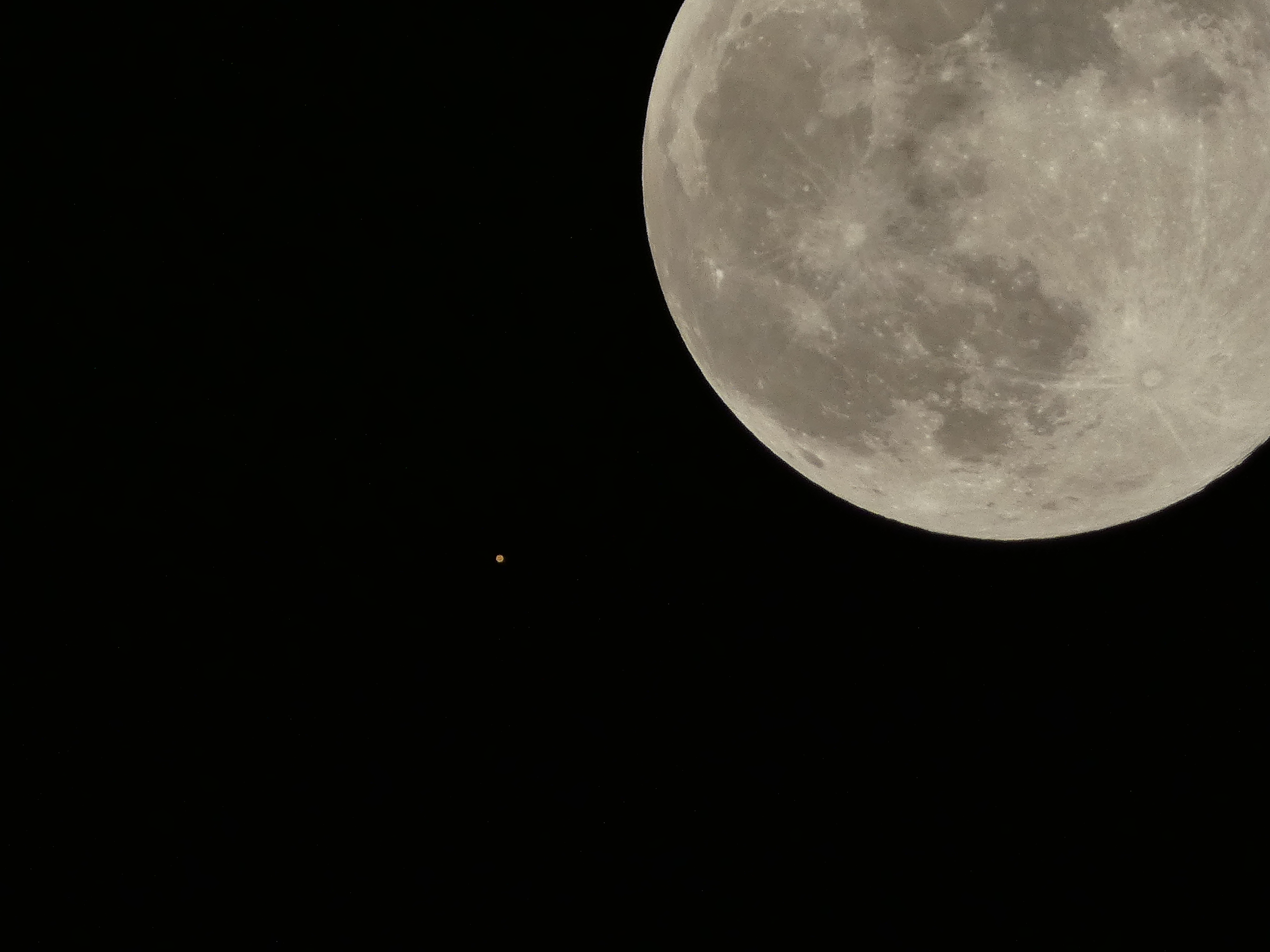
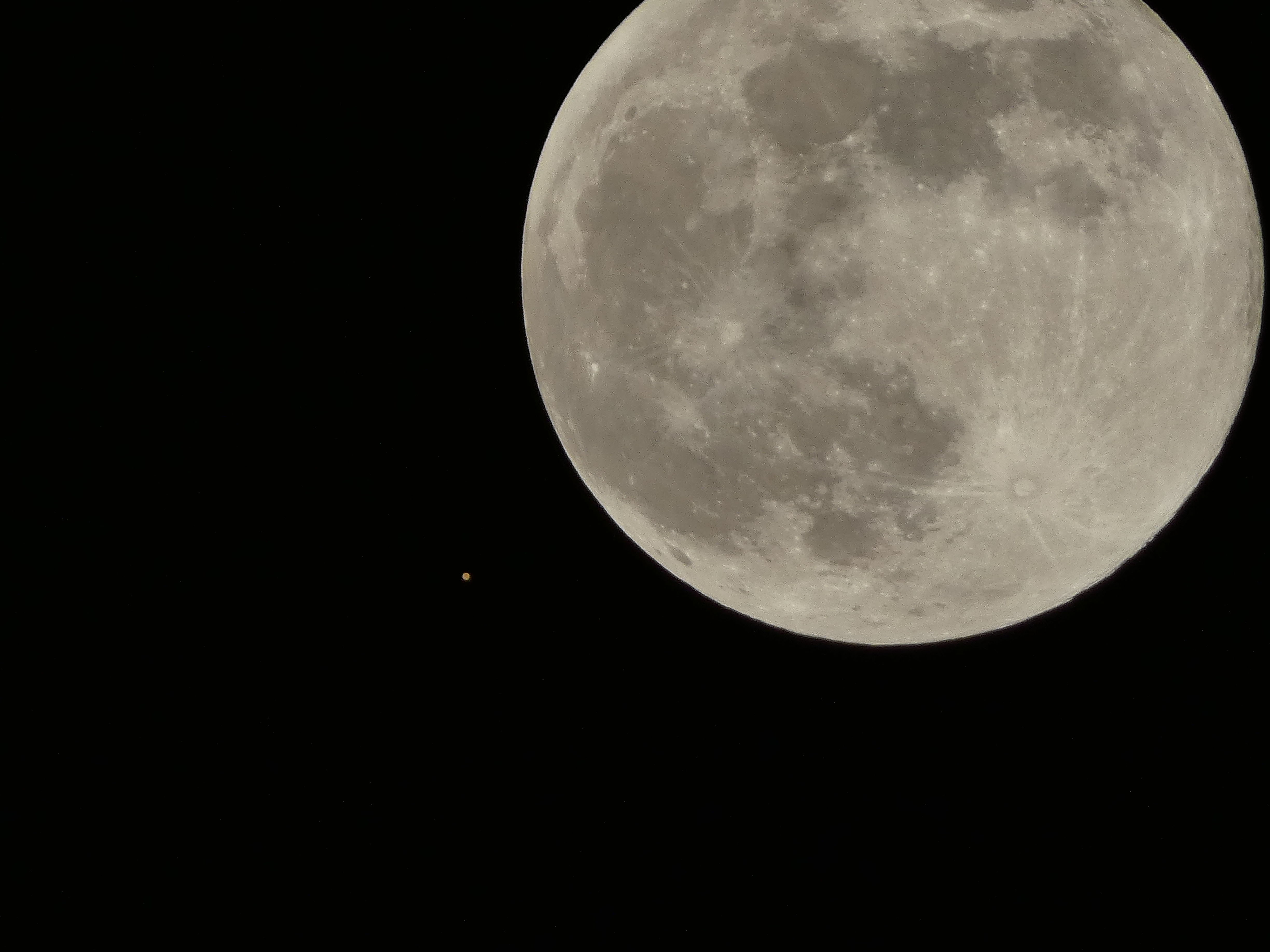
Some folks believe in the occult. I believe in a kind of occultation, but it involves our Moon and the planet Mars. This evening the full Moon, the Cold Moon, passed in front of the planet Mars. At that moment, the Earth, the Moon, and Mars were almost perfectly aligned.
The event unfolded over about twenty minutes from the time I got the camera out. At first Mars was easily seen, but as it got closer, the light of the full moon faded Mars out, but the camera had no problem.
I was photographing this with my handheld Panasonic Lumix DC-FZ80 with a 60x zoom. So the finer details weren't visible, but I bet some of the telescope rigs set up around the planet got some good features on Mars. I was happy to see the disk shape of the small planet!

I'd love to have captured the re-emergence of Mars on the other side, but I had to teach my night course. Such is life, but it sure is fun to see something for the very first time!

Wednesday, February 17, 2021

Mars Landing! And a Speculative Question: What Spot Would You Pick on Earth?


Courtesy of NASA

The landing is almost here (or by the time you read this, it's happened already, for better or worse)! I hope, hope, hope that all goes well. Mars is a tough target, and I've seen to many failures and disasters. But...if they are able to stick the landing, we'll have an incredible adventure ahead of us, exploring the Jezero Crater, the site of an ancient sea and river delta complex. It's thought to be one of the most likely places to find evidence of any life that might have evolved on Mars.

Jezero Crater delta complex, landing site of the Perseverance Mission

Lots of good resources and landing schedules can be found here: Landing Toolkit: Perseverance Rover - NASA Mars. I've checked out things ahead of the landing, as you can see below, and the rock samples look intriguing.

(You can do your own pic with the mission toolkit)

I'm curious. The Mars landing site was carefully chosen as to glean the most information possible in a small area. If you had a single chance to land a rover on Earth for an only exploration, what place on Earth would you pick for the landing? And why? Answer in comments!


Tuesday, October 13, 2015

And Mercury Makes Four. Beautiful Gathering in the Morning Sky

There is still a beautiful show in the sky in the early morning this month. When I realized I missed Mercury in my Friday morning picture, I went out again this morning for another try, and caught it between the trees on the eastern horizon. It's only the fourth or fifth time that I've seen Mercury (mostly out of laziness because you have to know just where to look), and only the second time I've photographed it.
In all the excitement about Pluto and Ceres over the last few months, it might be good to remember that NASA and the European Space Agency have been on a real winning streak of late. There are the tireless surface vehicles on Mars, the Cassini exploration of Saturn, the Galileo mission to Jupiter, and the Messenger mission to Mercury that have given us an unprecedented look at our Solar System. It is simply stunning that we have in just 58 years of space travel that we have had such success in exploring our nearest neighbors in space, and that they have turned out to be places of the imagination. No one could have predicted in 1957 that the moons and planets of our Solar System could have been so strange and wonderful.

Monday, September 19, 2011

You Betcha, it's Breccia: Some Otherworldly Pictures

I'll be back to vagabonding in the next few posts, but it's a busy week and I have lots of photos to work through. In the meantime, I have two photos that crossed my desk this week, one a few years old, and one that has been recently acquired. The thing about them is that they both made my jaw drop, even though without context they look...almost mundane.
Courtesy of JAXA (Japan Aerospace Exploration Agency)
Take this first picture, for instance. It looked to me like the surface of a mudflow in a desert environment, judging from the lack of finer sediments, and the relative sheen of the rock surfaces. A simple explanation is that it is an example of desert pavement with desert varnish, taken by someone who was using some archaic black and white film (does anyone know what film is? I have vague memories...).

But it's not. Not even close...close to Earth, that is. This is the surface of another object in the Solar System, and it's not a planet either. It's an asteroid called Itokawa. I somehow missed these pictures in 2005-2006 when the Hayabusa satellite arrived there, landed, and returned to Earth with some small particles of the asteroid (it arrived back in June of 2010). Asteroid Itokawa is small (about 600-700 meters long), and is barely a single object. It is a fairly loose agglomeration of chunks and pieces of rock...a space breccia

I appreciate blogger Glacial Till, who brought this picture to my attention last week (by coyly putting a picture of Titus Canyon in Death Valley to distract me). For more info on the Hayabusa mission to Itokawa, check out this site.

The next picture is similar; it could have been taken in practically any desert environment. It looks like some wind has cleared off another piece of breccia of some sort. What's special is that this rock isn't on Earth either, it's on Mars. The Rover mission, slated to last for 90 days, has been continuing for seven years. This picture is hot off the press, taken just a short while ago (September 7) by the Opportunity Rover on the edge of Endeavour Crater. You can read a NASA press release about the rock here. The rock is called Chester Lake.
I can hardly speculate on the composition of the breccia. The Rover is doing some serious analysis of Chester Lake because it is an outcrop of bedrock, rather than crater impact debris.

The Rover, like any geologist working an outcrop, has to look up once in a while to gain some context for the area they are working in. Here is a shot of the view from the site. The researchers have to be very selective about which rocks to test. I feel such a powerful desire to wander across this landscape, picking up and collecting all kinds of samples. Many thanks to Joel Hagen for bringing these photos to my attention.
I can't begin to describe what incredible times we live in. When I was a young boy, I was fascinated with astronomy, and my most valued possession was a small telescope. Mars was such a compete mystery! It was a little red dot in my telescope, and little more in the largest telescopes in the world. We could barely distinguish surface details on the planet, even though there were those who were sure they could see canals on the surface, evidence of some kind of civilization (who invaded us in the War of the Worlds and in Buckaroo Bonzai). I was a college student by the time our satellites started sending clear pictures of the surface, and today we are trolling about on the surface. We carry incredible pieces of technology in our pockets and purses that allow us to gaze on the surface of another planet (when we can pull our attention away from cute cat pictures!). Incredible times.

Wednesday, August 12, 2009

Just Plain Cool: Images from Mars

NASA may have their problems, but what they have done with robotic exploration of the other planets in our Solar System is, in my highly sophisticated scientific blogger's jargon, really cool. This photo shows the half-mile wide Victoria Crater on Mars, taken from an oblique angle, roughly equivalent in their words to looking out a plane window. Dunes of martian dust fill the bottom, and tumbled boulders and layered rocks are visible in the crater walls.

For you conspiracy theorists out there, there are some great tracks on the left side of the photo (see the high resolution version) proving that there is an intelligent presence on the planet. The tracks are actually from the Mars Opportunity Rover, which has been exploring this crater for the last two years (these were bonus years, the original mission was to be a few months and has gone on for years instead).

I remember so well as a child in the 1960's being frustrated that the only pictures I could ever see from Mars were these fuzzy disks that revealed nothing of the planet surface. I hope that anyone looking at these incredible images appreciates the fact that we live in extraordinary times when such images of a planet other than our own are so easily accessible.

Get the NASA description of the photo here:
http://www.nasa.gov/mission_pages/MRO/multimedia/mro20091012a.html?msource=12209

Full resolution image here:
› Full resolution jpeg (1.34 Mb)

Sunday, June 1, 2008

Awe-Inspiring....Great Job, NASA!

I need to echo the comments of Chris at Highly Allochthonous about the extraordinary picture of the descent of the Phoenix onto the surface of Mars. I have written before about the incredible gift that technology has given all of us, especially in our ability to see beyond the confines of our own small planet. This is a simply astounding picture...

Monday, May 26, 2008

Martians Coming to Study Earth! Where Would You Land?


Congratulations to NASA for their successful landing on Mars! They are starting to beat the odds, as something like half of all landings have failed (I imagine the Martians shooting our spacecraft out of their atmosphere like an "Asteroids" game). Others in the geoblogosphere have discussed what we hope to find (here, here, and here), but I am curious:


If you were a Martian, and had five chances to land a spacecraft on Earth, what five locations would you pick to land in such a way as to learn as much about the planet as possible? Imagine that you have mapping spacecraft that provide high quality photographs of the surface, but that you know no more about Earth than we do about Mars.


I will give it some thought and offer my suggestions, but I haven't had time to think that far ahead.

Monday, March 3, 2008

Speaking of Landslides caught on film (disk?).....

And speaking of being in the right place at the right time...the pictures coming back from the HiRESE Orbiter over Mars are just spectacular. Read the story of this photo at http://hirise.lpl.arizona.edu/PSP_007338_2640, and more than 2,500 other images were released today at http://hirise.lpl.arizona.edu/pds_release_mar_08.php. Thanks to Arizona Geology (http://arizonageology.blogspot.com/) for the links.

I am once again reminded of how lucky I am to be alive these days, and how little we knew of the Solar System in the days of my youth. I waited for months for the chance of getting a telescope for Christmas when I was 11 or 12 years old. It was a bit like Ralphy hoping for the BB gun in Christmas Story. As luck would have it, the arrival of my beloved telescope coincided with the flooding in southern California in 1969, and it was actually weeks before I was able to actually look at stellar objects with my new pride and joy. And truth be told, I was a little disappointed, since stars looked just the same in the telescope as they did with the naked eye. I could see moons around Jupiter, and Saturn's rings, but not much else (and I certainly didn't take these pictures, however fuzzy).


I was consumed with curiousity about the other planets in our neighborhood, and all the science books could offer were small fuzzy pictures of Mercury, Mars, Jupiter, Saturn, and Venus. Uranus, Neptune, and Pluto (the dwarf formerly known as the 9th planet) appeared as only dots of light. With the arrival of the first pictures from Voyager and all the other planetary explorers, our world was changed, and we are richer for it.

Everyday, the people who do science, and their technological advances provide us with beauty and fascination, as exemplified by the continuing saga of the Mars Rovers and the Orbiters. Thanks to those who persevere in the face of budget cuts, and keep up the great work!