Showing posts with label Grand Tetons. Show all posts

Thursday, July 28, 2011

A Convergence of Wonders, Day 11: The Orange Steam is OK, but the Blue Stuff Will Kill You....

Say what? Oh yeah, I was once working on a series about our journey across the Pacific Northwest and the Northern Rocky Mountains in June called a Convergence of Wonders (the name derived from the influence of the Cascadia Subduction Zone, a convergent boundary). I had reached day 10 when we arrived and started exploring Yellowstone National Park, but was, uh, slightly distracted by another two week trip, a more personal trip. I'm home now, and I expect to wrap up this series now.
So what is today's title about? Well, the steam at Yellowstone National Park actually does have some bad stuff in it (high levels of carbon dioxide and hydrogen sulfide) and can cause some real problems for people with asthma and other conditions, but there is no blue steam or orange steam, except as it reflects the colors beneath it. The picture at the beginning is of Grand Prismatic Spring in the Midway Geyser Basin.
Yellowstone is justly famous for her collection of geothermal features; the 300 geysers in the park account for about two-thirds of all the geysers in the entire world. There are thousands of other fascinating geothermal features as well, including fumaroles, boiling mudpots and hot springs.

Fumaroles are steam vents. Sometimes fumaroles are short-lived features in the immediate aftermath of violent volcanic eruptions, but in places like Yellowstone (and Lassen Volcanic National Park in California) they are more permanent in nature. Sometimes they are transitional in nature, depending on the time of year and availability of groundwater. Some geysers erupt so rarely that they might as well be considered fumaroles that occasionally explode.
Boiling mudpots are cauldrons of hot acidic mud derived from the weathering of the surrounding volcanic rock. The bubbling mud above is the Fountain Paint Pot near the Lower Geyser Basin.
Hot springs are carefully defined as springs that have, uh, hot water. They are one of the most beautiful of Yellowstone's geothermal features due to the interplay of color caused by select absorption of sunlight and the presence of extremophile bacteria (which can survive in near-boiling water). Grand Prismatic Springs is one of the most spectacular features in the national park system, although it is hard to see except from above (there is a trail on the nearby hillside).


The hot spring we looked at in the last post, Mammoth Hot Spring, was a mountain of calcium carbonate derived from the solution of limestone layers along the pathway of groundwater movement. Most of the hot springs in the park are within a rhyolite caldera, and most of the springs have much less voluminous deposits made mostly of silica. White Dome Geyser, below, is the highest silica dome in the park at twelve feet.
No trip to Yellowstone would be complete without a visit to Old Faithful. At least that's what I've heard. I managed (quite on purpose) to miss two eruptions while we were there. There's just something about having amphitheatre seating and a giant crowd of people that is off-putting.
So what were these people standing around for? The rangers seemed far more excited about convincing people to see an eruption of Beehive. Is that it, that little bit of spray?
Oh, there it is! It produced a spectacular eruption!

As we started south to leave the park, we made a short stop at Grant Village to have a look at Yellowstone Lake, a huge body of water (132 square miles) that is the largest freshwater lake above 7,000 feet in the country, and possibly the world. The lake lies within the Yellowstone Caldera, and recent activity has caused parts of the lake bottom to tilt. Some shorelines are rising and others are falling.

I also took a moment to say hi to Nina Fitzgerald, a ranger at Yellowstone. She is a fellow geoblogger, and has been writing a great series of posts about her experiences in the park system. You can catch her work at Watch For Rocks.
We ended our day by traveling south along the Rockefeller Byway to Grand Teton National Park. More in the next post!

Wednesday, May 18, 2011

See Glacier Before the Glaciers are Gone; See Yellowstone Before the Supervolcano Blows: Take a Geology Field Course This Summer

There was a time when the our national parks seemed like unchangeable icons and symbols. They were protected from development, they were reservoirs of intact ecosystems and clean water and air, and a family might have told stories of camping in the olden days of the 30's and 40's, and until recently one could reasonably expect to have a similar experience in the current era. Times are changing, however. Glaciers are disappearing from Glacier National Park, forests and wildlife are transforming in parks like Yellowstone and Yosemite as the climate warms, and some parks are becoming isolated islands in seas of urban development. Views in parks like Grand Canyon, Bryce Canyon and Sequoia are increasingly obscured by air pollution. Our orphaned parks, the state parks, are being being closed for lack of funding. Others face privatization. It's a shame that the best idea our country ever had is being in some ways abandoned. I would love to think that we are coming up with better ways of caring for our national and state treasures, but I am not optimistic. When budget cuts come, the parks get cut first.
I guess this is an odd way to extend an invitation! But if you live in the Modesto region (or are willing to make some major travel arrangements), we would like to invite you to travel with us on an exploration of some of our country's most precious places: the Pacific Northwest and the Northern Rocky Mountains. I'm working with our anthropology professor to offer a dyad class on the archaeology and geology of nine national parks and monuments (Lava Beds, Crater Lake, Newberry Crater, Mt. Rainier, Glacier, Yellowstone, Grand Tetons, Great Basin, Yosemite) as well as a multitude of state parks and other sites. And you can get three units of semester credit doing something interesting!
That's not to say there will be no work...you have to learn stuff, and demonstrate it too us! And it is a camping excursion, with all the possibilities of rain, snow, sun, wind and critters. On the other hand, there will be plenty of opportunities to hike, to see starlight skies and wonderful sunsets, and to have a multitude of unforgettable and unique experiences. If you are interested, see the press release below for more information. We are having an informational meeting on Monday if you live nearby. We can provide info by e-mail if you can't come to the meeting.

MJC offers new Geology and Archaeology summer field studies class

(Modesto, CA) — Modesto Junior College is offering a unique summer field studies course entitled Geology and Archaeology of the Pacific Northwest and Northern Rocky Mountains held June 15 to June 30, 2011. Anyone interested in enrolling in this special learning opportunity is invited to attend the orientation meeting on Monday, May 23 at 7 p.m. in Science 132 on East Campus.

The course will provide an exploration of Yellowstone, Crater Lake, Grand Tetons and Glacier National Parks, and Mount St. Helens and Lava Beds National Monuments. Participants will also have the chance to visit and discover some less familiar spots that provide evidence of the geological and human history of the region, including Great Basin National Park, Berlin-Ichthyosaur State Park, Fossil Butte National Monument, and Newberry Crater.

The new joint class is being taught by Professor of Anthropology Susan Kerr and Professor of Geology Garry Hayes and students will earn 3 semester units in either Geology 174 or Anthropology 174. A background is not required in either of these subjects. Basic principles will be developed prior to and during the course, and participation will benefit anyone interested in a career in teaching, park management and rangering, or science.

The group will camp in the parks and monuments and the $650 class fee includes all transportation, camping fees, park admission fees, and food. A registration fee of $26 per unit is additional, as are other applicable fees for those not already enrolled as an MJC student. Anyone wishing to register for the class who is not already enrolled as an MJC student must submit an application online at www.mjc.edu.

For additional information email Susan Kerr at kerrs@mjc.edu or Garry Hayes hayesg@mjc.edu or visit http://virtual.yosemite.cc.ca.us/ghayes/serv06.htm for a complete itinerary.

Thursday, December 4, 2008

The Cretaceous Parks of the Colorado Plateau: the Story of a DinoDig


To continue our story of the Cretaceous history of the Colorado Plateau, we have taken a slight detour to the north to Montana, where the Cloverly Formation stands in for the Cedar Mountain Formation as the critical link between the late Jurassic ecosystems of the Morrison Formation and the later more widespread late Cretaceous formations. As explained in a previous post, this is because I've dug in the Cloverly, but have never seen (or at least recognized) the Cedar Mountain Formation to the south.

Lots of people participate in dinosaur digs, either as researchers, as students, or as paying volunteers through any number of commercial excavators. Our opportunity arose in 1993 when Jack Horner gave a lecture at Modesto Junior College on Tyrannosaurus rex (thus, the photo above). You may recall that at the time the movie Jurassic Park had pretty much re-ignited dinosaur-mania around the country, and Horner had gained some notoriety as a technical advisor for the film-makers. He had also garnered popular attention as the author of several great books about parenting dinosaurs (the Maiasaurs), and T-Rex (horrible predator or scavenger?). So his arrival at MJC caused quite a stir among my geology students, and they (and me too, I guess) hung around him like a bunch of groupies.

Over beer and pizza the next day, Mr. Horner suggested that we could help with one of his digs that coming summer in Montana, if we were at all interested. He stipulated that we could include 7-8 students, we would have to feed ourselves, provide all our camping supplies, get to Montana at our own expense, and that we would be diggers, not brushers and excavators. It would be hot and dusty or rainy and windy, or even snowy. There would be cows. Starstruck, we said yes, sounds fun!

Over the following months, the list of students crept up to 17 (lots of delicate e-mail negotiations), and they worked hard raising funds with burger sales and yard sales. Eventually they raised something like $5,000 to fund our expedition. So, early in June we set forth in our vans on the way to Bridger, Montana. The first day we slogged our way 550 miles to Angel Lake in the Humboldt Range of Nevada, and the next day traveled to Grand Tetons National Park, where we set up camp in the Gros Ventre Group Campground.

What happened that particular evening became one of our department legends for the ages. One our students had a knack for fomenting trouble with the powers-that-be in the Universe. On various previous trips he had speculated about what it would be like to get stung by a scorpion, and within a day, he had been (unwillingly) stung by a scorpion. At a stop, he asked if we would see any rattlesnakes. He stepped on one moments later. There was a karma that hung about Craig like a hangman's noose.


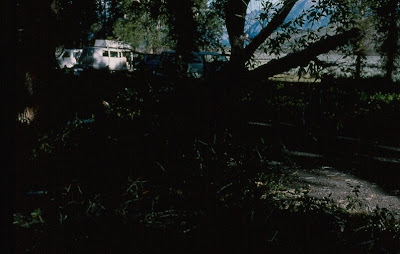
There was a discussion that evening at Grand Tetons in the twilight about whether we would experience any bad weather on our journey. The skies were clear that night with just a few puffy clouds about. For some reason, Craig looked at towards the heavens, raised a rock hammer towards the sky, and said "I dare the gods to make it rain!". I'm not kidding about what followed. Within ten minutes of his brash statement, our campground was enveloped in a violent storm, our vision obscured by thick blowing dust, and high winds were knocking down old cottonwood trees all around us. Fifteen minutes later the winds died, the dust cleared, and the camp was a shambles. Tents were ripped apart, and branches were down all over our camp. Our vans were undamaged, but a tree had crushed a van in the other part of the campground (people were in it, but were unhurt). We thought we had been hit by a tornado, but more likely it was a microburst from a storm that approached us unseen from the east.


Needless to say, Craig spent much of the rest of the trip muzzled....and this story will be continued.