Showing posts with label Cloverly Formation. Show all posts

Sunday, December 28, 2008

The Cretaceous Parks of the Colorado Plateau: the Final Discovery


In the last installment of our dinosaur-digging story, we had finally come across evidence that dinosaurs had, in fact, actually lived during the time of the deposition of the Cloverly Formation; we had found deinonychus claws, and bones of tenontosaurs and anklyosaurs. In the final days on the site, we had become fairly sharp at picking out bone fragments on the slopes of the dig site, and two of our party found a fairly significant bone scatter a few yards away from the main quarry.

By working their way up the slope, they found where the bones were emerging, and we started another (much smaller) quarry, and uncovered several dozen bones in situ, of a creature we could not immediately identify. It was smaller than the other species we were expecting to find, and was thus sort of mysterious. We delineated the bone area, and started the process of protecting the exposed bone with "butvar", coating the bones with paper towels and covering the entire mess with plaster. By our last day on the site, we had constructed a giant plaster monstrosity.

The paleo-experts on the dig looked bemusedly at our work, and very politely waited until we had said goodbye and started on our way home before they started tearing off all the plaster and carving the rock mass into smaller parts. The dig was nearly a quarter-mile from the vehicle, and our plaster monster must have weighed 300 pounds! No one wanted to carry it down that hill!

The experts also were nice enough to report on what they found once the specimen had been hauled off to the Museum of the Rockies. Our find turned out to be numerous fragments of a Zephyrosaurus, a species that had been found only once before, and had been named on the basis of a few pieces of the skull, and some vertebrae fragments. We had found leg and claw elements, pieces of a skull, and vertebrae and rib fragments. The animal was a small bipedal herbivore. If your fifth-grader has ever heard of it, it is probably because the kid has a Dinosaur A-to-Z book, and zephyrosaurs are one of the few "Z" dinosaurs!

Images of the bones could be accessed for some time on the Museum website, but they were eventually taken down, so I wonder if they have reconsidered the identification of the specimen. If anyone wants to track it down, it was MOR #759. I would love to know what our creature is up to these days!

The Cretaceous Parks of the Colorado Plateau: the story of a Dino-Dig wraps up


Continuing the story of our 1994 dino-dig, in which we learned the truth of uncovering new scientific knowledge. We were re-opening the quarry where the raptor Deinonychus had first been discovered. After nearly a week of hard digging we were approaching the bone layer, but work was pre-empted by a heavy rain and hail-storm that drenched the area. We had found nothing to speak of, but in the days that followed the storm, bones began to appear.

Our first effort to actually discover bone involved Karma Craig, whose previous efforts had netted us a near tornado, scorpions, rattlesnakes and deer-van collisions. Knowing of his power, we got him to say the words "I wonder what it would be like to find dinosaur bones?". His Karma was strong, and later that day he stumbled over some tail vertebrae (second picture) of a Tenontosaurus, the large iguanadon-like plant-eater that appears to have been the main prey of Deinonychus. Soon after, another member of the party found an odd boulder that turned out to be the carapace of a turtle (third picture; the matching half of the carapace was later found to be already ensconced in the Museum of the Rockies). I had walked past a pile of rocks for a week before it occurred to me that we were in mudstones, and that rock chunks shouldn't be there; they turned out to be the bones of an anklyosaurus relative. And several members of our party wandering on the other side of the gully found a partial Deinonychus claw and numerous other scattered bone fragments (fourth picture).

Meanwhile, the diggers had reached the bone-level of the main pit. Tensions were high as the professionals climbed in with their dental picks and brushes and went to work. What would come to light? Whole skeletons of Deinonychus locked in a death embrace with their victims? Well, no, we didn't find that; we found a single claw, which fell to pieces upon exposure, and was lost. But that's what happens, I guess. We were quite thrilled with our other discoveries.

Just the same, there was one more discovery to be made in our last days on the site. That story follows soon!

Thursday, December 4, 2008

The Cretaceous Parks of the Colorado Plateau: the Story of a DinoDig


To continue our story of the Cretaceous history of the Colorado Plateau, we have taken a slight detour to the north to Montana, where the Cloverly Formation stands in for the Cedar Mountain Formation as the critical link between the late Jurassic ecosystems of the Morrison Formation and the later more widespread late Cretaceous formations. As explained in a previous post, this is because I've dug in the Cloverly, but have never seen (or at least recognized) the Cedar Mountain Formation to the south.

Lots of people participate in dinosaur digs, either as researchers, as students, or as paying volunteers through any number of commercial excavators. Our opportunity arose in 1993 when Jack Horner gave a lecture at Modesto Junior College on Tyrannosaurus rex (thus, the photo above). You may recall that at the time the movie Jurassic Park had pretty much re-ignited dinosaur-mania around the country, and Horner had gained some notoriety as a technical advisor for the film-makers. He had also garnered popular attention as the author of several great books about parenting dinosaurs (the Maiasaurs), and T-Rex (horrible predator or scavenger?). So his arrival at MJC caused quite a stir among my geology students, and they (and me too, I guess) hung around him like a bunch of groupies.

Over beer and pizza the next day, Mr. Horner suggested that we could help with one of his digs that coming summer in Montana, if we were at all interested. He stipulated that we could include 7-8 students, we would have to feed ourselves, provide all our camping supplies, get to Montana at our own expense, and that we would be diggers, not brushers and excavators. It would be hot and dusty or rainy and windy, or even snowy. There would be cows. Starstruck, we said yes, sounds fun!

Over the following months, the list of students crept up to 17 (lots of delicate e-mail negotiations), and they worked hard raising funds with burger sales and yard sales. Eventually they raised something like $5,000 to fund our expedition. So, early in June we set forth in our vans on the way to Bridger, Montana. The first day we slogged our way 550 miles to Angel Lake in the Humboldt Range of Nevada, and the next day traveled to Grand Tetons National Park, where we set up camp in the Gros Ventre Group Campground.

What happened that particular evening became one of our department legends for the ages. One our students had a knack for fomenting trouble with the powers-that-be in the Universe. On various previous trips he had speculated about what it would be like to get stung by a scorpion, and within a day, he had been (unwillingly) stung by a scorpion. At a stop, he asked if we would see any rattlesnakes. He stepped on one moments later. There was a karma that hung about Craig like a hangman's noose.


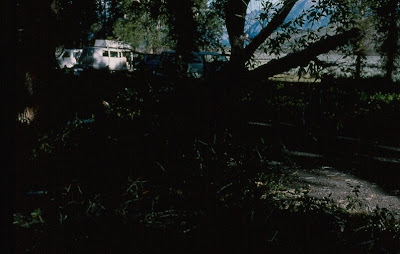
There was a discussion that evening at Grand Tetons in the twilight about whether we would experience any bad weather on our journey. The skies were clear that night with just a few puffy clouds about. For some reason, Craig looked at towards the heavens, raised a rock hammer towards the sky, and said "I dare the gods to make it rain!". I'm not kidding about what followed. Within ten minutes of his brash statement, our campground was enveloped in a violent storm, our vision obscured by thick blowing dust, and high winds were knocking down old cottonwood trees all around us. Fifteen minutes later the winds died, the dust cleared, and the camp was a shambles. Tents were ripped apart, and branches were down all over our camp. Our vans were undamaged, but a tree had crushed a van in the other part of the campground (people were in it, but were unhurt). We thought we had been hit by a tornado, but more likely it was a microburst from a storm that approached us unseen from the east.


Needless to say, Craig spent much of the rest of the trip muzzled....and this story will be continued.


Tuesday, December 2, 2008

The Cretaceous Parks of the Colorado Plateau: the Cedar Mountain Formation

Well, yeah, except that it isn't the Cedar Mountain Formation, and it's not on the Colorado Plateau, and it isn't a park of any kind. If I may explain, the Cedar Mountain Formation is an exceedingly important part of the geological history of the Colorado Plateau, being the only representative layer in the region dating from the early/middle Cretaceous Period. It has also turned out to be a treasure trove of fossils with a rich collection of dinosaurian and other species preserving a time when animals were mixing or being separated from related species in Europe and Asia. So it is really important and all, and every geology field trip should stop and have a look at it and take lots of pictures and stuff. Except that I haven't done so on all of my many trips onto the plateau.

Extensive work on the Cedar Mountain Formation does not seem to have begun until the early 1990's (compare to the Morrison Formation, which was being excavated for dinosaurs in the 1870's). Some two dozen dinosaur species have been found in the unit, including several sauropods, iguanadons, troodons, one of the earliest hadrosaurs (eolambia), and my personal favorites, deinonychus, utahraptor, tenontosaurus, and a zephyrosaurus. At different levels in the formation these dinosaurs share affinities with European faunas while others are related to faunas from Asia. These connections reveal the severing of North America from the former and the linking to the latter during early and middle Cretaceous time.

So what's with the picture above? It is an exposure of the Cloverly Formation near Bridger, Montana. The Cloverly is nearly contemporaneous with the Cedar Mountain Formation, and many of the fossils found within it are similar as well. And I have actually been there, and participated in a dinosaur dig that was a defining life event for me and many of my students. So a few posts will soon follow, describing what we did there back in 1994. Please excuse the somewhat diminished quality of the photography, as these are scans of slides that were taken by a grossly incompetent photographer (me) back in the dark days before digital imaging.

These stories will also serve as my contribution to this month's Accretionary Wedge, hosted by Dave Shumaker at Geology News. The topic of the month is our favorite places to do field work, and was this ever it!

More soon!