It's so hard to imagine the tourist who drives for hours and hours, arrives at the rim of the Grand Canyon, looks down and simply leaves. A person can be impressed with the huge gorge, the beautiful colors, and may even appreciate the incredible geologic story they read in the visitor center. But it sort of ends, and they move on to other things. The schedule must be maintained. The curiosity is awakened for a moment, but then it slumbers again. When do we lose the desire to yearn after greater knowledge?
Watch a child in the outdoors sometime (I know, an increasingly rare situation). A trickle of water will fascinate them for hours, and they'll pick up pebble after pebble. Leaves and bugs. Frogs. They'll play with the tadpoles. And they'll ask questions. So many questions! What is it that drives that fascination with nature out of their lives?
Standing on the edge of the Grand Canyon makes me feel like a child all over again. Maybe a child of the Cosmos. I don't want to leave; I want to explore the folds in the rock, the dark mysterious canyons. I want to float down the big river hidden in the depths below. And then it happened!
I went
into the Great Unknown as John Wesley Powell called it. 226 miles over 16 days, drifting with the slow currents, and making headlong rushes down the 160 or so rapids, including
a pretty good dunking at Mile 99. There was no way we could stop at every side canyon and explore, despite my intense desire to do so. I've been around long enough that I have to be a lot more careful than I used to be jumping from boulder to boulder, or climbing around on exposed cliff sides. But there were many beautiful hidden places that we did stop and explore.
Shinumo Creek on the morning of day 10 was one of them. Later in the day we reached two more, Elve's Chasm and Blacktail Canyon.
As I've said many times as I've written about this trip, the canyon constantly changes. There was always something new to see and experience. Elve's Chasm was such a new place. It is a tributary canyon to the Colorado River, like hundreds of others, but in this particular spot travertine spring deposits covered much of the sedimentary rock. The creek (and debris flows) cut down through the solid rock, but then the springs flowed and mineral deposits (mostly calcite) developed and covered the rocks.
The travertine is a porous rock (as can be seen above), but it is also strong and easily cut. I was much to surprised to find that the massive columns surrounding St. Peter's Square at the Vatican in Rome (and many other building facings) were carved from travertine rather than marble.
It was bit of a climb up the canyon, but the waterfall at the end of our walk was wonderful. The fallen boulders made for easy climbing in the darkness behind the waterfall, so the kid in me delighted in climbing and then jumping into the deep pool below! Being a kid doesn't involve just asking questions...
I saw multitudes of reptiles and amphibians over the course of the trip, and once in awhile one would stay in place long enough for a picture. Anyone want to identify the species for me?
As we drifted down the river we passed a massive travertine deposit that could have been a statue of Jabba the Hut. I don't know why we need to make these natural features into something more familiar, but it happens. I guess it helps us to remember them more easily.
We stopped for lunch at the imaginatively named Mile 117.6 Camp. As we were wrapping up, we had a treat. I had seen a bighorn sheep along the river on the second day out, but had no chance for a picture (we were at the very top of a big rapid). Someone in the group spotted movement across the river, and we realized there was a herd of bighorns coming down to the river for a drink.
It was a number of ewes and their lambs. It was a sight watching them climb along the cliffs and rocks. They made me feel positively clumsy.
Even the young ones looked supremely confident. The bighorns were hunted by the Ancestral Puebloans, but I find it hard to accept that they were a major food staple. It seems like they would be a difficult prey. Powell's men had rifles, intending to supplement their diet with sheep and deer, but it almost never worked out. The sheep were simply too cautious and quick.
And hard to see! How many sheep are in the picture below?
I wondered if the sheep ever swim across the river. This didn't answer the question for sure, but a short distance downstream there was a handsome ram all by himself. I have no idea if it was his harem on the other side, but then on the other hand, maybe the ewes swam across to get away from him!
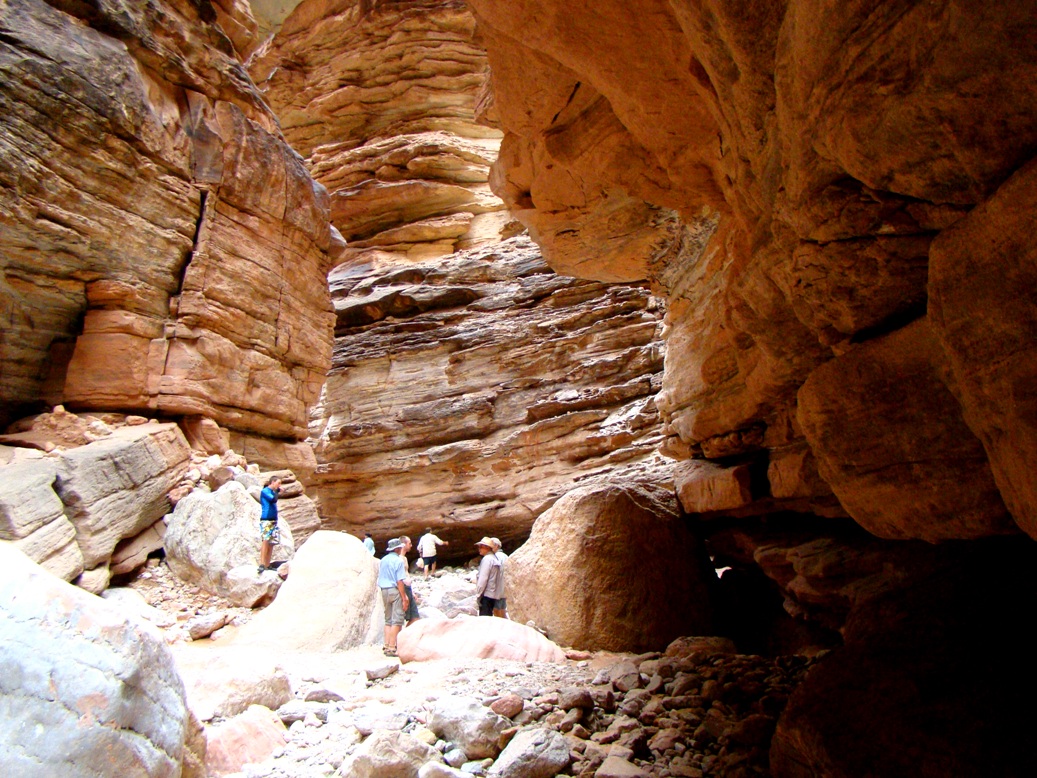
Downstream we pulled out for one more excursion up a tributary stream, this time at Blacktail Canyon. It is a narrow gorge cut through the Tapeats Sandstone of Cambrian age (around 520 million years), and a bit of the underlying metamorphic rocks of the Granite Gorge Metamorphic Suite (mostly about 1.7 billion years old).
The ledges of Tapeats contain layers of sandstone and conglomerate that represent the coastal rivers and beach deposits of the transgressing Cambrian sea that eventually covered much of the early North American Continent. As we walked up the canyon, an extraordinary contact became visible.
It was a wonderful exposure of the
Great Unconformity, the buried erosion surface representing a gap in time of 1.2 billion years. We had seen the unconformity in several places along the river upstream, but it was often hidden by debris and fallen rocks, or was too high above the river to get a close look. Here in Blacktail, one can put a finger on a line representing more time than the entire existence of complex life forms on planet Earth.
The canyon had another virtue. It was a wonderful acoustic chamber. Our crew brought a harmonica, but they told stories of others who have brought brass instruments or cellos to make beautiful music. As Pete played a song, a canyon wren added a counter melody that just made my heart soar (you can scroll down
this page to hear a canyon wren). I love those birds !
At the head of the canyon, we found a pool and a small tricking waterfall. It was such a peaceful place to explore. As everyone wandered back down the canyon I sang a few verses of "Amazing Grace". I was still upset by the rough ride down the rapid the previous day. I had profusely thanked the wonderful people who were there to pull me out of the turbulent water, but thought it would be nice to send another message into the Cosmos to whomever might be listening.
Through many dangers, toils and snares
I have already come;
'Tis Grace that brought me safe thus far
and Grace will lead me home.
We headed down the canyon and back onto the river. We reached a sandy camp called Enfilada. Interesting things lay ahead down the river, and the boatmen were beginning to talk about Lava Falls.