I've spent the last two weeks going through the archives of ten years of Geotripper. I've been enjoying picking out a few bits here and there that I really enjoyed writing. One of these was the story of the toughest fish in the world, and the very surprising place where it is found. This was posted on February 19, 2015...
What kinds of fish are tough? Some Marlin that you spent a couple of hours trying to reel in one time in Mexico? A nice two pound Rainbow Trout that fought hard against your fishing skills in a mountain lake in the Sierra? Some Small-mouth Bass in a reservoir somewhere? I doubt any of them can stack up to this little fish. They were out and about last week during our field trip in numbers I haven't seen in some time.
It's little, hardly exceeding two inches in length. It's certainly not big enough to take a hook. It doesn't have a mouthful of teeth, and it's not a predator (unless you are a diatom or a clump of algae). So how is this a tough fish?
Consider this: it lives in water that can sometimes exceed the saltiness of seawater. By three times. I don't think there is another fish in the world that can do that. And...it can survive in water where the temperature exceeds 100 degrees. Again, I don't think there is another fish in the world that can do that. And one more: the environment in which these fish live can reaching freezing on occasion. No fish that I am aware of can survive such extremes.
But these little fish can.
On top of everything else about this species is the place where it lives,
the last place one would even think of looking for fish: Death Valley in
eastern California. The hottest place in the world, and the driest
place in North America.
Meet the Death Valley Pupfish (Cyprinodon salinus salinus), sometimes known as the Salt Creek Pupfish. It is just one of nine or so species and subspecies of fish that survive in the Death Valley region.
Once you realize that fish are living in Death Valley, certain questions are bound to arise. How can there be water enough for them to survive? How did they get there? And how did there come to be so many species and subspecies ?
The first question is perhaps the easiest to answer. It is true that rain almost never falls in Death Valley, with an average year seeing no more than 1.5-2 inches of precipitation. But Death Valley is the lowest ground in North America, and groundwater flows towards the valley, in some cases from a hundred miles away. Springs and pools form when faults or rock barriers force the water to the surface. These water sources don't depend on the rare rainstorm. It's thought that the water flowing from springs at Furnace Creek or Scotty's Castle has been underground for more than 10,000 years. These stable springs and pools have provided a secure source of water since the end of the last ice age around 12,000 years ago.
But how did the fish get there in the first place? We can say that the fish did not arrive under current climate conditions. River connections between fault basins could only occur during the ice ages when glaciers covered about 30% of the Sierra Nevada. Glacial meltwater drained into the Owens Valley and spilled over into other desert valleys, filling them, and ultimately filling even Death Valley with a hundred mile long freshwater lake. At some point, a connection was made with the Colorado River, and numerous species of fish invaded the ecosystem. But then the ice ages ended.
The vast lakes began to dry up, and the fish were forced to adapt or die out. A number of trout species survived in the cool waters of the Carson, Walker and Truckee River drainages, but in Death Valley, it was only the Cyprinodon species. The one species was forced to survive in different environments, water that might be fresh, salty, hotter, or cooler. The single species diverged into many, much as the finches of the Galapagos Islands did.
During the spring, the Salt Creek Pupfish expand rapidly into the growing flow downstream. Hundreds of fish become thousands, then a million or more. Most of them are doomed when the extreme summer heat sets in and Salt Creek mostly dries up. A few find refuge in the pools and springs at the head of the shallow canyon (a canyon that exists on the floor of Death Valley because of faulting).
Other species of pupfish are more severely limited. The Devil's Hole Pupfish is restricted to a single cavern opening only a few tens of feet across. It is said to be the most endangered vertebrate species in America and maybe the world. There have rarely been more than 300, and at times the population has dipped to barely two dozen. Their continued survival is obviously in doubt.
Toughness doesn't have to be measured by strength or stature. The pupfish of Death Valley show their toughness by surviving in one of the most extreme environments on Earth. They deserve our respect and protection, something we have not always provided. The Tecopa Pupfish (Cyprinodon nevadensis calidae) once lived in two hot springs east of Death Valley. Modifications of the springs in the 1960s to build bath houses destroyed their habitat, and they were gone by 1970. It was the first species to be taken off the endangered species list, not because it was doing better, but because it was extinct. Let's do better with the others.
Postscript: Since I originally posted this story on the pupfish, I've become aware of another species of pupfish in the region that was thought to be extinct, but which now is thriving on private property in Shoshone, east of Death Valley. Here is the very interesting story of their discovery. Biological and environmental details can be found here.
Showing posts with label Salt Creek. Show all posts
Monday, January 15, 2018
Sunday, March 13, 2016
Invitation to a Drive-by Shooting (of a Superbloom) in Death Valley
| Telescope Peak (11,043 feet) and the Death Valley graben and salt pan |
| Scarp of the Furnace Creek fault zone north of Furnace Creek Resort |
| Panamint Mountains on the west side of Death Valley, with the gulch of Salt Creek on the valley floor. |
| North end of the Black Mountains in the vicinity of Furnace Creek |
| Headed south from Furnace Creek towards Badwater Basin |
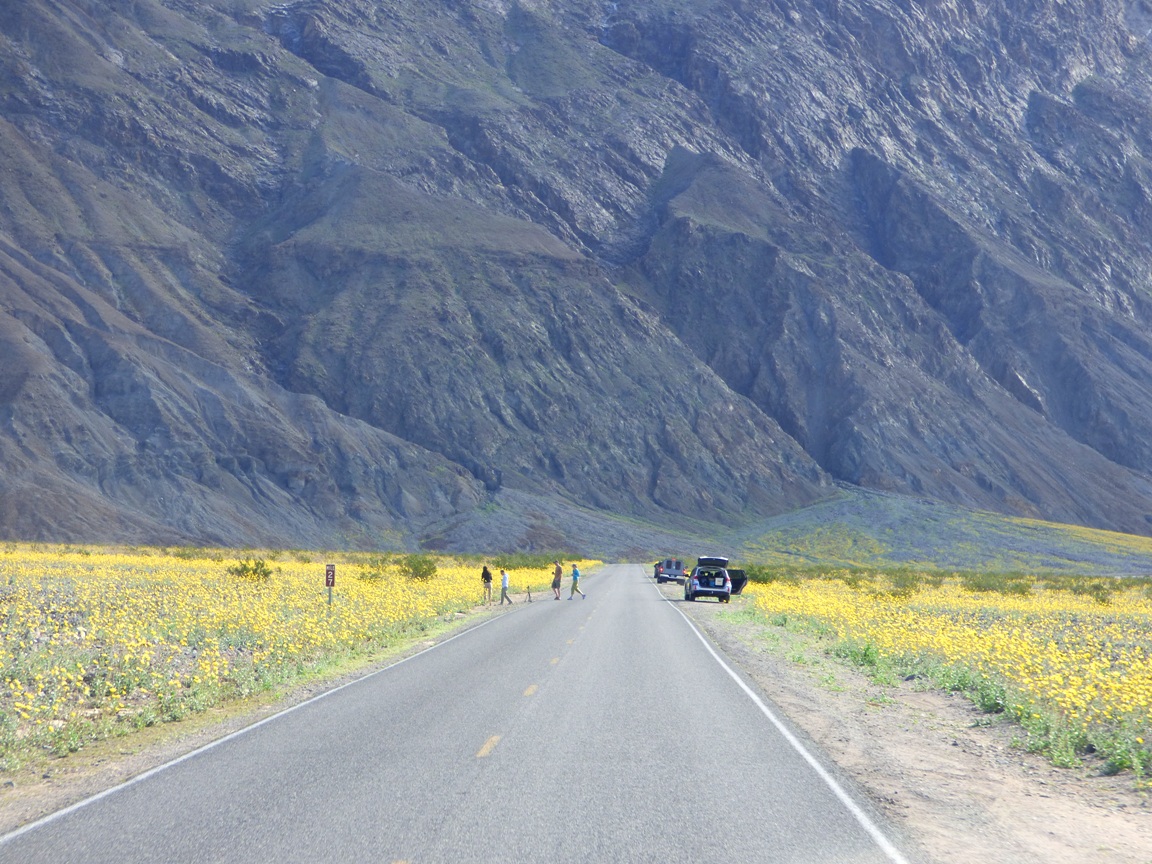
It is so very strange to see the alluvial fans that are usually so barren turning green and yellow with life. The flowers increased in number as we moved south, I assume due to better exposures to sunlight. It seems to happen that way the few times I've seen plentiful shows of color.
It's a wondrous show, and park visitors were in sort of a trance. The kind of trance that causes them to wander aimlessly across busy highways without looking around for oncoming traffic (like heavily loaded college vans).
As we approached Shoreline Butte and the offset cinder cone, flowers covered much of the valley floor, and climbed far up the alluvial fans. Maybe flowers cover these surfaces more often in the main flower months of March and April, but I can't remember seeing them in February when we are usually there.
Shoreline Butte itself was covered with flowers. The butte is a cinder cone that has been shaped by the waves of Lake Manly, the ice age freshwater lake that once filled Death Valley 600 feet deep. The lake was present most recently about 20,000 years ago.
So, you are wondering, did we stop AT ALL where we could see some flowers up close? Why yes, yes we did. I made sure that some of our geology stops would require walking through the fields of Desert Gold, Five-Spot and Phacelia. Pictures will be coming soon!
Monday, March 2, 2015
How Did Fish Get into the Desert of the Basin and Range Province?
here and here), I received a comment asking where the connections were that allowed fish to make the journey from the Colorado River system into areas as isolated at the Owens Valley and Death Valley. Courtesy of Philip Stoffer of the U.S. Geological Survey, here is the map. The drainage through Danby, Cadiz, and Bristol Lakes is the probably route of numerous fish species during the ice ages. From there, they were able to move through Soda and Silver Lakes into the Death Valley-Owens River system.
It is an unexpectedly diverse group of fish. According to this report, there were 56 species and 75 subspecies of fish living in the Basin and Range/Mojave Desert provinces. Ten of these historically known species/subspecies are extinct. Another 75 are listed, are candidates for federal listing, or are species of concern. 9 out of 10 of the subspecies are endemic, meaning they are found nowhere else in the world. The fish include the highly endangered Devils Hole Pupfish, the popular Lahontan cutthroat trout, as well as a variety of dace, chubs and suckers.
The story of why they are endangered is easy to summarize. They need water to survive, and so do humans. It is the choices that humans make that will determine the future of this fascinating group of fish. The Owens pupfish (Cyprinodon radiosus) would be extinct today but for the intervention of a Fish and Wildlife officer who carried the worlds entire population (800 individuals) out of a drying pond in two buckets, and established the fish in six other localities (four of these remain). The Devils Hole Pupfish in Death Valley National Park exist today because of a Supreme Court decision halting the drilling of groundwater near the only pool in which they exist.
It is an unexpectedly diverse group of fish. According to this report, there were 56 species and 75 subspecies of fish living in the Basin and Range/Mojave Desert provinces. Ten of these historically known species/subspecies are extinct. Another 75 are listed, are candidates for federal listing, or are species of concern. 9 out of 10 of the subspecies are endemic, meaning they are found nowhere else in the world. The fish include the highly endangered Devils Hole Pupfish, the popular Lahontan cutthroat trout, as well as a variety of dace, chubs and suckers.
The story of why they are endangered is easy to summarize. They need water to survive, and so do humans. It is the choices that humans make that will determine the future of this fascinating group of fish. The Owens pupfish (Cyprinodon radiosus) would be extinct today but for the intervention of a Fish and Wildlife officer who carried the worlds entire population (800 individuals) out of a drying pond in two buckets, and established the fish in six other localities (four of these remain). The Devils Hole Pupfish in Death Valley National Park exist today because of a Supreme Court decision halting the drilling of groundwater near the only pool in which they exist.
![]() |
| A Death Valley Pupfish, found in Salt Creek on the floor of Death Valley. |
Thursday, February 19, 2015
You Think Some Fish You Caught Was Tough? How Does it Stack Up Against This One?
What kinds of fish are tough? Some Marlin that you spent a couple of hours trying to reel in one time in Mexico? A nice two pound Rainbow Trout that fought hard against your fishing skills in a mountain lake in the Sierra? Some Small-mouth Bass in a reservoir somewhere? I doubt any of them can stack up to this little fish. They were out and about last week during our field trip in numbers I haven't seen in some time.
It's little, hardly exceeding two inches in length. It's certainly not big enough to take a hook. It doesn't have a mouthful of teeth, and it's not a predator (unless you are a diatom or a clump of algae). So how is this a tough fish?
Consider this: it lives in water that can sometimes exceed the saltiness of seawater. By three times. I don't think there is another fish in the world that can do that. And...it can survive in water where the temperature exceeds 100 degrees. Again, I don't think there is another fish in the world that can do that. And one more: the environment in which these fish live can reaching freezing on occasion. No fish that I am aware of can survive such extremes.
But these little fish can.
On top of everything else about this species is the place where it lives, the last place one would even think of looking for fish: Death Valley in eastern California. The hottest place in the world, and the driest place in North America.
Meet the Death Valley Pupfish (Cyprinodon salinus salinus), sometimes known as the Salt Creek Pupfish. It is just one of nine or so species and subspecies of fish that survive in the Death Valley region.
Once you realize that fish are living in Death Valley, certain questions are bound to arise. How can there be water enough for them to survive? How did they get there? And how did there come to be so many species and subspecies ?
The first question is perhaps the easiest to answer. It is true that rain almost never falls in Death Valley, with an average year seeing no more than 1.5-2 inches of precipitation. But Death Valley is the lowest ground in North America, and groundwater flows towards the valley, in some cases from a hundred miles away. Springs and pools form when faults or rock barriers force the water to the surface. These water sources don't depend on the rare rainstorm. It's thought that the water flowing from springs at Furnace Creek or Scotty's Castle has been underground for more than 10,000 years. These stable springs and pools have provided a secure source of water since the end of the last ice age around 12,000 years ago.
But how did the fish get there in the first place? We can say that the fish did not arrive under current climate conditions. River connections between fault basins could only occur during the ice ages when glaciers covered about 30% of the Sierra Nevada. Glacial meltwater drained into the Owens Valley and spilled over into other desert valleys, filling them, and ultimately filling even Death Valley with a hundred mile long freshwater lake. At some point, a connection was made with the Colorado River, and numerous species of fish invaded the ecosystem. But then the ice ages ended.
The vast lakes began to dry up, and the fish were forced to adapt or die out. A number of trout species survived in the cool waters of the Carson, Walker and Truckee River drainages, but in Death Valley, it was only the Cyprinodon species. The one species was forced to survive in different environments, water that might be fresh, salty, hotter, or cooler. The single species diverged into many, much as the finches of the Galapagos Islands did.
During the spring, the Salt Creek Pupfish expand rapidly into the growing flow downstream. Hundreds of fish become thousands, then a million or more. Most of them are doomed when the extreme summer heat sets in and Salt Creek mostly dries up. A few find refuge in the pools and springs at the head of the shallow canyon (a canyon that exists on the floor of Death Valley because of faulting).
Other species of pupfish are more severely limited. The Devil's Hole Pupfish is restricted to a single cavern opening only a few tens of feet across. It is said to be the most endangered vertebrate species in America and maybe the world. There have rarely been more than 300, and at times the population has dipped to barely two dozen. Their continued survival is obviously in doubt.
Toughness doesn't have to be measured by strength or stature. The pupfish of Death Valley show their toughness by surviving in one of the most extreme environments on Earth. They deserve our respect and protection, something we have not always provided. The Tecopa Pupfish (Cyprinodon nevadensis calidae) once lived in two hot springs east of Death Valley. Modifications of the springs in the 1960s to build bath houses destroyed their habitat, and they were gone by 1970. It was the first species to be taken off the endangered species list, not because it was doing better, but because it was extinct. Let's do better with the others.
It's little, hardly exceeding two inches in length. It's certainly not big enough to take a hook. It doesn't have a mouthful of teeth, and it's not a predator (unless you are a diatom or a clump of algae). So how is this a tough fish?
Consider this: it lives in water that can sometimes exceed the saltiness of seawater. By three times. I don't think there is another fish in the world that can do that. And...it can survive in water where the temperature exceeds 100 degrees. Again, I don't think there is another fish in the world that can do that. And one more: the environment in which these fish live can reaching freezing on occasion. No fish that I am aware of can survive such extremes.
But these little fish can.
On top of everything else about this species is the place where it lives, the last place one would even think of looking for fish: Death Valley in eastern California. The hottest place in the world, and the driest place in North America.
Meet the Death Valley Pupfish (Cyprinodon salinus salinus), sometimes known as the Salt Creek Pupfish. It is just one of nine or so species and subspecies of fish that survive in the Death Valley region.
Once you realize that fish are living in Death Valley, certain questions are bound to arise. How can there be water enough for them to survive? How did they get there? And how did there come to be so many species and subspecies ?
The first question is perhaps the easiest to answer. It is true that rain almost never falls in Death Valley, with an average year seeing no more than 1.5-2 inches of precipitation. But Death Valley is the lowest ground in North America, and groundwater flows towards the valley, in some cases from a hundred miles away. Springs and pools form when faults or rock barriers force the water to the surface. These water sources don't depend on the rare rainstorm. It's thought that the water flowing from springs at Furnace Creek or Scotty's Castle has been underground for more than 10,000 years. These stable springs and pools have provided a secure source of water since the end of the last ice age around 12,000 years ago.
But how did the fish get there in the first place? We can say that the fish did not arrive under current climate conditions. River connections between fault basins could only occur during the ice ages when glaciers covered about 30% of the Sierra Nevada. Glacial meltwater drained into the Owens Valley and spilled over into other desert valleys, filling them, and ultimately filling even Death Valley with a hundred mile long freshwater lake. At some point, a connection was made with the Colorado River, and numerous species of fish invaded the ecosystem. But then the ice ages ended.
The vast lakes began to dry up, and the fish were forced to adapt or die out. A number of trout species survived in the cool waters of the Carson, Walker and Truckee River drainages, but in Death Valley, it was only the Cyprinodon species. The one species was forced to survive in different environments, water that might be fresh, salty, hotter, or cooler. The single species diverged into many, much as the finches of the Galapagos Islands did.
During the spring, the Salt Creek Pupfish expand rapidly into the growing flow downstream. Hundreds of fish become thousands, then a million or more. Most of them are doomed when the extreme summer heat sets in and Salt Creek mostly dries up. A few find refuge in the pools and springs at the head of the shallow canyon (a canyon that exists on the floor of Death Valley because of faulting).
Other species of pupfish are more severely limited. The Devil's Hole Pupfish is restricted to a single cavern opening only a few tens of feet across. It is said to be the most endangered vertebrate species in America and maybe the world. There have rarely been more than 300, and at times the population has dipped to barely two dozen. Their continued survival is obviously in doubt.
Toughness doesn't have to be measured by strength or stature. The pupfish of Death Valley show their toughness by surviving in one of the most extreme environments on Earth. They deserve our respect and protection, something we have not always provided. The Tecopa Pupfish (Cyprinodon nevadensis calidae) once lived in two hot springs east of Death Valley. Modifications of the springs in the 1960s to build bath houses destroyed their habitat, and they were gone by 1970. It was the first species to be taken off the endangered species list, not because it was doing better, but because it was extinct. Let's do better with the others.
Sunday, February 20, 2011
Death Valley Days: The Third Day - This place is wild!
Trivia of the night: In what movie have we seen this view before? It was just one of the incredible sights on our third day through Death Valley National Park. The sun didn't just break through...it appeared in all its glory as the last vestiges of our storm blew east. Only a few drops fell during the night.
Other questions of trivia: What is the last thing one expects to find in the bottom of Death Valley, the hottest and driest place in the northern hemisphere? How about a permanent stream? And yet there is one, Salt Creek, which is caused by a structural tweak of the valley floor by faulting. The consequence is that groundwater is forced to the surface and flows for a distance of a mile or so before sinking into the ground again. This is a 'river' flowing below sea level!
The only thing that could make this stream stranger is to imagine it filled with fish. It is. How in the world did they get there? In a word, they got here more or less by accident during the Ice Ages, when giant pluvial lakes (glacial meltwater lakes) filled the low basins of the Basin and Range Province. At some point a water connection was made with the Colorado River system, and fish moved into the freshwater lakes of Death Valley and other basins. When the ice ages ended 12,000 years ago, the lakes dried up, but isolated springs and waterways provided a refuge for a few lucky survivors. Since some of the water sources were salty and others fresh water, the fish diverged from a single species into at least five, with a total of 10 distinct populations. The Salt Creek Pupfish survive in the hottest environment of any fish on the planet, often as much as 100 degrees.After visiting with the fish, we headed a mile high in the Black Mountains for a spectacular view of the valley at Dante's View. That's one part of the view in the picture at the top of the post, and the salt flats at Badwater are shown below. The faint turquoise color on the right is water on the playa surface, left over from December and January's storms.
After taking in the view and talking about the alluvial fans at the base of the mountain, we headed down to Zabriskie Point to work on a project, trying to assess the problems with diverting a dangerous desert wash into the badlands topograpy below Manly Beacon. The students made their predictions not knowing that the diversion was already made 70 years ago. Their conclusions were pretty good, especially about the rapid downcutting in the soft shales and mudstones, and it was neat that they could immediately see the consequences of the diversion.
Gower Gulch (below), the diversion point, has carved downwards about 60 feet in as many years. It has an intricate set of meanders and loops, and it changes visibly from year to year.
The lower fan of Gower Gulch has changed too, with the higher velocity floods carving a deep channel in the fan surface(below).
Our day was almost done with, but we had one more goal: Walking right into the heart of a mountain range, at Titus Canyon. Titus is a huge gorge, in places more than three thousand feet deep, and in the lower canyon the walls so narrow that passenger cars can barely pass through. Getting there required a bumpy three mile ride up the bouldery alluvial fan, and then we entered on foot.
In the twilight the canyon was peaceful and quiet, and the gray cliffs towered above us. It was a good way to end the day's journeys. It's a starry night and we have to go home tomorrow, so I am off to sleep. We have a few more stops in the morning, so look for at least one more entry of Death Valley Days! Adios!
After taking in the view and talking about the alluvial fans at the base of the mountain, we headed down to Zabriskie Point to work on a project, trying to assess the problems with diverting a dangerous desert wash into the badlands topograpy below Manly Beacon. The students made their predictions not knowing that the diversion was already made 70 years ago. Their conclusions were pretty good, especially about the rapid downcutting in the soft shales and mudstones, and it was neat that they could immediately see the consequences of the diversion.
The lower fan of Gower Gulch has changed too, with the higher velocity floods carving a deep channel in the fan surface(below).
Our day was almost done with, but we had one more goal: Walking right into the heart of a mountain range, at Titus Canyon. Titus is a huge gorge, in places more than three thousand feet deep, and in the lower canyon the walls so narrow that passenger cars can barely pass through. Getting there required a bumpy three mile ride up the bouldery alluvial fan, and then we entered on foot.
In the twilight the canyon was peaceful and quiet, and the gray cliffs towered above us. It was a good way to end the day's journeys. It's a starry night and we have to go home tomorrow, so I am off to sleep. We have a few more stops in the morning, so look for at least one more entry of Death Valley Days! Adios!
Subscribe to:
Posts (Atom)