Showing posts with label Desert Gold. Show all posts
Monday, April 15, 2019
Tales From the Semi-Super-Bloom Tour, Part 2: Death Valley National Park
The Desert Five-Spot (Eremalche rotundifolia) has to be one of my favorite desert wildflowers. I don't see it often because it is rarely blooming during my customary visits to Death Valley National Park in February. It's mysterious because it always seems to be hiding its five spots in a globular-shaped bloom that doesn't seem to open out entirely. For these reasons, our visit at Death Valley National Park was extraordinary. We saw some of the Five-Spots in all their revealed glory.
We were on the third day of our Semi-Super-Bloom Tour of California. We were seeking out not the news-making corners of the state that are attracting tens of thousands of people, but the quieter places that haven't been in the news because they didn't quite as much rain as the places like Elsinore and the Antelope Valley Poppy Preserve. There are flowers out there, maybe not as abundant, but beautiful just the same, and there were no crowds.
Death Valley is the driest place in North America, and the hottest place in the world (so far). Wildflowers are a precious gift in such a place, although they are not in any way out of place. Life finds ways to thrive in even the harshest of Earth's environments, and the flowers of Death Valley are no exception. The seeds can lie dormant in the soil for years, and once they germinate they can grow fast and lay down more seeds for the future. In the process the plants become a food source for all kinds of insects and animals, and as such are an important link in the ecosystem.
Knowing where to look for wildflowers is important when the rainfall is more sparse or later than usual (as is the case in 2019). Many of the usual tourist magnets like Zabriskie Point and Badwater were lacking in flower displays but a drive south towards Jubilee Pass and the ruins of Ashford Mill (15 miles or so) provided some scattered color. We saw what I assume were Yellow Cups (above) and Phacelia (below). Gentle corrections are encouraged!
I haven't figured out the name of the flower below yet.
But Desert Gold is hard to miss. When a super-bloom does occur in Death Valley, there are millions of them on the slopes of Jubilee Pass. There were scattered patches of them, especially along the highway, where the runoff from the pavement provides an extra edge in the water supply for the seeds.
Hairy Sand Verbena is a familiar sight from super-blooms past. We found a few of them along the road near Ashford Mill.
These are plants at the cusp of existence. They arose out of some late storms that provided the water needed to germinate, but it is a only few short weeks before temperatures soar and the desiccating winds begin to blow. Life will once again go into hiding to wait out the searing months.
Monday, March 21, 2016
Scenes from a Superbloom (Part 2), and Evidence of a Snowball Earth (in Death Valley???)
Death Valley is a wondrous place at any time of the year, although it can be darned uncomfortable. There is value, however, in understanding the limits of human existence, which is something you indeed experience when the temperature reaches 120 degrees or so. I prefer visiting at times other than summer as a rule, and late winter is often ideal. We've been bringing students out here in February for more than a quarter century, and I never get tired of seeing this place.
But every decade or so, events conspire to turn a journey to Death Valley into something very special. The geology is always there and in your face (and in your nose, ears, and shoes). But if there have been a few precious rainstorms spaced just right in the fall, you can experience an explosion of life in the desert. Seeds that have lain dormant in the thin soils for years will suddenly germinate, and the barren rocks will be painted bright yellow, with lavender and white undertones here and there.
We had driven just a few miles past Ashford Mill for a chance to look at some of the rocks from the earliest history of the North American continent. Around a billion years ago, an earlier supercontinent (called Rodinia, not Pangea) was stretching and started to fracture and break up. A series of fault basins developed in what is now Arizona, Utah, Montana, and here in Death Valley. Sediments filled the valleys, producing a three-mile-thick sequence of sedimentary rocks preserving several hundred million years of Proterozoic history (the time before complex multicelled life came to dominate the ecosystems of Earth). The mouth of the canyon below Jubilee Pass provided accessible outcrops of the three formations, the Crystal Springs, Beck Springs, and the Kingston Peak.
The Crystal Springs formation preserves ancient algal structures called stromatolites. They are the oldest evidence of life in California (but not in the world; life had already been on the planet for two billion years). The Beck Springs formation (in the dark hill below) is composed mostly of dolomite, which formed at tropical, even equatorial latitudes.
The presence of tropical rocks makes the Kingston Peak formation a real enigma. It's composed in part of a strange conglomerate referred to as a diamictite. The large boulders are in a matrix of muddy sediments such as one might expect to find on the ocean floor. The puzzle is: where did the large rocks come from? Big boulders don't usually get carried far out to sea unless they are encased in icebergs.
Icebergs? In the tropics? Even the most intense of the ice ages that we've studied from the last two million years never approached the tropics. They barely crossed the northen flanks of the United States. As evidence mounted, geologists started to realize the occurrence of an ice age more intense than any other ever discovered. The Snowball Earth hypothesis suggests that the entire planet may have been covered by ice around 700 million years ago, except maybe for a narrow strip at the equator.
We walked across the alluvial fan for a closer look at the Beck Springs and Kingston Peak rocks, but were distracted somewhat by the incredible flower display.
I got down on the ground and tried to get a few shots from a ground squirrel's point of view. If nothing else, the local rodents are able to look around and say "salad" today!
The explosion of life on the barren desert floor was just stunning. These plants are supremely adapted to survive in this most harsh environment, and it was such a privilege to see it happening.
There were trade-offs, of course. The storms that brought the flowers also brought devastating flash-floods that destroyed roads. We couldn't visit some of our normal outcrops, so I had to redesign our itinerary for the next day. That led to a rather fine adventure, one in which we drove through a mountain range. That's "through", not "over". More in coming posts!
But every decade or so, events conspire to turn a journey to Death Valley into something very special. The geology is always there and in your face (and in your nose, ears, and shoes). But if there have been a few precious rainstorms spaced just right in the fall, you can experience an explosion of life in the desert. Seeds that have lain dormant in the thin soils for years will suddenly germinate, and the barren rocks will be painted bright yellow, with lavender and white undertones here and there.
| Beck Springs formation on the left, and Kingston Peak formation on the right. |
The Crystal Springs formation preserves ancient algal structures called stromatolites. They are the oldest evidence of life in California (but not in the world; life had already been on the planet for two billion years). The Beck Springs formation (in the dark hill below) is composed mostly of dolomite, which formed at tropical, even equatorial latitudes.
The presence of tropical rocks makes the Kingston Peak formation a real enigma. It's composed in part of a strange conglomerate referred to as a diamictite. The large boulders are in a matrix of muddy sediments such as one might expect to find on the ocean floor. The puzzle is: where did the large rocks come from? Big boulders don't usually get carried far out to sea unless they are encased in icebergs.
Icebergs? In the tropics? Even the most intense of the ice ages that we've studied from the last two million years never approached the tropics. They barely crossed the northen flanks of the United States. As evidence mounted, geologists started to realize the occurrence of an ice age more intense than any other ever discovered. The Snowball Earth hypothesis suggests that the entire planet may have been covered by ice around 700 million years ago, except maybe for a narrow strip at the equator.
We walked across the alluvial fan for a closer look at the Beck Springs and Kingston Peak rocks, but were distracted somewhat by the incredible flower display.
I got down on the ground and tried to get a few shots from a ground squirrel's point of view. If nothing else, the local rodents are able to look around and say "salad" today!
The explosion of life on the barren desert floor was just stunning. These plants are supremely adapted to survive in this most harsh environment, and it was such a privilege to see it happening.
There were trade-offs, of course. The storms that brought the flowers also brought devastating flash-floods that destroyed roads. We couldn't visit some of our normal outcrops, so I had to redesign our itinerary for the next day. That led to a rather fine adventure, one in which we drove through a mountain range. That's "through", not "over". More in coming posts!
Thursday, March 17, 2016
Scenes from a Superbloom: Death Valley 2016 (Part 1 of 2)
I could have made up a detailed geological description of the geology of this alluvial plain at the south end of the Death Valley graben. This is a geology blog, after all. But we were there in the middle of February during the most extraordinary flower show, a "superbloom", in a decade. A series of fall storms were spaced just well enough to wake up the myriads of seeds that hide in the soil, biding their time and waiting for the right conditions to bloom. And this was the time. I'm showing flowers today!
First and foremost is the Desert Five Spot (Eremalche rotundifolia). I'm in Death Valley every year during February, and I might see a few flowers scattered about even in dry years, but I only find the Five Spots during years like this, and I have almost no good pictures of them. That changed this year!
The slopes were covered with Desert Gold (Geraea canescens). A few Desert Golds seem to sprout in the dry years, but if there is water, these are the flowers that turn the slopes and fans bright yellow. It almost feels like walking through alpine meadows, yet one can never escape the sense that these flowers are growing as fast as they can, setting seeds, and dying as the hot winds begin to blow (and the hot winds can come at any time of the year).
Another dependable flower even in drier years is the Desert Sand Verbena (Abronia villosa). There were lots of them in the washes at Ashford this year.
The Ashford Mill was built to process gold ores from a mine a few miles away in the Black Mountains. A bit of gold was produced over the years, but the total output was described as providing the owners with little more than "groceries and lawsuits". Not much is left beyond a few walls and foundations, but they provide a decent frame for viewing Telescope Peak.
The Black Mountains form the eastern wall of the south part of Death Valley, and they are one of the most rugged mountain ranges to be found anywhere. The steepness results from the rapid uplift of the mountains (or rapid subsidence of the valley floor, or both), and the slow rate of erosion in the exceedingly dry climate of eastern California. In this season of "plenty" (in the relative sense, of course), they provide a somber backdrop to the rich display of flowers across the valley floor.
In the next post, we'll check out a few other flowers from another spot just up the highway.
First and foremost is the Desert Five Spot (Eremalche rotundifolia). I'm in Death Valley every year during February, and I might see a few flowers scattered about even in dry years, but I only find the Five Spots during years like this, and I have almost no good pictures of them. That changed this year!
The slopes were covered with Desert Gold (Geraea canescens). A few Desert Golds seem to sprout in the dry years, but if there is water, these are the flowers that turn the slopes and fans bright yellow. It almost feels like walking through alpine meadows, yet one can never escape the sense that these flowers are growing as fast as they can, setting seeds, and dying as the hot winds begin to blow (and the hot winds can come at any time of the year).
Another dependable flower even in drier years is the Desert Sand Verbena (Abronia villosa). There were lots of them in the washes at Ashford this year.
The Ashford Mill was built to process gold ores from a mine a few miles away in the Black Mountains. A bit of gold was produced over the years, but the total output was described as providing the owners with little more than "groceries and lawsuits". Not much is left beyond a few walls and foundations, but they provide a decent frame for viewing Telescope Peak.
The Black Mountains form the eastern wall of the south part of Death Valley, and they are one of the most rugged mountain ranges to be found anywhere. The steepness results from the rapid uplift of the mountains (or rapid subsidence of the valley floor, or both), and the slow rate of erosion in the exceedingly dry climate of eastern California. In this season of "plenty" (in the relative sense, of course), they provide a somber backdrop to the rich display of flowers across the valley floor.
In the next post, we'll check out a few other flowers from another spot just up the highway.
Sunday, March 13, 2016
Invitation to a Drive-by Shooting (of a Superbloom) in Death Valley
| Telescope Peak (11,043 feet) and the Death Valley graben and salt pan |
| Scarp of the Furnace Creek fault zone north of Furnace Creek Resort |
| Panamint Mountains on the west side of Death Valley, with the gulch of Salt Creek on the valley floor. |
| North end of the Black Mountains in the vicinity of Furnace Creek |
| Headed south from Furnace Creek towards Badwater Basin |
It is so very strange to see the alluvial fans that are usually so barren turning green and yellow with life. The flowers increased in number as we moved south, I assume due to better exposures to sunlight. It seems to happen that way the few times I've seen plentiful shows of color.
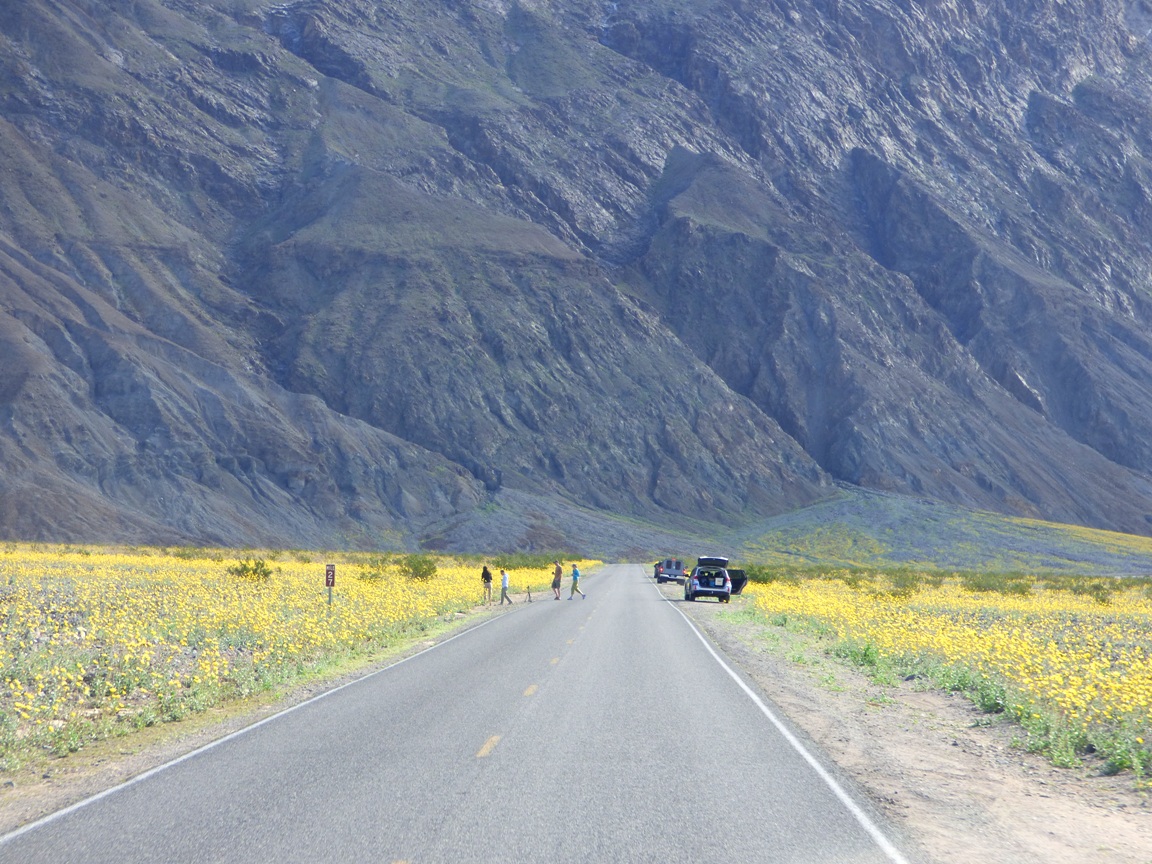
It's a wondrous show, and park visitors were in sort of a trance. The kind of trance that causes them to wander aimlessly across busy highways without looking around for oncoming traffic (like heavily loaded college vans).
As we approached Shoreline Butte and the offset cinder cone, flowers covered much of the valley floor, and climbed far up the alluvial fans. Maybe flowers cover these surfaces more often in the main flower months of March and April, but I can't remember seeing them in February when we are usually there.
Shoreline Butte itself was covered with flowers. The butte is a cinder cone that has been shaped by the waves of Lake Manly, the ice age freshwater lake that once filled Death Valley 600 feet deep. The lake was present most recently about 20,000 years ago.
So, you are wondering, did we stop AT ALL where we could see some flowers up close? Why yes, yes we did. I made sure that some of our geology stops would require walking through the fields of Desert Gold, Five-Spot and Phacelia. Pictures will be coming soon!
Thursday, February 20, 2014
Out of the Valley of Death: A bit of life hangs on
![]() |
| Desert Gold near Ashford Mill |
![]() |
| Golden Poppy near Exclamation Point |
![]() |
| I don't know this diminutive flower |
![]() |
| Sand Verbena |
![]() |
| Sand Verbena |
![]() |
| Phaecelia |
Subscribe to:
Posts (Atom)