Showing posts with label Capitol Reef. Show all posts

Saturday, December 28, 2024

About That Bucket List...What Would You Do To See These Places?

Horseshoe Bend on the Colorado River
So...about that bucket list of yours. 

Surely you have one. If you don't, what's keeping you from making one? Here's a version I promoted a few years back (I've made it to around 70% of them so far and feel exceedingly lucky to have been able to do so).

In any case, how many of the following are (or should be) on your personal list? Possibly Grand Canyon, Zion, Bryce Canyon, Arches, Petrified Forest, Capitol Reef, Yosemite, Great Basin, or Canyonlands National Parks? What about Ancestral Pueblo cliff dwellings at places like Bear's Ears or Grand Staircase-Escalante? Finding ancient petroglyphs along the Colorado River? Or searching for dinosaur bones? How would your life be changed if you could somehow do all these things...in one trip? It's possible!
Grand Canyon National Park
There is no place on this planet like the Colorado Plateau. It's hard to find anyplace else on Earth where the crust remained relatively stable for upwards of a billion years, accumulating several miles of horizontal sediments, only to be lifted up rapidly in the last few million. The Colorado River and her tributaries then stripped away much of the sedimentary cover, and cut deep into the underlying metamorphic rocks. Those metamorphic rocks record a violent geologic history of colliding landmasses and mountain-building. The resulting landscape is one of the most beautiful regions imaginable.
Angels Landing Trail in Zion National Park, Utah
The plateau country is a training ground for geologists and earth scientists, and has been since the days of John Wesley Powell and Joseph Ives, who were the first to lead research parties into the region (they didn't "discover" the plateau, of course; Native Americans have known the region for thousands of years). If you are curious about learning geology in this incredible region, you might consider joining us as a student (of any age) on our geology field studies course Geology 191: Geology of the Colorado Plateau, offered under the auspices of Modesto Junior College in Modesto, California. The course is designed to fulfil the curiosity and build the skills of lay geologists and archaeologists as well.
Mesa Arch in Canyonlands National Park
Our field course will be a grand loop through the plateau country, with investigations of the Mojave National Scenic Preserve, Grand Canyon, Zion, Bryce Canyon, Arches, Canyonlands, Petrified Forest, Capitol Reef, Great Basin and Yosemite National Parks, as well as many monuments, including Bear's Ears, Grand Staircase-Escalante, Natural Bridges, Navajo, and Hovenweep. It will be an unforgettable two week trip from June 3-17, 2025, beginning and ending in Modesto, California. Further information will be found soon here and at my school website. 
Petroglyphs on the plateau
It's not a comfortable trip...we travel in school vans (which of course are known for their luxuriousness!), we camp every night, and the days can be hot, windy, cold, or stormy, and we are out in the middle of anything that happens. But we are staying in beautiful places each night, and there are even showers and laundry available every third day or so! Extensive hiking is not required, but there will be many chances to explore the trails in each park and monument.
Petrified Forest National Park
Geology 191 is a 3-semester-unit course. By end of the course, you will be able to see the landscape the way geologists do: by identifying rocks, minerals and fossils, and interpreting the geological history of an area by working out the sequence of events as exposed in outcrops. If you are a science teacher, you will come home with a collection of photographs that illustrate most of the important principles of geology, and a selection of rocks, minerals and fossils that will make a great classroom teaching tool (legally collected, of course; there are many localities outside of protected parks from which to collect samples). You will also gain some mastery of the archaeology and culture of the plateau region, the home of the Ancestral Puebloans, the Fremont people, the Navajo, the Utes, and others.
Canyonlands National Park, Utah

The cost of the trip (still to be officially determined) will be $850 plus the cost of tuition (Currently $46 per unit for California residents, and around $225 per unit for out-of-state residents). The cost includes transportation, food, camp fees, and entrance fees. Participants would want to bring a few dollars along for showers, laundry, and souvenirs.  The food is tasty and plentiful (everyone helps cook and clean!), and the school vans...are vans.
House-on-Fire Ruin, Bear's Ears National Monument
For those of you who live in the Modesto region, we are having an organizational meeting in April which will also be available as a Zoom session. Details will be provided later on.

If you are not in the area, we will be glad to arrange for transportation from nearby airports and train stations (we actually have an Amtrak station in town). Enrollment can be completed online once you are registered with the college (http://www.mjc.edu). Please contact me with any questions you may have.
Bryce Canyon National Park
Hope to see you out there, back of beyond!

Wednesday, April 4, 2018

The Most Extraordinary Landscape on Planet Earth: Geotripping on the Colorado Plateau, June 2-17, 2018

North Rim of Grand Canyon National Park

There is no place on this planet like the Colorado Plateau. It's hard to find anyplace else on Earth where the crust remained relatively stable for upwards of a billion years, accumulating several miles of horizontal sediments, only to be lifted up rapidly in the last few million. The Colorado River and her tributaries then stripped away much of the sedimentary cover, and cut deep into the underlying metamorphic rocks. Those metamorphic rocks record a violent geologic history of colliding landmasses and mountain-building. The resulting landscape is one of the most beautiful places imaginable.
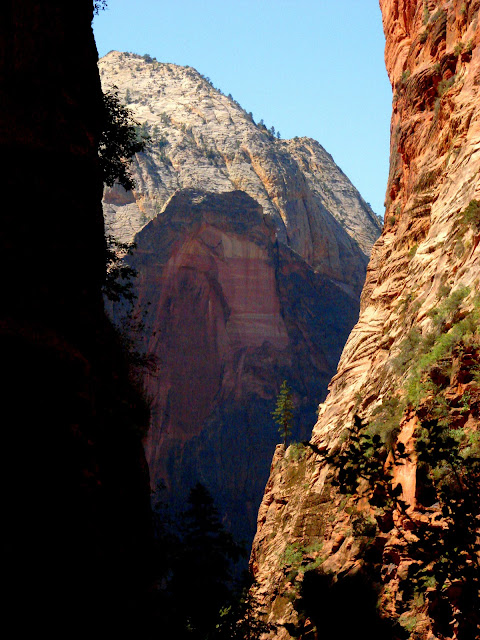
Angels Landing Trail in Zion National Park, Utah
The plateau country is a training ground for geologists and earth scientists, and has been since the days of John Wesley Powell and Joseph Ives, who were the first to lead research parties into the region (they didn't "discover" the plateau, of course; Native Americans have known the region for thousands of years). If you are curious about learning geology in this incredible region, you might consider joining us as a student (of any age) on our geology field studies course Geology 191, offered under the auspices of Modesto Junior College in Modesto, California. The course is designed to fulfil the curiosity of lay geologists and archaeologists, but also to build the skills of geology and archaeologists as well.
Goosenecks of the San Juan River, Utah
Our field course will be a grand loop through the plateau country, with investigations of the Mojave National Scenic Preserve, Grand Canyon, Zion, Bryce Canyon, Arches, Canyonlands, Capitol Reef, Black Canyon of the Gunnison, Mesa Verde and Great Basin National Parks, as well as many monuments, including Bear's Ears, Grand Staircase-Escalante, Natural Bridges, Navajo, Hovenweep, and Colorado National Monuments. It will be an unforgettable two week trip from June 2-17, 2018, beginning and ending in Modesto, California. Information can be found soon at my school website at http://hayesg.faculty.mjc.edu/Geology_191_Colorado_Plateau.html .
Black Canyon of the Gunnison National Park in Colorado
It's not a comfortable trip...we travel in school vans (which of course are known for their luxuriousness!), we camp every night, and the days can be hot, windy, cold, or stormy, and we are out in the middle of anything that happens. But we are staying in beautiful places each night, and there are even showers and laundry available every third day or so! Extensive hiking is not required, but there will be many chances to explore the trails in each park and monument.
Double Arch in Arches National Park in Utah
Geology 191 is a 3 semester unit course which will be taught as a dyad with Anthropology 191 (also 3 units). By end of the course, you will be able to see the landscape the way geologists do: by identifying rocks, minerals and fossils, and interpreting the geological history of an area by working out the sequence of events as exposed in outcrops. If you are a science teacher, you will come home with a collection of photographs that illustrate most of the important principles of geology, and a selection of rocks, minerals and fossils that will make a great classroom teaching tool (legally collected, of course; there are many localities outside of protected parks from which to collect samples). The dual nature of the course means that you will also have a mastery of the archaeology of the plateau region, the home of the Ancestral Puebloans, the Fremont people, the Navajo, the Utes, and others.
Canyonlands National Park, Utah
The cost of the trip will be $850.00 plus the cost of tuition (Currently $46 per unit for California residents, and $222 per unit for out-of-state residents). The cost includes transportation, food, camp fees, and entrance fees. Participants would want to bring a few dollars along for showers, laundry, and souvenirs.  The food is tasty and plentiful (everyone helps cook and clean!), and the school vans...are vans.

For those of you who live in the Modesto region, we are having an organizational meeting on Monday, April 16 in Room 326 of the Science Community Center on the west campus of Modesto Junior College from 6:30-7:30 PM. If you are unable to make it to the meeting, you can contact me for details and handouts.

If you are not in the area, we will be glad to arrange for transportation from nearby airports and train stations (we actually have an Amtrak station in town). Enrollment can be completed online once you are registered with the college (http://www.mjc.edu). Please contact me through the class website if you have any questions.
Bryce Canyon National Park
Hope to see you out there, back of beyond!

Monday, July 31, 2017

But Wait! THIS Summer isn't even over yet! Explore the Colorado Plateau, June 2-17, 2018 (Put it on your calendar now!)

North Rim of Grand Canyon National Park (yes, Gaelyn, we'll be on the North Rim, hope to see you there!)
"Wait!", you are saying, "it's still the summer of 2017! Why are you talking about the summer of 2018?" It's a fair question, and the answer is predicated on an unfortunate truth: our parks are too small and too crowded. If I hope to mount a field studies expedition NEXT summer, I have to start making the reservations right now. That's what I was up to today, and it occurred to me that it's never too early to put something on your calendar. We'd love to have you join us next year, on June 2-17, 2018.

There is no place on this planet like the Colorado Plateau. It's hard to find anyplace else on Earth where the crust remained relatively stable for upwards of a billion years, accumulating several miles of horizontal sediments, only to be lifted up rapidly in the last few million. The Colorado River and her tributaries then stripped away much of the sedimentary cover, and cut deep into the underlying metamorphic rocks, which record a violent geologic history of colliding landmasses and mountain-building. The resulting landscape is one of the most beautiful places imaginable.
Angels Landing Trail in Zion National Park, Utah
The plateau country is a training ground for geologists and earth scientists, and has been since the days of John Wesley Powell and Joseph Ives, who were the first to lead research parties into the region (they didn't "discover" the plateau, of course; Native Americans have known the region for thousands of years). If you are curious about learning geology in this incredible region, you might consider joining us as a student (of any age) on our geology field studies course Geology 191, offered under the auspices of Modesto Junior College in Modesto, California. The course is designed to fulfil the curiosity of lay geologists and archaeologists, but also to build the skills of geology and anthropology majors as well.
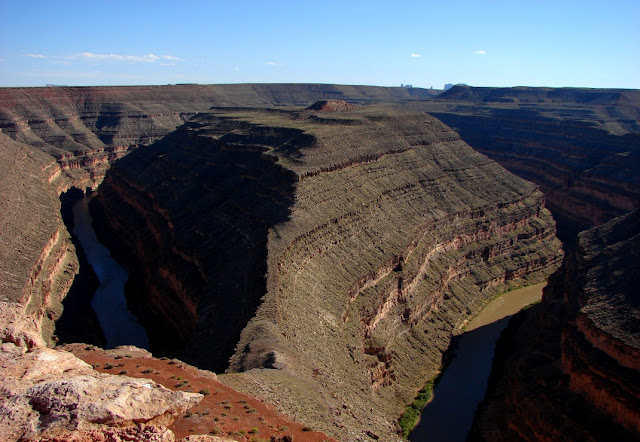
Goosenecks of the San Juan River, Utah
Our field course will be a grand loop through the plateau country, with investigations of the Mojave National Scenic Preserve, Grand Canyon, Zion, Bryce, Arches, Canyonlands, Capitol Reef, Black Canyon of the Gunnison, Mesa Verde and Great Basin National Parks, as well as many monuments, including the new Bear's Ears, Grand Staircase-Escalante, Natural Bridges, Navajo, Hovenweep, Colorado, and state parks like Goblin Valley and Berlin-Ichthyosaur. It will be an unforgettable two week trip from June 2-17, 2018, beginning and ending in Modesto, California. Information can be found soon at my school website at  http://hayesg.faculty.mjc.edu/Geology_174_Colorado_Plateau.html.
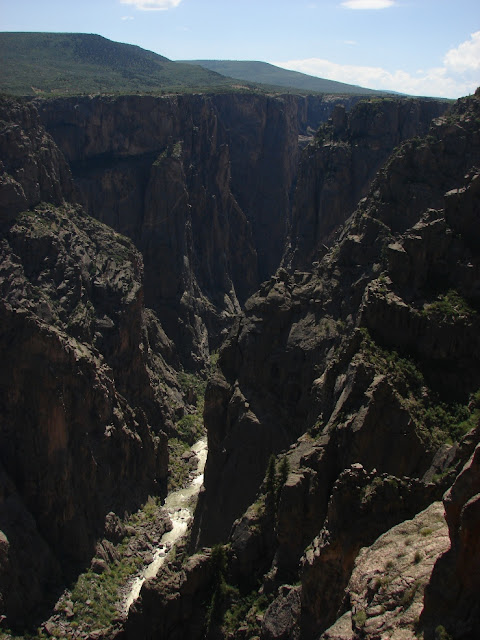
Black Canyon of the Gunnison National Park in Colorado
It's not a comfortable trip...we travel in school vans (which of course are known for their luxuriousness!), we camp every night, and the days can be hot, windy, cold, stormy, and we are out in the middle of anything that happens. But we are staying in beautiful places each night, and there are even showers and laundry available every third day or so! Extensive hiking is not required, but there will be many chances to explore the parks and monuments that we are visiting.
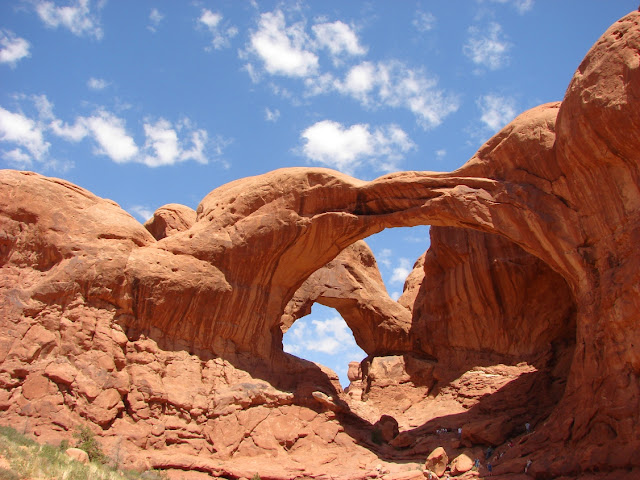
Double Arch in Arches National Park in Utah
Geology 191 is a 3 semester unit course which will be taught as a dyad with Anthropology 191 (also 3 units). By end of the course, you will be able to see the landscape the way geologists do: by identifying rocks, minerals and fossils, and interpreting the geological history of an area by working out the sequence of events as exposed in outcrops. If you are a science teacher, you will come home with a collection of photographs that illustrate most of the important principles of geology, and a selection of rocks, minerals and fossils that will make a great classroom teaching tool (legally collected, of course; there are many localities outside of protected parks from which to collect samples). The dual nature of the course means that you will also have a mastery of the archaeology of the plateau region, the home of the Ancestral Puebloans, the Fremont people, the Navajo, the Utes, and others.
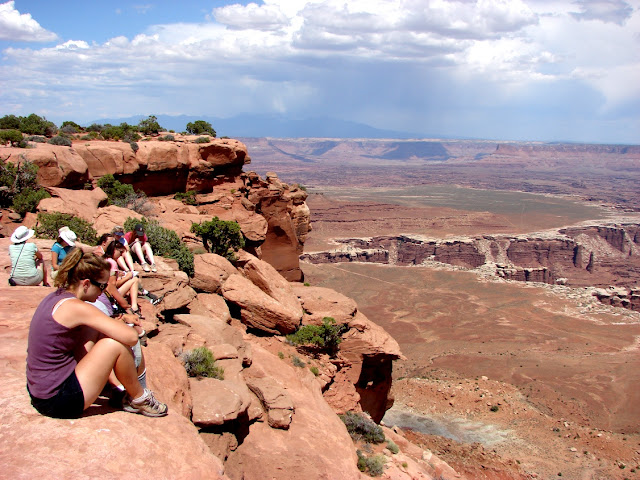
Canyonlands National Park, Utah
The cost of the trip will be about $850.00 plus the cost of tuition (Currently $46 per unit for California residents, and $222 per unit for out-of-state residents). The cost includes transportation, food, camp fees, and entrance fees. Participants would want to bring a few dollars along for showers, laundry, and souvenirs.  The food is tasty and plentiful (everyone helps cook and clean!), and the school vans...are vans.

For those of you who live in the Modesto region, we are having an organizational meeting in April, towards the end of the spring semester.

If you are not in the area, we will be glad to arrange for transportation from nearby airports and train stations (we actually have an Amtrak station in town). Enrollment can be completed online once you are registered with the college (http://www.mjc.edu/index.html). Please contact me through the class website if you have any questions.
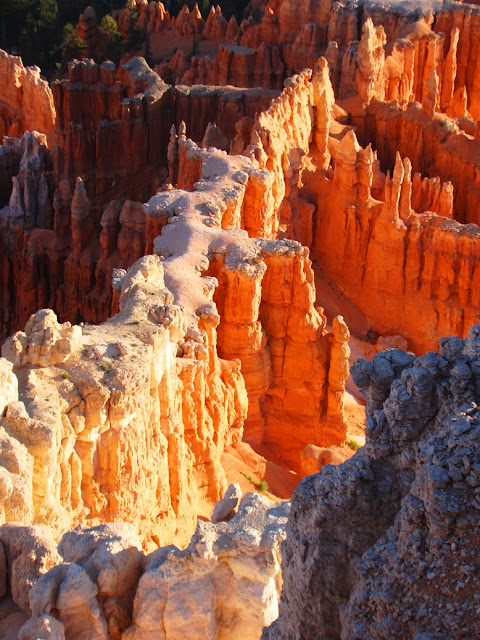
Bryce Canyon National Park
Hope to see you out there, back of beyond!

Sunday, November 30, 2008

The REAL Jurassic Parks were really Cretaceous

As any knowledgeable fifth-grader could tell you, few of the dinosaurs in the movie Jurassic Park had anything to do with the Jurassic Period. Most of the species in the movie lived during the Cretaceous Period, many millions of years later, including the velociraptors, tyrannosaurs, triceratops, and the ornithomimus herd. Offhand the only Jurassic dinosaurs I can recall from the movie were the massive brachiosaurs that occupied just a few scenes. The premise (from the sequels anyway) of the animals living in some kind of ecologically balanced paradise would be unlikely at best. The mixing of predator and prey species from long separated periods would lead to disaster, as most of the species would have no evolved defenses to predator attack methods. And of course, the whole "reconstitute a dinosaur" from old dinosaur DNA mixed with frog DNA idea is a real stretch anyway, although interesting results are coming from research with wooly mammoth DNA.

In any case, we continue onwards on our march through the geology of the Colorado Plateau. Cretaceous sediments are an important part of the Colorado Plateau sequence, and they reveal a changing world, including new plants (the angiosperms), a host of diverse new dinosaur species and many other animals. At the end of the period, the dinosaurs (and many other species) disappeared forever and a new world emerged in the Plateau country. A final transgression and regression of a shallow sea was followed by widespread deformation of the crust, and the rise of the region above sea level. The most recent era, the Cenozoic, our own time period, was beginning.

The Cretaceous formations of the Colorado Plateau are not as colorful as the Jurassic and Triassic sediments, but several national parks and monuments have been established in areas containing Cretaceous sediments, and in some cases the scenery is quite spectacular. Grand Staircase-Escalante National Monument and Capitol Reef National Park are two of the more striking examples, but other parks that are not really known for their rocks are also notable, including Mesa Verde National Park, Chaco Culture National Historical Park, Hovenweep National Monument, and Canyons of the Ancients National Monument. Important formations include the Cedar Mountain Formation, the Dakota Sandstone, the Mancos Shale, and the Mesa Verde Group.

Today's photograph is a sunset view of Fajada Butte in Chaco Canyon, one of the eeriest (but not in the scary sense) parks I've ever visited on the Plateau. The rocks are part of the Mesa Verde Group.

More soon!