Saturday, February 5, 2022

Winter Days at the National Wildlife Refuges of the Great Valley, and Remembering What Once Was

What's the largest number of birds you've ever seen from one spot?

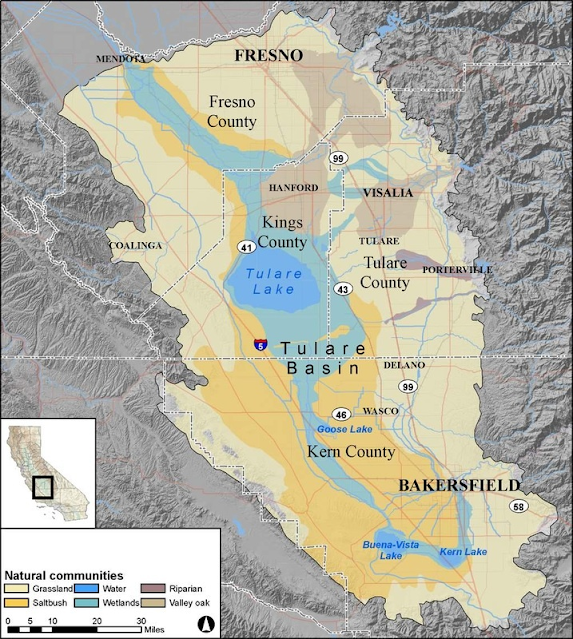
The Great Valley of California is a great place to see a lot of birds in one place. In pre-colonist days, the 400-mile-long valley was a prairie that was watered by a series of rivers flowing from the adjacent Sierra Nevada. There was enough water that even in historical time there were two immense lakes between Bakersfield and Fresno, Tulare Lake and Buena Vista Lake. Before water diversions for irrigation caused it to dry up, Tulare Lake was the largest freshwater lake west of the Mississippi.
Source: Quora
The mild winter climate of California led to the adoption of the wetlands and marshes of the Great Valley as the favored seasonal home of millions upon millions of waterfowl and other migratory birds of the arctic and far north. I can hardly begin to imagine what a wintertime journey through the pre-European Great Valley must have been like.
The ecological role of grazer in the refuges is occupied by a handful of deer and lots of sheep and cows to make up for the now-extinct megafauna

But historical accounts and paleontology can provide us some idea. In addition to birds, the vast prairies supported huge herds of tule elk, deer, antelope, and even bison. Prior to 12,000 years ago, the plant-consuming animals included giant ground sloths, mammoths, mastodons, horses, and camels. The birds and grazing animals were the prey of an imposing array of predators including the recently departed California Grizzly Bear, black bears, wolves, mountain lions, coyotes, and foxes. The pre-12,000-year crew included saber-toothed cats, dire wolves (bigger than wolves of today), American Lions, jaguars, and the immense Short-faced Bear, an animal that would have made a Grizzly think twice about a confrontation. The reason for the almost simultaneous extinctions of the species of the so-called 'mega-fauna' is a subject of contention among geologists, paleontologists and anthropologists (the role of humans has not been ruled out).
This cuddly little Short-faced Bear can be seen at the Fossil Discovery Center near Madera
I was thinking about this as we made our customary winter journeys to the local national wildlife refuges in and around Modesto and Merced. The main units open to visitation include the Merced, the San Luis (including the separate Bear Creek Unit), and the San Joaquin River National Wildlife Refuges. Although the boundaries of these refuges tend to be very square or rectangular and they are crisscrossed by maintenance roads, they are the only places that come close to recreating the primeval landscape that once existed.
The national wildlife refuge system grew out of a number of motives, some noble, others not so much. When wetlands of the valley were drained and planted with crops, millions of birds found their ancestral winter homes gone. With nowhere else to go, many of the geese and others began to forage on the tilled fields to the distress of the farmers. Instead of massacring untold numbers of birds, a series of refuges were established up and down the valley to provide a haven and food for at least some of the migrants. Of course, the refuges were also designed to preserve populations of the birds so they could be shot. Much of the refuge funding comes from the sales of hunting permits.

Snow Geese at the San Luis National Wildlife Refuge

So that is where are today. The refuges provide forage for millions of migratory cranes, geese, swans and ducks (in many they grow fields of corn for the singular purpose of feeding the birds). The birds are too crowded, and diseases can spread if the flocks are not managed properly, but it is a better situation than having no refuges at all. Some species, especially the Aleutian Cackling Goose, have been brought back from the brink of extinction (once down to just 300 or so birds, the population is more than 100,000; they mostly shelter at the San Joaquin NWR just west of Modesto). And yearly, more and more abandoned farmlands are being converted to the original riparian habitat to allow for population growth. 

I don't do video often, but the one at the top seemed necessary because I was looking at what I believed was the largest single grouping of birds I've ever seen (and I've been exploring these refuges for 7-8 years now). It required about a 180-degree pan. On the other hand, there is nothing in the world quite like watching thousands of geese taking flight all at once. When we were at the San Luis NWR last week, the serene view was of several thousand Snow Geese and Tundra Swans. It's not really a good thing for the birds to be scared into the air, as it uses precious energy, and they could get hurt. But a helicopter flew overhead at a low elevation, and it spooked the geese (the swans seemed like they could care less) and several thousand took flight. I caught the flight on video, and you can clearly hear the helicopter. I took a picture of the craft thinking to report it, but it turned out to be medi-flight out on an emergency call.  

The number of birds and the variety of birds at the local refuges is truly astounding. We saw 50 species at the San Luis Refuge last week and 46 at the Merced Refuge yesterday. The really good birders will report 60-65 in a single trip. And the birds are beautiful. Here are some that caught my eye this last week.
This Great Egret was at the San Luis NWR. Both refuges offer "auto-tours" where visitors stay in their cars (kind of like those African savannah tours, but there aren't any lions trying to eat you). The cars serve as blinds, startling birds far less than humans bumbling around.
We were looking for swans and saw large white birds off in the distance. They turned out to be American White Pelicans. They may be the most ungainly-looking birds on the ground but are positively graceful in flight. And they are huge.
The blue bill of the Ruddy Duck is rather distinctive.
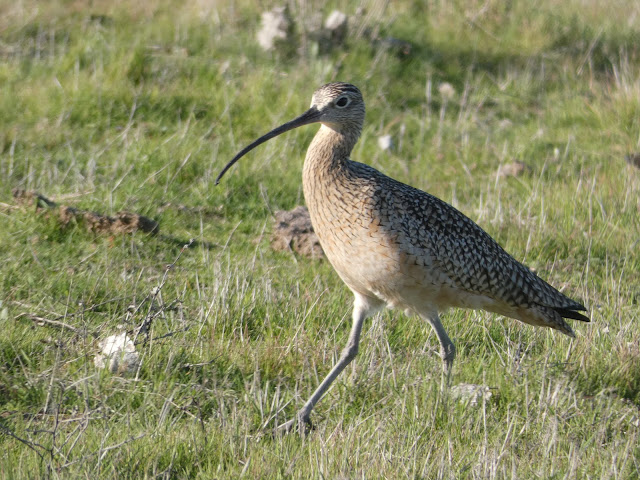
The prize for wildest beak goes to the Long-billed Curlew. I guess they can reach bugs and worms in the mud and soil that other birds can only dream of.
The Greater White-fronted Goose may be one of the more unfamiliar goose species around the valley. I've seen only a few in urban settings. Like the others, they are long-range migrants.
One of the special treats for the last two or three years has been a female Vermilion Flycatcher that decided to spend winters at the Merced NWR. This is the extreme north end of their range, and only a few are ever seen on a yearly basis in Stanislaus or Merced counties. Global warming may be allowing them to expand northward, and it may be only a matter of time before the scattered males and females find each other and start making little flycatchers.
This is an American Avocet, another bird that has a crazy bill that is good for probing deep in the mud.
There are a goodly number of raptor species that live in the refuges. One of the most beautiful is the White-tailed Kite. We thought we were done with photo opportunities when we reached the open grasslands at the end of the auto-tour at Merced, but this kite was perched on the sole tree eyeing the ground squirrels (and they were eyeing it).
The last bird of the day was the biggest surprise of all because it was the first time I had seen it in several years. It's a Black-bellied Plover, and it's not all that rare. It's just that I don't always know to look for it or recognize it when I see it. And it doesn't have a black belly. The males grow it when breeding season comes along.
Sunset at the Merced NWR
We here in the Great Valley sometimes forget that it is indeed a great valley, and that there are treasures that lie just beyond the boundaries of our cities. The auto-tours at Merced and San Luis provide opportunities for all, but those who want to walk will find a number of nice level trails. I especially recommend the Pelican Trail at the San Joaquin River National Wildlife Refuge. It passes through a series of diverse habitats and offers the greatest diversity of birds outside of the Modesto Water Treatment Plant (seriously, sewage ponds attract a lot of birds!). Check it out sometime, or any of the others up and down the valley.

Friday, January 28, 2022

Stuck Between a Volcano and a Hard Place (part 2): Politics and Geology Square Off in a Small Town with a Big Problem

I've been more and more concerned about the public damage being done to the scientific community and larger society as politics has swirled like a tornado around global warming, climate change, and pandemics. Trust is eroding in some quarters, and I only see this leading to worse disasters in the years to come (and really, nearly a million Americans dead is a huge disaster, even though it unfolded slowly over two years; just imagine the impact if those people had died all on one day). This damaged social compact between those who do science and the society at large reminded me that it isn't the first time this kind of issue has affected the public, and a few years ago I wrote about it in a two-part series. Here, with some modifications and updates, is part two.
Twin Lakes, above the town of Mammoth Lakes on the edge of the Long Valley Caldera
So what happened in Mammoth Lakes?

In the last post we talked about the titanic explosion at the Long Valley Caldera 760,000 years and tried to comprehend the scale of an event where 150 cubic miles of ash was blown into the atmosphere, covering much of the country. We then fast-forwarded to the near-present day of Mammoth Lakes in the 1980s. When we left the story, geologists were trying to decide what to do at the ski resort town in the face of astounding earthquake swarms, ground level changes, and increased geothermal activity.

It could probably be called a (tragi)comedy of errors. The USGS volcanologists carefully prepared a report to accompany a NOTICE OF POTENTIAL VOLCANIC HAZARD, the lowest level warning in their guidelines. A reporter from the Los Angeles Times figured out what was going on and published a story about the potential volcanic activity the day before the USGS released their report. The geologists got scooped, in other words, and the story became a runaway train in the national media. The government and emergency services personnel who were supposed to get the report and develop a response plan were blindsided by reporters asking them how it felt to be living in a doomed town.

The carefully worded statement from the USGS noted that "available evidence is insufficient to suggest that a hazardous event is imminent", but it was their description of the hazards that caught the attention of reporters and news hosts: rocks falling out of the sky miles from the eruptive vents, hot ash flows melting thick snowpacks and producing dangerous mudflows, and dangerous gases suffocating people. The very manna of the most desired headline: if it bleeds, it leads.
Hot Creek, a geothermal site in the Long Valley Caldera
By some accounts, the damage to the economy of Mammoth Lakes from the media circus may have been worse than an actual volcanic eruption (though no one died). Tourists stayed away in droves, businesses went belly up, and condo projects were abandoned. The business leaders of the town were livid at the geologists for stirring things up and scaring people (although by my reading, their notices were very conservative and carefully worded). They demanded that the geologists stop their campaign of terror/error, accusing them of bad science or something darker. There were even bomb threats (I had forgotten that detail; see the reference at the end of this post).
Warning sign at Horseshoe Lake, one of the carbon dioxide tree-kill sites on Mammoth Mountain.
The geologists could only respond in disbelief. I feel like I would have said something along the lines of "You are sitting on top of an active body of magma that is a few thousand feet from the surface! It would be irresponsible to keep such a thing secret". The geologists stuck to their guns, and the threat level remained at level one, the lowest level of concern, but concern nonetheless.

The business owners and local politicians went up the chain of command. They appealed to the head of the USGS, and his boss, the Secretary of the Interior, a man named James Watt. They may have communicated with then-president Reagan. As far as I can tell, there was intense political pressure from above, and eventually the director of the USGS unilaterally scrapped the warning system. Poof! It was gone. No discussion. It its place would be an informal warning system of quiet communications between geologists and civic leaders.

If this were a Hollywood movie, what happens next would be preordained. Everyone would come back. The skiers would be happily sliding down the slopes, businesses would be taking in money hand over fist, and suddenly out of nowhere there would be a resounding explosion and all hell would break loose as the caldera gives way to a catastrophic eruption that kills the "evil" business leaders because they had been greedy, and a gritty, yet handsome geologist would lead a beautiful woman and her plucky children to safety. Heck, I could see casting someone like, oh, say, Pierce Brosnan as the geologist and Linda Hamilton as the lady. Maybe call it "Dante's Peak" and move the setting to Idaho for some reason.
Yeah, I'd say that casting choice for the geologist was about right. Either one of them....
But that isn't what happened, of course. The molten magma was almost certainly there, but it cooled and solidified instead of continuing to the surface. The earthquake swarms ebbed, but other swarms have taken place over the years, though most have been tectonic in origin (related to faulting rather than magma). Gases from the magma chamber, especially carbon dioxide, have continued to seep from the ground, killing trees and other vegetation in several areas, including Horseshoe Lake (below). The gases actually killed three people a few years ago.  After some years, the USGS established a volcano observatory that monitors Long Valley, and came up with a new warning system, one with four stages, and specific actions to be taken with each. It's based on colors, just like our former Bush-era terrorism warning system. The town's economy slowly recovered. They started building condos again.
Tree kill area at Horseshoe Lake. Carbon dioxide in the soil suffocates the roots and microorganisms necessary for the tree's survival
Some of the political leaders took a bit of action. One of the main concerns was that an eruption would have destroyed the only paved road out of town. No evacuation would have been possible if the highway was blocked off. A few years after the brouhaha, a road appeared at the upper end of town called the Mammoth Lakes Scenic Route. I have to say that as a geologist that I didn't see a whole lot of scenery as I drove this nice paved highway, but I couldn't help but notice that it was exactly where I would have chosen to put an evacuation route (according to Dick Thompson in Volcano Cowboys, the county supervisors responsible were recalled from office for arranging this bit of road-building; it was like an admission that volcanism was actually possible).
Hot Creek, one of the centers of geothermal activity within the Long Valley Caldera.
In the end, one can only say mistakes were made. Some of those mistakes involved a sort of public relations tone deafness, like releasing a volcano warning on the eve of a holiday weekend, but other mistakes were more nefarious.

There were people willing to deny the possibility of a natural catastrophe in order to protect their profit margins. I see too many parallels in today's political (but not scientific) debates over global warming and climate change, and in the willful denial of the Covid pandemic. The geologists had clear evidence of a volcanic threat and the civic response was to deny the evidence and to attack the reputation of the geologists who were trying to do the right thing. There was a threat to the economy of Mammoth Lakes, but the threat was from a geologic process, not those who discovered and analyzed the volcanic hazard. And threatening the lives of the geologists was criminal. And apparently unpunished.

And the media. What to do about the media? Isn't it amazing how media outlets were willing to blow a story way out of proportion in order to gain ratings? Isn't it nice to know that they don't do that sort of thing anymore? And that the internet (which didn't exist as such in 1983) has turned out to be the very model of accurate and measured analysis of stories like this one, despite the possible instant dissemination of incorrect and potentially dangerous information? I'm so glad we live in an age of logic and reason and respect of scientific research.

Oh, I'm sorry. I briefly stepped into "Opposite-world". I'm back now. Science education and science literacy have never been more important in a world where the internet and media are so irresponsible with their analysis of geological hazards. Every time there is another major earthquake or volcanic eruption, I feel like throwing a shoe through the television screen or computer monitor as the talking heads begin babbling. Instead, I do what I can by throwing words out into the internet trying to offer up a more measured explanation of things. But the mostly ignorant talking heads always seem to win people's attention.

Just imagine the outcome if the geologists at Mammoth Lakes were effectively squelched, no warnings were ever given, and a volcanic eruption had actually occurred. Beyond the devastation, just imagine the scapegoating that would have happened in the aftermath. In Italy such a situation led to prison terms for half a dozen geologists who failed to predict a deadly earthquake (they have since been released).

We can do better than this. Especially those in the news business who are responsible in times of emergency for providing us with reasoned assessments, not sensationalist drabble. When the crisis is over, they can go back to their manic headlines about the personal lives of the stars.

You can read the original post from 2015 here: https://geotripper.blogspot.com/2015/02/the-sierra-beyond-yosemite-politics-and.html

----------------------------
Although aspects of this story of the events at Mammoth Lakes and the Long Valley Caldera are drawn from my memory, I reviewed and confirmed many of the details in the excellent book called "The Volcano Cowboys: the Rocky Evolution of a Dangerous Science" by Dick Thompson (St. Martin's Press, 2002). Check it out, it's a fascinating account of the lives and activities of volcanologists.
Thursday, January 27, 2022

Exploring One of the World's Largest Volcanic Eruptions...Ever. And a Problem: Stuck Between a Volcano and a Hard Place

I've been more and more concerned about the public damage being done to the scientific community and larger society as politics has swirled like a tornado around global warming, climate change, and pandemics. Trust is eroding in some quarters, and I only see this leading to worse disasters in the years to come (and really, nearly a million Americans dead is a huge disaster, even though it unfolded slowly over two years; just imagine the impact if those people had died all on one day). This damaged social compact between those who do science and the society at large reminded me that it isn't the first time this kind of issue has affected the public, and a few years ago I wrote about it in a two-part series. Here, with some modifications and updates, is part one.
There is a story I tell on the first day of almost every class I teach. It's about a place filled with the evidence of one of the great explosions in Earth history, near Mammoth Lakes in the eastern Sierra Nevada. The students in the picture above are standing on the edge of a gorge that exposes some aspects of the explosion, but no one place reveals the full magnitude of what happened here. We made a number of stops many miles apart, but it's hard to comprehend the full scale of the blast. It's just too big.

About 760,000 years ago, a magma chamber composed of silica-rich rhyolite magma exploded in a titanic eruption that sent about 150 cubic miles (600 cubic kilometers) of ash across the western United States. Ash layers are still recognizable in places like Kansas and Nebraska, and in the immediate area around the blast, volcanic ash and tuff occur in deposits hundreds of feet thick spread over dozens of square miles. So much material was lofted into the atmosphere that the crust collapsed into a gigantic hole 10 miles (16 km) wide and 20 miles (32 km) long, and thousands of feet deep; it's called the Long Valley Caldera

For me, it took an overflight at 30,000 feet to even begin to see the full scale of the blast. Just about all the landscape in the picture above is covered with volcanic tuff. A freeway climbs the slope on the left side of the picture but is barely visible. I've added labels in the picture below to highlight the location of the caldera, which was obscured by clouds
Our field studies trip took us down the Owens Valley and some of the lands east of the Sierra Nevada crest, including this gigantic hole that actually breached the mountain wall. The lower section of the crest allows Pacific storms to blow through, dropping prodigious amounts of snow, especially on Mammoth Mountain, a volcano that developed on the edge of the caldera thousands of years after the climactic blast. Many thousands of years later, it was decided that this was a perfect place to put a ski resort.
The Owens River Gorge on the margin of the Long Valley Caldera.
The caldera filled with water, and for thousands of years there was a lake. Eventually it breached the south edge of the caldera and drained. The resulting Owens River carved a 400-foot-deep gorge in a short period of time (above), and the canyon walls provide a marvelous cross-section of the strange volcanic rock.
The edge of the Long Valley Caldera along the Sierra Nevada crest.
The caldera is a stunning place to visit and contemplate, but that's not actually the story I tell my students on the first day of most of my classes. The story concerns an incident at Mammoth Lakes dating from the early 1980s which still has huge implications in the present day. It's about civic responsibility and public safety in the face of deadly geologic hazards, and how geologists found themselves stuck between a volcano and a hard place. The purpose of telling the story to my classes is to highlight the danger of willful geological ignorance.

On May 18, 1980, Mt. St. Helens exploded with unexpected ferocity, killing nearly four dozen people. The U.S. Geological Survey was caught off guard in terms of predicting the moment of the eruption, as they did not yet understand the dynamics of Cascades volcanoes. Only a week or so later, a series of four magnitude 6 earthquakes struck the Mammoth Lakes region, injuring a number of people and causing several million dollars of damage. Many more earthquakes followed, and with the location of the epicenters being within the caldera, the geologists became concerned. They deployed more instruments in the region and discovered that the floor of the caldera had been rising, some 10 inches between 1979 and 1980. Even more disturbing was the discovery that the earthquakes were migrating, and becoming shallower, ultimately reaching a mere 7,000 feet or so beneath the surface. New steam vents were opening up (although geothermal activity has always been present). As I say to my students on their first day of class, "You've been geologists for 45 minutes now, what do YOU think was going on?"
The floor of the Long Valley Caldera with Crowley Lake, and Glass Mountain on the far rim of the caldera.
The people of Mammoth Lakes apparently only knew that they were getting a lot of earthquakes. There wasn't a lot of communication between the geologists who were researching the increasing activity and the government and emergency personnel responsible for the safety of the community. I imagine that this occurred (and still occurs today) because of the vast amount of uncertainty involved in predicting geologic events. Who would want to go out on a very long limb and suggest that a town could be on the cusp of a very dangerous, even catastrophic event? There was a fairly recent case of geologists in Italy who were jailed because they didn't predict a deadly earthquake.
At the time, the USGS had a warning system in place, with three tiers:

NOTICE OF POTENTIAL HAZARD-Information on the location and possible magnitude of a potentially hazardous geologic condition. However, available evidence is insufficient to suggest that a hazardous event is imminent, or evidence has not been developed to determine the time of occurrence.

HAZARD WATCH-Information, as it develops from a monitoring program or from observed precursors, that a potentially catastrophic event of a generally predictable magnitude may occur within an indefinite time (possibly months to years).

HAZARD WARNING-Information (prediction) as to the time, location, and magnitude of a potentially disastrous geologic event.

Give it some thought...given the intense geologic activity, what would you do? Would you notify the civic authorities? Would you go to the media? Is it possible that the media might report the facts as they are known, or would there be a tendency to go overboard on their coverage? Keep in mind the difference between 1983 and the present day when numerous cable news networks have to keep talking 24 hours a day. Or alternatively, would you keep things quiet, and hope that the geologic activity would die down without any catastrophes occurring? What happens if you quash your findings, and an eruption takes place? What is your liability in the deaths and injuries that result? Is there an easy answer here?

What would you do?

And what finally happened?

Find out in part 2!

Friday, January 21, 2022

I'm Occasionally Reminded I'm Near an Extraordinary Mountain Range: John Muir's Range of Light

It was one of those rare days of winter in the Great Valley of California. Recent rains have tamped down the dust, and gusty winds chased away the omnipresent haze. As a result, I was treated to a view of the mountain range that I live next to, but rarely see: the Sierra Nevada, John Muir's Range of Light. It is such a rare view that I have to realign my internal geography to recognize the peaks on the skyline. It's a special view, though. Almost all the high peaks lie within Yosemite National Park, one of my most treasured places.

I hike almost daily on the Tuolumne River Parkway Trail which climbs a short bluff to bypass the town's small water treatment plant. On clear days I am treated to a view towards the Sierra Nevada to the east, and a portion of the Diablo Range of the California Coast Ranges to the west. The most distant peaks, Mts. Lyell and Rogers Peak, are 80 miles away as the crow flies, so the initial peak identification is daunting. The distinctive shapes of the peaks are clearer at extreme zoom, so in the top picture I can identify Mt. Maclure on the far right, Mt. Simmons near the center, and below Simmons, almost invisible, the summit portion of Half Dome in Yosemite Valley! Cal Topo has a marvelous tool for identifying landmarks, as you can see below.

Source: Cal Topo
Mt. Clark and Gray Peak are the prominent peaks in the picture below. They are part of the Clark Range, a high spur that lies a number of miles west of the main Sierra Crest.

The next picture reveals the peaks south of Maclure. The three prominent triangular peaks (properly called glacial horns) from left to right are Mts. Maclure and Lyell, followed by Rogers Peak. Rogers is the only peak that is actually on the Sierra Crest, although Lyell is only a fifth of a mile away (the crest being defined as the ridge that separates west-flowing stream from those flowing east into the Owens Valley).
The last picture reveals Merced Peak (under the left side of the bird flock). It is part of the Clark Range. The Tuolumne River flows in the foreground.
The cabin fever resulting from pandemic isolation and winter conditions in the mountains is intense. I'm really looking forward to a chance to get back up into the mountains come spring and summer. But it is always nice to get a reminder that the mountains are there.
 

Saturday, January 1, 2022

For a Coming New Year of Challenges: River Otters!

There are so many challenges coming in this new year and the years that follow. Dealing with the worst pandemic in a century, protecting our democracy, and above all, working to mitigate the effects of climate change and global warming. Those of you on the front lines: you are making a difference. You may feel like you are burning out, but hang in there, and take a short sanity break. Here is something to help: River Otters (Lontra candensis).


We were towards the end of the Waterfowl Auto Loop at the San Luis National Wildlife Refuge, and I saw something dive into the algae-covered slough. Sure enough a fur-covered head popped up, and then another. They seemed as interested in us as much as we were in them. So here is a 90-second moment of Zen for a New Year. I hope that yours is as good a year as possible in challenging times.

Tuesday, December 28, 2021

A History of the Drought in Three Pictures.


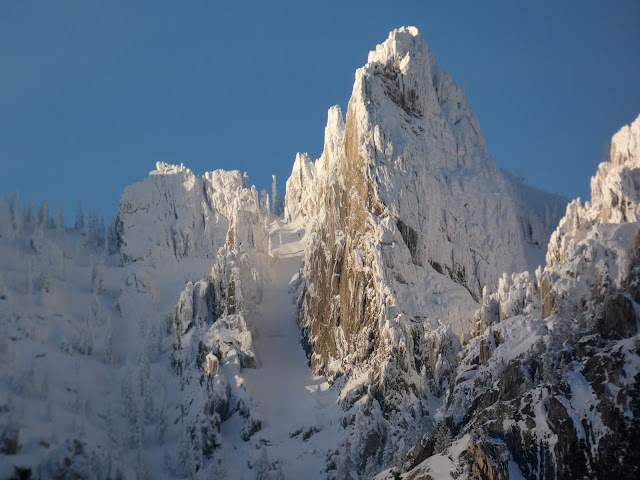
Castle Crags on December 27, 2021
It's nice to be able to report some good news once in a great while. Global warming models for California paint a truly depressing picture going forward of crippling droughts, failing snowpacks, and many tough choices to make regarding water use. We've been living those models for the past few decades with a five-year drought ending in 2017, and one of the worst drought years in history just last year. We are coming to depend more and more on the occasional intense atmospheric river events to fill reservoirs in preparation for the dry years. They've been in short supply in recent years.

My family-related travels have encapsulated the story of California's precarious water situation. The pandemic had prevented many forays north to Oregon and Washington, but we managed a trip last April, and we just completed a rather harrowing trip today. These trips were a lesson in contrasts.

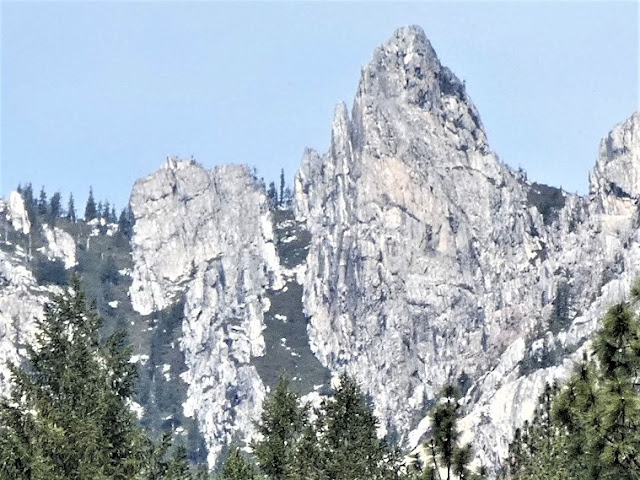
We always try to take a break at Castle Crags State Park near Dunsmuir and Mt. Shasta. The granite peaks are geologically the equivalent of the Sierra Nevada, but geographically they are part of the Klamath Mountains (which were displaced west from the Sierra millions of years ago). The Crags are shorter than the adjacent Sierra Nevada, but the loftiest peaks reach 6,500 feet, which allowed for glacial erosion during the Pleistocene Ice Ages.

Castle Crags on December 18, 2021
When we visited last April, the forest surrounding the crags was frighteningly dry (below). What should have been a damp forest floor with streams swollen by meltwater was like a tinder box waiting for the spark that would ignite an inferno. Like the rest of the mountains surrounding the Central Valley, the snowpack was gone, literally 5% of a normal year. 

When we left on our trip on December 18, things were looking up a little. There had been a surprising strong storm in late October that had dropped some snow on the mountains, but warmer weather had melted much of it. A dry November left the snowpack at 19% of normal.

Then a bunch of storms coincided with our trip plans. When we stopped in at Castle Crags on December 18th, there was a delightful cover of snow on the peaks (the picture above). It seemed a promising beginning of a decent snowpack.

We were in Seattle area at the beginning of one of the biggest snow events in the city's history. We left the city on freeways so covered in ice that the lane dividers couldn't be seen, and everyone guessed (only somewhat correctly) where those lanes were. Spinouts and accidents were everywhere, and it took us nearly four hours to go the first hundred miles towards the south. We eventually outran the storm but stopped for the night in Oregon were the storm caught back up to us. 

Our next day was 380 miles of icy anxiety, but luckily the roads were clear when we reached the top of the Siskiyou Mountains and Mt. Shasta. But what huge amount of snow had fallen! Looking at the top photo in the post, you can see the high peaks were literally coated in snow.

Castle Crags on April 23, 2021
In a more official vein, the Sierra Nevada had jumped from 19% to 159% of normal snowpack in the space of three weeks (below). We've received the 52% of the total amount of snow year, with three normally wet months to go. And at least two more storms are forecast in the next ten days. It's really good news, a possible respite from the long-term drought that has been gripping the region. But it's a real mess if you have to be traveling in it.

Source: Snow Pack Conditions - Snow Water Content Chart (ca.gov)
But the snowpack is not the whole story. Reservoirs across the state reached critically low levels in two years of drought (below), and it will take more than a couple of good storms to build them up again. A heavy snowpack is great, but warm periods can prematurely melt and evaporate the ice. I'm going to stay optimistic, but my mind is telling me that this is a respite, not a solution to our problems. If we get a good water year, we will still face imminent droughts and depleted groundwater reservoirs. We need to face the problems, and not put them off. 

Source: Interactive map of water levels for major reservoirs in California | American Geosciences Institute
But it sure was nice to see all that snow!


Friday, December 24, 2021

Hoping All a Peaceful Christmas and a Better New Year

Merry Christmas and Happy Holidays to all! As is my (sometimes neglected) tradition, I offer up a very big Christmas tree, the General Grant Tree in Kings Canyon National Park. The tree is so large (268 feet high, 40 feet across at the base) that it took three pictures for me to capture it.

I don't have a shot of the General Grant all dressed in snow, so here is another Sequoia after a surprise storm during an April trip some years ago.
The tree was declared by Calvin Coolidge in 1926 to be the nation's Christmas Tree. At an early ceremony, park superintendent Colonel John White said ""We are gathered here around a tree that is worthy of representing the spirit of America on Christmas Day. That spirit is best expressed in the plain things of life, the love of the family circle, the simple life of the out-of-doors. The tree is a pillar that is a testimony that things of the spirit transcend those of the flesh.

Individual trees can live for several thousand years, but the genus has existed since the time of the dinosaurs. They once grew across the northern hemisphere until they were done in by the Ice Ages. They survive today in several dozen groves scattered across the western slope of the Sierra Nevada.

It has really been a tough couple of years with droughts and other natural disasters. I am especially mourning the loss of so many Sequoia trees to wildfires. In the last two years, some 20 percent of all the Sequoia trees on this planet were destroyed. As we celebrate the beauty of these wonderful trees, we must acknowledge our role in their destruction, through climate change and misguided management of the groves. A horrible loss but the trees persist through it all.

It's odd to write of loss and tragedy in a post about a "happy" holiday season, but this holiday season has that sense of gloom and loss as well. I'm seeing people I've not seen in a long time, but we've had to be very careful, and the potential for tragedy continues in the form of a tiny but virulent virus that is surging for a fourth time. There is loss, but there is resilience as well, and that is my hope for all of you that you'll discover joy despite the losses we have all experienced.

I wish a wondrous season to you all!