Showing posts with label geology stereotypes. Show all posts

Tuesday, June 18, 2019

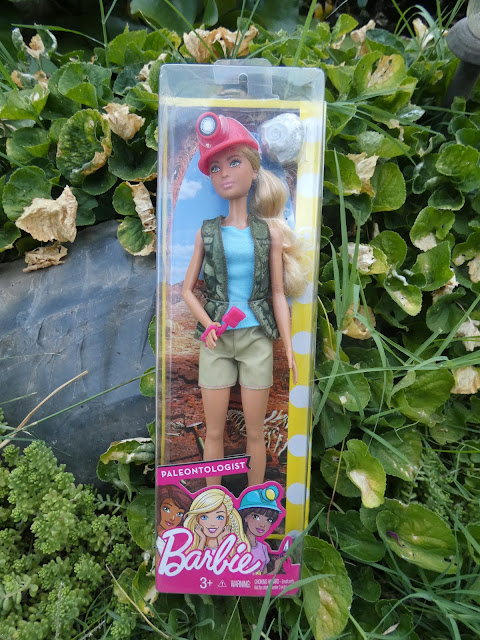
Our Newest Department Acquisition Has Arrived! Paleontologist Barbie!

21st Century Paleontologist Barbie
Be honest. If I suddenly shouted "paleontologist", what picture would occur in your mind before you give it any thought? How would this person look? What would this person be wearing? What gender or ethnicity would you see in your mind? What stereotypes lurk in your mind?

There's a story from the history annals of the geology department where I teach. In 1996, Mattel came out with a Paleontologist Barbie. Someone brought one by the lab one day, and a fascinating discussion followed. The women were just a bit brutal and offered a long list of "improvements" that would add to the authenticity of the doll. These included bruises, scrapes, and bandages for the legs, and suggestions of either deeply tangled and ratted hair from the desert wind, or hair cut very short. There should be the geologist's tan, the one caused by knee socks and short pants. The blouse most certainly did not garner kind reviews. I sort of wish that I had picked one up for the lab back then. Boxed versions of the doll are bringing in offers of $80-90 these days from resellers.
Paleontologist Barbie, 1996
One outcome of the discussions was the design of our very first Geology Club t-shirt. It was more egalitarian with both genders being described in fine detail. Somehow I managed to save one of them after all these years, which you can see below...
So we fast-forward to the present day...much about the world is changed, but Barbie lives on. I had not been following the line of Barbie dolls for at least two decades, and I was surprised to find that there is an entire line of careers for Barbie dolls and that ethnicities beyond blonde white woman are part of the line-up. It's a welcome change, but because of a Facebook discussion, I was looking for images of the ancient Barbie Doll online...and found that Paleontologist Barbie has been resurrected!
I wasn't going to make a mistake again and ordered one right away ($12.95 plus tax). It arrived this week, and I welcome your observations and suggestions about how future Paleontologist Barbie in 2050 can be improved.

My first impression about 2019 Barbie is that she is rolling her eyes in exasperation (see the first photo). This no doubt is because some supervisor is mansplaining something to her on a subject in which she is an expert. The utility vest over a blue shirt is a good change, much more efficient than a dinosaur blouse. I'm not so sure about the hardhat. I guess some fossil excavations take place in quarries, but most of my personal experiences have been in desert or prairie in the hot sun where a broad-rimmed hat makes a lot more sense. The original 1996 Barbie had a hat and a canteen.
The fossil sample was a revelation. I wasn't sure at first what to make of the fossil assemblage. As best I could tell, it's an ammonite fossil (a marine creature), along with a fern (terrestrial), and the tracks of...something. It makes no sense...except for this fact: recent news of the discovery of a dinosaur extinction/tsunami assemblage in North Dakota that included ammonite fragments along with terrestrial vegetation fossils and fragments of terrestrial animals! This specimen is amazingly prescient!

The boots seem serviceable enough, but there ought to be some thick socks. Blisters are a real problem out there in the field. I couldn't find any images of the footwear of 1996 Paleontologist Barbie.
I'm old enough and far-enough removed from the days of having a young daughter in the house that I still think of Barbie as a helpless princess, so I'm glad to find that the toy line has displayed some sensitivity to the career opportunities available for young girls of all ethnicities to dream about. I am actually going to  put the doll in the lab along with Gumby and Pokey, and a host of toy dinosaurs and other prehistoric creatures. I do in fact have children visiting in the lab on occasion, and I would like for them to be able to see themselves as geologists and paleontologists.

Monday, April 25, 2016

What's Your Favorite Stereotype of a Desert? The 2% Answer? The Dunes at Death Valley

Think of the word "desert". What''s the first picture that pops into your mind? Is it Saguaro Cacti, like an old western? Is it cliffs and spires like other old westerns? Is it a painted desert, like an old Disney movie or a Roadrunner cartoon? Or is it an endless sea of sand? At different times, I've had all those stereotypes established in my head. The California desert is the one I visit most often, and ironically, not one of those stereotypes apply in our state. Except for something less than 5% of the land surface, where sand dunes cover the landscape.
One need only to look at Death Valley itself. From a perch at the head of the Mosaic Canyon fan (above), one can see forty miles or more to the north and little in the way of dunes is visible. It's the same for the southern part of the valley, where salt is the dominant surface material. Or alluvial fans. Or the clay deposits of dry lakes. Dunes occur only where Tucki Mountain sticks out into the valley, interrupting the flow of wind currents that scream down the valley floor from the north.
The Mesquite Flat Dunes, or Death Valley Dunes, are perhaps the most famous dune field in the American West (although supporters of the dunes at White Sands in New Mexico or Great Sand Dunes in Colorado might argue the point). If you have seen CP30 and R2D2 wandering across dunes in the original "Star Wars", you've seen the dunes of Death Valley. It doesn't hurt that they are probably the most easily accessible dunes in the California desert.
And what a backdrop! The Grapevine Mountains rise thousands of feet above the sinuous ridges of sand. The dunes are not all that tall, only a hundred feet or so, but the field is several miles across, and are easy to explore.
There is a certain sensuousness about the dunes, a smoothness that belies the harsh ruggedness of other desert landscapes. It's the only place I can think of where I could imagine walking without shoes (as long as the day isn't too hot!), and the only place I could imagine laying down without carefully inspecting the ground first (there are lots of sharp and poisonous things on other parts of desert floor). It's also one of the few places I feel comfortable hiking at night without a flashlight. It's a marvelous experience to walk up and down the dune slopes, feeling the change in the temperature and humidity. In moonlight, it can be downright magical. 
The dune sands are composed of small grains of quartz and feldspar. The grains start as mudflows and flashfloods coming off the mountains that tower over the valley floor. Winds carry away the finer dust particles, and leave behind the larger pebbles and boulders. During windstorms, the sand bounces along the desert floor, a process called saltation. The grains rarely bounce more than three feet off the desert floor, a fact that I can attest to, based on the experience of standing in a violent windstorm wearing shorts. The sand was stinging my legs, but not my arms or face.
It is understandable that people might think that most desert erosion is caused by wind, but water still does most of the work. Wind can't carve deep canyons or remove mountains. But wind can be distinctive force in moving sediments around on the desert floor, and forming one of the most beautiful landscapes possible.

Friday, April 5, 2013

What Does a Geologist/Earth Scientist Look Like? Let Us Know!

Look! A geologist! And he's an old white guy with a rock hammer! No stereotypes here (Photo by Mrs. Geotripper).

A post today over at Jacks of Science bemoaned the stereotypes of scientists as indicated by stock photography. Some of the pictures of "scientists" at work were a bit hilarious, but it was also a bit sobering to think that stock photography sites are the places that authors and publishers go to for pictures on just about any subject. I'm sure there are pictures of scientists that don't involve white coats and test tubes filled with colored liquids. Right?

I got curious, though. What would the stock photography sites have under the topic of "geologist"? I started scouring the stock image sites, and was pretty much unimpressed. If we are to go by these images, almost all geologists are men, and they work with oil derricks in the background. And like gold miners with their pans and jackasses, all geologists carry rock hammers. Okay, well that's true if they are in the field, but at least they use them right. There are three people, a senior man, a senior woman, and a kid who all strangely appear on just about all the sites, and all of them are holding the hammer the wrong way.

Stereotypes are sometimes true, but they are also often wrong, and limiting. What is anyone to think if the only picture we get of geologists is that they are all men and only work in the oilfields? It has taken years to convince minority and women students that there are great opportunities in the earth sciences, and some data suggest that enrollments are leveling off in some areas. At the same time a large percentage of practicing geologists are approaching retirement age and schools are not enrolling enough students to fill the expected shortfall in the coming decade. We who are employed as geologists and earth scientists should be doing whatever we can to reverse these trends.

Over at my "stock" photography site Geotripper Images (I do indeed have pictures of stocks on the site), I've opened a new category called "Geologists at Work". There is very little in it thus far, but I am asking my readers and fellow geobloggers (is 'fellow' a gender stereotype?) to consider sending over a picture of themselves or their coworkers doing geology in whatever setting. My goal is to have pictures that show the wide variety of careers in geology and the earth sciences, and if they can show up in an image search, maybe folks (especially young students working on career-type projects) can get a better impression of what geologists do.

The pictures on my photography site are free for use in educational projects and non-profit publications, but I ask for payment if the photographs are to be used in profit-making publications and textbooks. If you donate a photo, you will retain all copyright privileges, and if I am ever contacted by a publisher who wants to use your photo, I will refer them to you.

If you would like to submit a photograph, make sure whoever is in the photo is okay with it being posted, and send it to me at hayesg (at) mjc.edu. I will try to post it as soon as possible. Thanks for your assistance!

Speaking of stereotypes, check out the story of my own attempt at drawing a "geologist at work":
For a description of all the aspects of being a geology student, check out: http://geotripper.blogspot.com/2009/03/fully-equipped-geology-student.html