A geologist, a biologist and a pair of lawyers were out in a boat fishing one day. The lawyers were arguing back and forth about a case they were fighting in court. It went on and on. The two scientists looked at one lawyer and then the other, and then at each other, rolled their eyes, and got out of the boat and walked to shore. Right over the water. Without getting wet. The lawyers were astonished. They stopped arguing, and jumped off the boat, intending to walk to shore like the scientists, but landed in water up to their necks. They made it the shore, but were soaked in mud. "How did you stay dry?", they asked the scientists. "We stood on the rocks", came the reply.
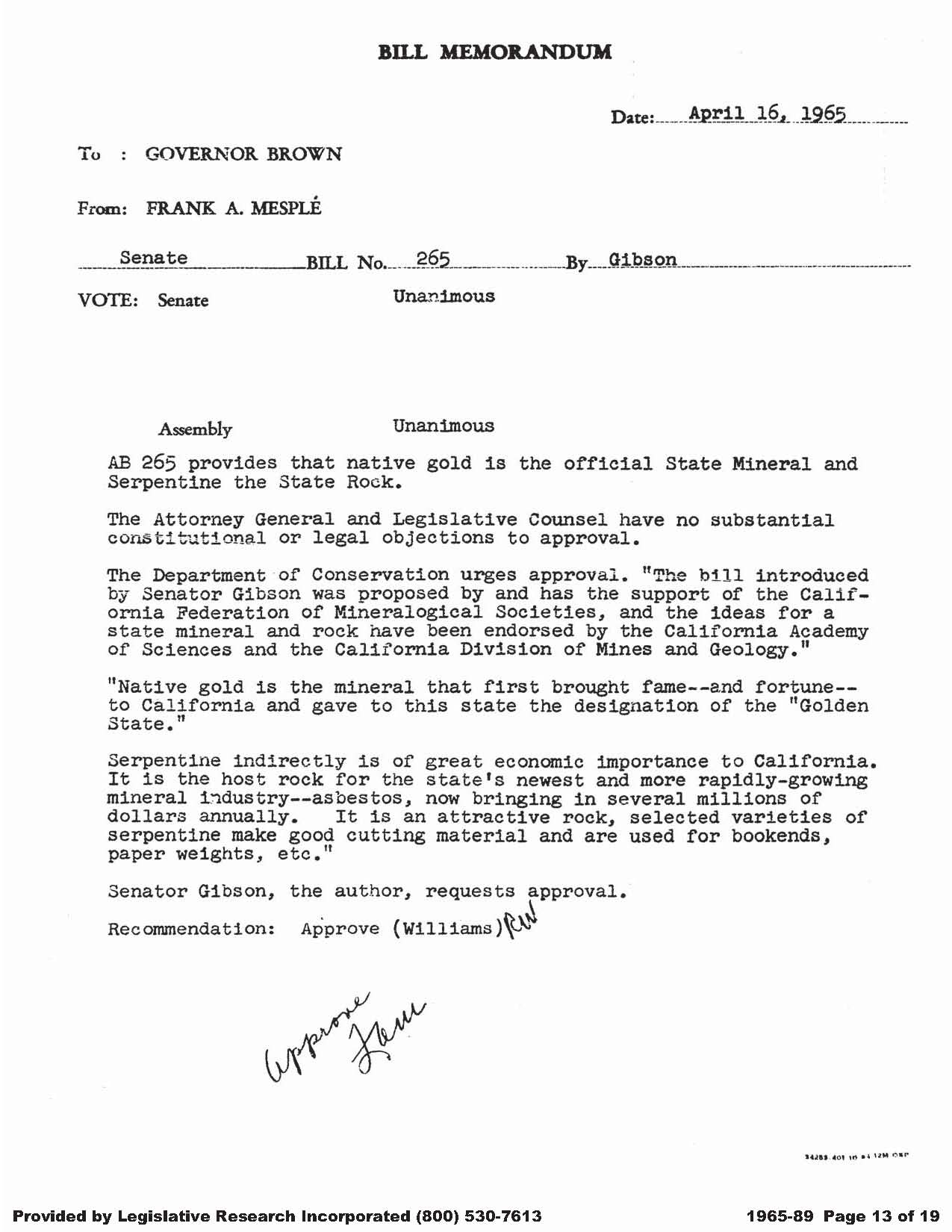
O.K., a really bad joke, but its the best I can do on short notice. Senate Bill 624, which is on the floor of the California State Assembly along with several hundred other bills that must be acted on by August 31st, would remove serpentine's standing as the California's state rock. I've mentioned the possible legal consequences of the legislation, but not being a lawyer, I don't really know. The sponsor of the original legislation assures me that the original intent of the bill was not legal. I'm going to take her at her word on this, but the fact is the bill will have deep legal implications whether they were intended or not. How can I know this, if I am not a lawyer?
The answer is pretty straightforward. There are lawyers arguing vociferously about Senate Bill 624. There are lawyers listed in the Assembly analysis as supporting the bill. There are legal organizations who have stated in no uncertain terms that they are opposed. The sponsors of the bill say their sponsorship dates to 2007. I take their word on this. But other lawyer organizations have been pushing this concept from as early as 2004. How could they be interested in whether California has a state rock or not? Really, why would a bunch of lawyers care about a rock? That's the $70 billion dollar question (yes, that's how much is at stake). The answer? Asbestos. Yeah, that stuff, the inflammable stuff that can cause cancer, the subject of tens of thousands of lawsuits across the country. Serpentine is a rock that sometimes contains chrysotile asbestos, one of six different varieties of asbestos (amphibole asbestos is the really dangerous stuff).
I wrote early on about my concerns about how this legislation came about: the tactics looked suspicious, the sponsor list was full of organizations that had a possible financial stake in the legislation, and most importantly, no one in the natural science community was consulted. No geologists, no biologists, no educators; the very people who use the state symbols as part of the educational process. This is the reason that we went public with our objections, and I like to think that this is the reason the story has caught on in the media over the last month (See the Silver Fox compilation of news stories here). And I argue now that the legislature needs to hear in no uncertain terms from the scientists and educators. Why? Because I and the other bloggers who have been raising objections don't have a financial stake in the outcome. Our goal from the start has been education.
I don't like lawyers telling my colleagues in press releases and tweets to "go at it", and I don't like lawyers telling me "to be careful who one associates with". I would prefer that lawyers weren't involved at all. They've got their millions of dollars at stake, and they have dozens, if not hundreds of lobbyists in Sacramento who have the ears of our legislators. I have a few new friends in the blogosphere and some samples of serpentine that I use in a classroom discussion. As a citizen in a democracy, I want to be heard in Sacramento too. It tells me so much that I sent information about serpentine to all 80 assembly members expressing my scientific concerns, offering to answer any questions they might have. I received two form letters in response.
Take your stand on a rock! Time is short. Your voice needs to be heard now, even if you've written before. Call your assembly person first (find who your rep is here), then your senator, and then call the governor. The following is the list I posted a few weeks ago about why serpentine is an appropriate symbol for our state.
Be cordial, we want to educate people who may not know a great deal about geology and biology!
• Serpentine, or more properly serpentinite, is a rock made up of as many as 20 different minerals. It is found in at least 42 of California’s 58 counties, and makes up a significant part of the Sierra Nevada Mother Lode, the Klamath Mountains, and the California Coast Ranges. It is a relatively common rock in California and rare in most other parts of the country.
• The rock is variable in color, ranging from deep jade-green to black or blue. It often displays polished surfaces due to its mode of emplacement along fault zones. The minerals making up serpentine are complex magnesium iron silicates with varying amounts of heavy metals such as chromium, mercury, nickel, and cobalt.
• Serpentinite is derived from the metamorphism (alteration by addition of heat and water) of peridotite and other ultramafic rocks from the Earth’s mantle. As such, serpentinite provides researchers a window into the deep crustal and mantle processes of the planet.
• Serpentinite is often brought to the Earth’s surface by forces related to subduction zones. Subduction occurs when oceanic crust containing ultramafic rock is driven beneath oceanic or continental crust where it is partially melted to form volcanic rock, like that seen in the Cascades volcanoes like Mt. Shasta; or plutonic rock like the granite seen in the Sierra Nevada, the Peninsular Ranges, or the Mojave Desert.
• Serpentinite and related ultramafic rocks have served as an ore for numerous valuable minerals, including chromite, mercury, magnesite, platinum, nickel, and cobalt. Many of these minerals are exceedingly rare, and most must be imported from foreign sources.
• Serpentine is used as a colorful ornamental stone, in sculpture, in carved jewelry, and in buildings. Jade is sometimes found in association with serpentine, and the world’s only source of California’s state gemstone benitoite is a serpentine deposit in the California Coast Ranges.
• Soils developed on serpentine are rich in heavy metals like chromium, nickel, and cobalt, and depleted in essential nutrients such as nitrogen, potassium, and phosphorus. As a result, plants growing in these soils are highly adapted, and about 10% of California’s endemic species are found in serpentine areas, even though the rock covers only about 1% of the land area of the state.
• Serpentines and related rocks are increasingly viewed as a possible repository for sequestering carbon dioxide (CO2), because these rocks can chemically combine to fix the CO2 in the solid mineral magnesite (magnesium carbonate). Serpentine may thus play an important role in global efforts to control greenhouse emissions and climate change.
• Serpentine was chosen as the state rock of in part to promote a growing asbestos mining industry and to promote serpentine’s use as ornamental stone, but the law itself does not mention these things, and asbestos has not been mined in the state since 2002. The original promoters of serpentine had little knowledge of the educational value of the rock they chose as a state symbol.
For more information about California’s state rock, check out:
http://www.consrv.ca.gov/CGS/information/publications/cgs_notes/note_14/note_14.pdf
http://www.conservation.ca.gov/cgs/information/publications/cgs_notes/note_14/Pages/Index.aspx
And here, as concisely as possible is what is factually wrong with Senate Bill 624:
Summary: Senate Bill 624 seeks to remove serpentine as the state rock of California. The language of the bill includes statements about serpentine that are inaccurate. Some argue that if enacted into law these statements could be legally actionable. This bill has not received the appropriate and necessary scrutiny that is needed to produce scientifically accurate and binding statements of law. Unless there is a transparent and complete investigation of the implications of the language of the bill, the legislature should consider tabling or voting down Senate Bill 624.
The current state rock, serpentine, is not the cause of mesothelioma in the state of California or anywhere else. Serpentine is an interesting and valuable rock that has an important role in education about California history, geology, biology, and environmental science. Chrysotile asbestos is sometimes found in serpentine. It is human use and abuse of asbestos in its many forms that has exposed people to the dangers of the material.
Statements from the bill are shown in bolded text below.
SECTION 1. The Legislature finds and declares the following:
(b) Serpentine contains the deadly mineral chrysotile asbestos, a known carcinogen, exposure to which increases the risk of the cancer mesothelioma.
This statement makes an improper connection between serpentine and mesothelioma. Exposure to serpentine does not cause mesothelioma. Mesothelioma is caused by exposure to any of the six forms of asbestos, and the vast majority of cases are related to workplace environments, not natural ones. Chrysotile asbestos is sometimes found in serpentine, but serpentine is not asbestos, and as such, should not be branded a known carcinogen in legislation. The use of the word “deadly” in the legislation is inflammatory.
(c) California has the highest rate of mesothelioma deaths in the nation.
This statement is factually and scientifically incorrect. The rate of mesothelioma deaths in California is 11.0 per million residents, according to the Centers for Disease Control (1999-2005). This number is slightly below the national average of 11.7 per million. In states like Maine, Wyoming, West Virginia, Pennsylvania, New Jersey and Washington, the death rate exceeds 20 per million residents. California has the greatest number of deaths, but that is a simple function of having the greatest population of any state.
(d) California should not designate a rock known to be toxic to the health of its residents as the state's official rock.
This statement is factually wrong. Serpentine is not toxic. A mineral that is found in the rock, chrysotile, in its asbestos form, has been shown to be dangerous when improperly utilized. Almost any rock contains ores that can be dangerous, including the ores that produce gold, our state mineral. It is the role of state and national regulatory agencies to identify areas that might contain dangerous minerals, and practices that might expose people to hazards, and regulate those activities. Numerous laws already exist that regulate the exposure of citizens to asbestos materials.
There is an appropriate place for discussing the dangers of asbestos, and how the state can best protect its citizens from dangerous exposure levels. A bill to remove the designation of serpentine as the state rock is not the appropriate venue, and is instead a detriment to proper education about asbestos.
The entire text of SB624 can be found here: http://leginfo.ca.gov/pub/09-10/bill/sen/sb_0601-0650/sb_624_bill_20100623_amended_asm_v96.html
O.K., a really bad joke, but its the best I can do on short notice. Senate Bill 624, which is on the floor of the California State Assembly along with several hundred other bills that must be acted on by August 31st, would remove serpentine's standing as the California's state rock. I've mentioned the possible legal consequences of the legislation, but not being a lawyer, I don't really know. The sponsor of the original legislation assures me that the original intent of the bill was not legal. I'm going to take her at her word on this, but the fact is the bill will have deep legal implications whether they were intended or not. How can I know this, if I am not a lawyer?
The answer is pretty straightforward. There are lawyers arguing vociferously about Senate Bill 624. There are lawyers listed in the Assembly analysis as supporting the bill. There are legal organizations who have stated in no uncertain terms that they are opposed. The sponsors of the bill say their sponsorship dates to 2007. I take their word on this. But other lawyer organizations have been pushing this concept from as early as 2004. How could they be interested in whether California has a state rock or not? Really, why would a bunch of lawyers care about a rock? That's the $70 billion dollar question (yes, that's how much is at stake). The answer? Asbestos. Yeah, that stuff, the inflammable stuff that can cause cancer, the subject of tens of thousands of lawsuits across the country. Serpentine is a rock that sometimes contains chrysotile asbestos, one of six different varieties of asbestos (amphibole asbestos is the really dangerous stuff).
I wrote early on about my concerns about how this legislation came about: the tactics looked suspicious, the sponsor list was full of organizations that had a possible financial stake in the legislation, and most importantly, no one in the natural science community was consulted. No geologists, no biologists, no educators; the very people who use the state symbols as part of the educational process. This is the reason that we went public with our objections, and I like to think that this is the reason the story has caught on in the media over the last month (See the Silver Fox compilation of news stories here). And I argue now that the legislature needs to hear in no uncertain terms from the scientists and educators. Why? Because I and the other bloggers who have been raising objections don't have a financial stake in the outcome. Our goal from the start has been education.
I don't like lawyers telling my colleagues in press releases and tweets to "go at it", and I don't like lawyers telling me "to be careful who one associates with". I would prefer that lawyers weren't involved at all. They've got their millions of dollars at stake, and they have dozens, if not hundreds of lobbyists in Sacramento who have the ears of our legislators. I have a few new friends in the blogosphere and some samples of serpentine that I use in a classroom discussion. As a citizen in a democracy, I want to be heard in Sacramento too. It tells me so much that I sent information about serpentine to all 80 assembly members expressing my scientific concerns, offering to answer any questions they might have. I received two form letters in response.
Take your stand on a rock! Time is short. Your voice needs to be heard now, even if you've written before. Call your assembly person first (find who your rep is here), then your senator, and then call the governor. The following is the list I posted a few weeks ago about why serpentine is an appropriate symbol for our state.
Be cordial, we want to educate people who may not know a great deal about geology and biology!
• Serpentine, or more properly serpentinite, is a rock made up of as many as 20 different minerals. It is found in at least 42 of California’s 58 counties, and makes up a significant part of the Sierra Nevada Mother Lode, the Klamath Mountains, and the California Coast Ranges. It is a relatively common rock in California and rare in most other parts of the country.
• The rock is variable in color, ranging from deep jade-green to black or blue. It often displays polished surfaces due to its mode of emplacement along fault zones. The minerals making up serpentine are complex magnesium iron silicates with varying amounts of heavy metals such as chromium, mercury, nickel, and cobalt.
• Serpentinite is derived from the metamorphism (alteration by addition of heat and water) of peridotite and other ultramafic rocks from the Earth’s mantle. As such, serpentinite provides researchers a window into the deep crustal and mantle processes of the planet.
• Serpentinite is often brought to the Earth’s surface by forces related to subduction zones. Subduction occurs when oceanic crust containing ultramafic rock is driven beneath oceanic or continental crust where it is partially melted to form volcanic rock, like that seen in the Cascades volcanoes like Mt. Shasta; or plutonic rock like the granite seen in the Sierra Nevada, the Peninsular Ranges, or the Mojave Desert.
• Serpentinite and related ultramafic rocks have served as an ore for numerous valuable minerals, including chromite, mercury, magnesite, platinum, nickel, and cobalt. Many of these minerals are exceedingly rare, and most must be imported from foreign sources.
• Serpentine is used as a colorful ornamental stone, in sculpture, in carved jewelry, and in buildings. Jade is sometimes found in association with serpentine, and the world’s only source of California’s state gemstone benitoite is a serpentine deposit in the California Coast Ranges.
• Soils developed on serpentine are rich in heavy metals like chromium, nickel, and cobalt, and depleted in essential nutrients such as nitrogen, potassium, and phosphorus. As a result, plants growing in these soils are highly adapted, and about 10% of California’s endemic species are found in serpentine areas, even though the rock covers only about 1% of the land area of the state.
• Serpentines and related rocks are increasingly viewed as a possible repository for sequestering carbon dioxide (CO2), because these rocks can chemically combine to fix the CO2 in the solid mineral magnesite (magnesium carbonate). Serpentine may thus play an important role in global efforts to control greenhouse emissions and climate change.
• Serpentine was chosen as the state rock of in part to promote a growing asbestos mining industry and to promote serpentine’s use as ornamental stone, but the law itself does not mention these things, and asbestos has not been mined in the state since 2002. The original promoters of serpentine had little knowledge of the educational value of the rock they chose as a state symbol.
For more information about California’s state rock, check out:
http://www.consrv.ca.gov/CGS/information/publications/cgs_notes/note_14/note_14.pdf
http://www.conservation.ca.gov/cgs/information/publications/cgs_notes/note_14/Pages/Index.aspx
And here, as concisely as possible is what is factually wrong with Senate Bill 624:
Summary: Senate Bill 624 seeks to remove serpentine as the state rock of California. The language of the bill includes statements about serpentine that are inaccurate. Some argue that if enacted into law these statements could be legally actionable. This bill has not received the appropriate and necessary scrutiny that is needed to produce scientifically accurate and binding statements of law. Unless there is a transparent and complete investigation of the implications of the language of the bill, the legislature should consider tabling or voting down Senate Bill 624.
The current state rock, serpentine, is not the cause of mesothelioma in the state of California or anywhere else. Serpentine is an interesting and valuable rock that has an important role in education about California history, geology, biology, and environmental science. Chrysotile asbestos is sometimes found in serpentine. It is human use and abuse of asbestos in its many forms that has exposed people to the dangers of the material.
Statements from the bill are shown in bolded text below.
SECTION 1. The Legislature finds and declares the following:
(b) Serpentine contains the deadly mineral chrysotile asbestos, a known carcinogen, exposure to which increases the risk of the cancer mesothelioma.
This statement makes an improper connection between serpentine and mesothelioma. Exposure to serpentine does not cause mesothelioma. Mesothelioma is caused by exposure to any of the six forms of asbestos, and the vast majority of cases are related to workplace environments, not natural ones. Chrysotile asbestos is sometimes found in serpentine, but serpentine is not asbestos, and as such, should not be branded a known carcinogen in legislation. The use of the word “deadly” in the legislation is inflammatory.
(c) California has the highest rate of mesothelioma deaths in the nation.
This statement is factually and scientifically incorrect. The rate of mesothelioma deaths in California is 11.0 per million residents, according to the Centers for Disease Control (1999-2005). This number is slightly below the national average of 11.7 per million. In states like Maine, Wyoming, West Virginia, Pennsylvania, New Jersey and Washington, the death rate exceeds 20 per million residents. California has the greatest number of deaths, but that is a simple function of having the greatest population of any state.
(d) California should not designate a rock known to be toxic to the health of its residents as the state's official rock.
This statement is factually wrong. Serpentine is not toxic. A mineral that is found in the rock, chrysotile, in its asbestos form, has been shown to be dangerous when improperly utilized. Almost any rock contains ores that can be dangerous, including the ores that produce gold, our state mineral. It is the role of state and national regulatory agencies to identify areas that might contain dangerous minerals, and practices that might expose people to hazards, and regulate those activities. Numerous laws already exist that regulate the exposure of citizens to asbestos materials.
There is an appropriate place for discussing the dangers of asbestos, and how the state can best protect its citizens from dangerous exposure levels. A bill to remove the designation of serpentine as the state rock is not the appropriate venue, and is instead a detriment to proper education about asbestos.
The entire text of SB624 can be found here: http://leginfo.ca.gov/pub/09-10/bill/sen/sb_0601-0650/sb_624_bill_20100623_amended_asm_v96.html
The history, Assembly floor analysis, and current status of SB624 can be found here: http://totalcapitol.com/?bill_id=200920100SB624
The Centers for Disease Control cancer statistics site can be found here: http://wonder.cdc.gov/cancer-v2002.HTML
And there you have it. I am sorry for the long post, but things are coming to a head very soon.