Showing posts with label Senate Bill 624. Show all posts

Thursday, August 12, 2010

California Serpentine: To Assembly Member Lieu - A Question of Openness and Fairness


Senate Bill 624 in the California legislature calls for serpentine to be removed as the state rock of California. The bill is in the Assembly, and if passed there, will move on to the Senate, where it will be voted on by August 31. I and many other bloggers, geologists, biologists, mineral collectors, and teachers have objected to the bill (see here for my posts on the subject, and the Silver Fox compilation of media reports). There are many important reasons to oppose the bill, and the problem at this juncture is that the Assembly members simply do not have the time to hear and consider what we have to say. They must act on 300 bills in the next two weeks. This is no way to pass smart legislation.

Assemblyman Ted Lieu is the floor manager for SB624 (His website and contact information are here). I am calling on Assemblyman Lieu to please consider withdrawing his sponsorship of this bill. There has not been a full discussion in the Assembly of the possible problems with this bill, and opponents have not had the time or opportunity to express our views. Only one witness spoke at the assembly hearing on the bill, and the opponents (there are many) are not listed in the Assembly analysis of the bill. It is a matter of fairness. Removing a valid state symbol is a serious issue, and should not happen at the behest of a single constituency without a full hearing of all of those concerned.

I have offered an alternative approach that would meet the goals of both sides of the issue of serpentine as a state rock. Our Assembly people need to know that such alternatives exist, but they won't hear anything in the crush of legislative battles taking place this month in Sacramento. Please contact Assemblyman Lieu today.

Tuesday, August 10, 2010

Standing on a Rock: Why the California Legislature Needs to Hear From Educators, Students and Scientists


A geologist, a biologist and a pair of lawyers were out in a boat fishing one day. The lawyers were arguing back and forth about a case they were fighting in court. It went on and on. The two scientists looked at one lawyer and then the other, and then at each other, rolled their eyes, and got out of the boat and walked to shore. Right over the water. Without getting wet. The lawyers were astonished. They stopped arguing, and jumped off the boat, intending to walk to shore like the scientists, but landed in water up to their necks. They made it the shore, but were soaked in mud. "How did you stay dry?", they asked the scientists. "We stood on the rocks", came the reply.

O.K., a really bad joke, but its the best I can do on short notice. Senate Bill 624, which is on the floor of the California State Assembly along with several hundred other bills that must be acted on by August 31st, would remove serpentine's standing as the California's state rock. I've mentioned the possible legal consequences of the legislation, but not being a lawyer, I don't really know. The sponsor of the original legislation assures me that the original intent of the bill was not legal. I'm going to take her at her word on this, but the fact is the bill will have deep legal implications whether they were intended or not. How can I know this, if I am not a lawyer?

The answer is pretty straightforward. There are lawyers arguing vociferously about Senate Bill 624. There are lawyers listed in the Assembly analysis as supporting the bill. There are legal organizations who have stated in no uncertain terms that they are opposed. The sponsors of the bill say their sponsorship dates to 2007. I take their word on this. But other lawyer organizations have been pushing this concept from as early as 2004. How could they be interested in whether California has a state rock or not? Really, why would a bunch of lawyers care about a rock? That's the $70 billion dollar question (yes, that's how much is at stake). The answer? Asbestos. Yeah, that stuff, the inflammable stuff that can cause cancer, the subject of tens of thousands of lawsuits across the country. Serpentine is a rock that sometimes contains chrysotile asbestos, one of six different varieties of asbestos (amphibole asbestos is the really dangerous stuff).

I wrote early on about my concerns about how this legislation came about: the tactics looked suspicious, the sponsor list was full of organizations that had a possible financial stake in the legislation, and most importantly, no one in the natural science community was consulted. No geologists, no biologists, no educators; the very people who use the state symbols as part of the educational process. This is the reason that we went public with our objections, and I like to think that this is the reason the story has caught on in the media over the last month (See the Silver Fox compilation of news stories here). And I argue now that the legislature needs to hear in no uncertain terms from the scientists and educators. Why? Because I and the other bloggers who have been raising objections don't have a financial stake in the outcome. Our goal from the start has been education.

I don't like lawyers telling my colleagues in press releases and tweets to "go at it", and I don't like lawyers telling me "to be careful who one associates with". I would prefer that lawyers weren't involved at all. They've got their millions of dollars at stake, and they have dozens, if not hundreds of lobbyists in Sacramento who have the ears of our legislators. I have a few new friends in the blogosphere and some samples of serpentine that I use in a classroom discussion. As a citizen in a democracy, I want to be heard in Sacramento too. It tells me so much that I sent information about serpentine to all 80 assembly members expressing my scientific concerns, offering to answer any questions they might have. I received two form letters in response.

Take your stand on a rock! Time is short. Your voice needs to be heard now, even if you've written before. Call your assembly person first (find who your rep is here), then your senator, and then call the governor. The following is the list I posted a few weeks ago about why serpentine is an appropriate symbol for our state.

Be cordial, we want to educate people who may not know a great deal about geology and biology!

• Serpentine, or more properly serpentinite, is a rock made up of as many as 20 different minerals. It is found in at least 42 of California’s 58 counties, and makes up a significant part of the Sierra Nevada Mother Lode, the Klamath Mountains, and the California Coast Ranges. It is a relatively common rock in California and rare in most other parts of the country.

• The rock is variable in color, ranging from deep jade-green to black or blue. It often displays polished surfaces due to its mode of emplacement along fault zones. The minerals making up serpentine are complex magnesium iron silicates with varying amounts of heavy metals such as chromium, mercury, nickel, and cobalt.

• Serpentinite is derived from the metamorphism (alteration by addition of heat and water) of peridotite and other ultramafic rocks from the Earth’s mantle. As such, serpentinite provides researchers a window into the deep crustal and mantle processes of the planet.

• Serpentinite is often brought to the Earth’s surface by forces related to subduction zones. Subduction occurs when oceanic crust containing ultramafic rock is driven beneath oceanic or continental crust where it is partially melted to form volcanic rock, like that seen in the Cascades volcanoes like Mt. Shasta; or plutonic rock like the granite seen in the Sierra Nevada, the Peninsular Ranges, or the Mojave Desert.

• Serpentinite and related ultramafic rocks have served as an ore for numerous valuable minerals, including chromite, mercury, magnesite, platinum, nickel, and cobalt. Many of these minerals are exceedingly rare, and most must be imported from foreign sources.

• Serpentine is used as a colorful ornamental stone, in sculpture, in carved jewelry, and in buildings. Jade is sometimes found in association with serpentine, and the world’s only source of California’s state gemstone benitoite is a serpentine deposit in the California Coast Ranges.

• Soils developed on serpentine are rich in heavy metals like chromium, nickel, and cobalt, and depleted in essential nutrients such as nitrogen, potassium, and phosphorus. As a result, plants growing in these soils are highly adapted, and about 10% of California’s endemic species are found in serpentine areas, even though the rock covers only about 1% of the land area of the state.

• Serpentines and related rocks are increasingly viewed as a possible repository for sequestering carbon dioxide (CO2), because these rocks can chemically combine to fix the CO2 in the solid mineral magnesite (magnesium carbonate). Serpentine may thus play an important role in global efforts to control greenhouse emissions and climate change.

• Serpentine was chosen as the state rock of in part to promote a growing asbestos mining industry and to promote serpentine’s use as ornamental stone, but the law itself does not mention these things, and asbestos has not been mined in the state since 2002. The original promoters of serpentine had little knowledge of the educational value of the rock they chose as a state symbol.

For more information about California’s state rock, check out:
http://www.consrv.ca.gov/CGS/information/publications/cgs_notes/note_14/note_14.pdf

http://www.conservation.ca.gov/cgs/information/publications/cgs_notes/note_14/Pages/Index.aspx

And here, as concisely as possible is what is factually wrong with Senate Bill 624:

Summary: Senate Bill 624 seeks to remove serpentine as the state rock of California. The language of the bill includes statements about serpentine that are inaccurate. Some argue that if enacted into law these statements could be legally actionable. This bill has not received the appropriate and necessary scrutiny that is needed to produce scientifically accurate and binding statements of law. Unless there is a transparent and complete investigation of the implications of the language of the bill, the legislature should consider tabling or voting down Senate Bill 624.

The current state rock, serpentine, is not the cause of mesothelioma in the state of California or anywhere else. Serpentine is an interesting and valuable rock that has an important role in education about California history, geology, biology, and environmental science. Chrysotile asbestos is sometimes found in serpentine. It is human use and abuse of asbestos in its many forms that has exposed people to the dangers of the material.

Statements from the bill are shown in bolded text below.

SECTION 1. The Legislature finds and declares the following:

(b) Serpentine contains the deadly mineral chrysotile asbestos, a known carcinogen, exposure to which increases the risk of the cancer mesothelioma.

This statement makes an improper connection between serpentine and mesothelioma. Exposure to serpentine does not cause mesothelioma. Mesothelioma is caused by exposure to any of the six forms of asbestos, and the vast majority of cases are related to workplace environments, not natural ones. Chrysotile asbestos is sometimes found in serpentine, but serpentine is not asbestos, and as such, should not be branded a known carcinogen in legislation. The use of the word “deadly” in the legislation is inflammatory.

(c) California has the highest rate of mesothelioma deaths in the nation.

This statement is factually and scientifically incorrect. The rate of mesothelioma deaths in California is 11.0 per million residents, according to the Centers for Disease Control (1999-2005). This number is slightly below the national average of 11.7 per million. In states like Maine, Wyoming, West Virginia, Pennsylvania, New Jersey and Washington, the death rate exceeds 20 per million residents. California has the greatest number of deaths, but that is a simple function of having the greatest population of any state.

(d) California should not designate a rock known to be toxic to the health of its residents as the state's official rock.

This statement is factually wrong. Serpentine is not toxic. A mineral that is found in the rock, chrysotile, in its asbestos form, has been shown to be dangerous when improperly utilized. Almost any rock contains ores that can be dangerous, including the ores that produce gold, our state mineral. It is the role of state and national regulatory agencies to identify areas that might contain dangerous minerals, and practices that might expose people to hazards, and regulate those activities. Numerous laws already exist that regulate the exposure of citizens to asbestos materials.

There is an appropriate place for discussing the dangers of asbestos, and how the state can best protect its citizens from dangerous exposure levels. A bill to remove the designation of serpentine as the state rock is not the appropriate venue, and is instead a detriment to proper education about asbestos.

The entire text of SB624 can be found here: http://leginfo.ca.gov/pub/09-10/bill/sen/sb_0601-0650/sb_624_bill_20100623_amended_asm_v96.html

The history, Assembly floor analysis, and current status of SB624 can be found here: http://totalcapitol.com/?bill_id=200920100SB624

The Centers for Disease Control cancer statistics site can be found here: http://wonder.cdc.gov/cancer-v2002.HTML


And there you have it. I am sorry for the long post, but things are coming to a head very soon.

Monday, August 9, 2010

A Call for Education About Serpentine

As the California legislature prepares to vote on Senate Bill 624, it is important that our senators and assembly members know that issue is important, and that they know the full story about serpentine. To this end, I agreed to a joint statement with Linda Reinstein of the Asbestos Disease Awareness Organization and Jon Christensen of the Bill Lane Center for the American West calling for increased education on the issue. We seriously disagree about the way our goals should be accomplished, but nothing good can come from ignorance on the issue. The bill may be undergoing changes in the legislature today, so please contact your assembly member as soon as possible and let them know your views. I will be updating on the issue as I learn of any developments in the legislature.

The press release follows:

For Immediate Release

August 9, 2010

Opponents seek common ground over California state rock

Contacts:

Jon Christensen, Bill Lane Center for the American West, Stanford University, 650-759-6534, jonchristensen@stanford.edu

Linda Reinstein, Asbestos Disease Awareness Organization (ADAO), c/o ADAOMedia, Doug Larkin, 202-391-1546, media@AsbestosDiseaseAwareness.org

Garry Hayes, Modesto Junior College, 209-575-6294, hayesg@yosemite.edu

The California legislature is currently considering a bill to take the official title away from the state rock serpentine. A lively and at times angry debate has erupted online — on Twitter, Facebook, and blogs. And the unusual story has been picked up by hundreds of newspapers around the world.

But now some of the key people involved in both sides of the debate say the ruckus has gone too far. They are calling for both sides in the debate to stop throwing rhetorical stones at each other and instead use the debate over Senate Bill 624 as an opportunity to educate Californians about serpentine and asbestos, which is found in some forms of the rock.

“As this debate exploded on the internet and in the media over the past month, the arguments about serpentine have become mostly about things other than the rock itself,” said Jon Christensen, an environmental historian and executive director of the Bill Lane Center for the American West at Stanford University. “We shouldn’t be surprised. Symbols, such as a state rock, mean different things to different people. What has been surprising is how powerful this symbol is to many people, and how strongly people feel about serpentine as a symbol.”

Over the weekend, Christensen joined with Linda Reinstein and Garry Hayes, two vocal advocates on opposite sides of the state rock controversy, to try to find common ground on serpentine.

Reinstein is co-founder of the Asbestos Disease Awareness Organization (ADAO), an independent nonprofit organization dedicated to education about asbestos and support of patients and their families, which advocates for removing the official state rock designation from serpentine, because some forms of the rock contain asbestos. Hayes is a geology professor at Modesto Junior College, past president of the Far Western Section of the National Association of Geoscience Teachers, and one of the most active voices in an online campaign to retain the state rock honor for serpentine.

Reinstein and Hayes agreed the educational value of the debate about serpentine was in danger of being eclipsed by polarized political rhetoric over its official status as a symbol. Whether the bill passes or not, they agreed that education about serpentine and asbestos is important to Californians. Some serpentine contains asbestos, although hazardous asbestos fibers are not released from the rock unless it is broken up, crushed, or repeatedly disturbed. Common sense guidelines for limiting exposure to the asbestos fibers that naturally occur in some serpentine are readily available on the web.

In 2009, Reinstein said, ADAO joined efforts with The John McNamara Foundation and the Pacific Heart, Lung and Blood Institute, on a campaign to “Drop the Rock” to raise awareness about asbestos-related diseases. Reinstein’s husband died of mesothelioma. This spring, she told her story to state Senator Gloria Romero, who agreed to sponsor a bill to remove serpentine’s title as the official state rock.

“ADAO understands the geological importance of serpentine and respects its historical significance to our state,” said Reinstein. “SB 624 seeks to remove a symbolic title from a rock that represents pain and suffering for many patient and families who have been affected by asbestos-caused diseases in California, and beyond. Promoting asbestos mining was one of the many reasons for designating serpentine the state rock in 1965. Asbestos mining no longer takes place in California, and the use of asbestos in industrial processes is regulated. This is about education not litigation.”

“State symbols provide a great opportunity for education,” agreed Hayes. The geology professor would like to see serpentine remain the state rock, though he would prefer to have the name changed to the technically correct term serpentinite. Hayes said he understands and respects the concerns that Reinstein and others have about asbestos. His grandfather died of lung cancer.

“We should take this teachable moment to establish serpentinite as the state rock with a clear statement of why it is the state rock,” Hayes said. “Then every child who does a school project in the years to come about state symbols will learn about this fascinating and unique rock, and they will learn about asbestos at the same time.” Hayes said there is abundant information available about the special role that serpentine has played in helping geologists understand the geological formation of California, as well as the native plants that live on serpentine’s harsh soils.

While Reinstein and Hayes agreed to disagree about the current bill and prospects for amending it, they joined with Christensen in urging citizens to learn more about serpentine as the debate over the bill continues, and urging advocates on both sides to focus on education.

“Whether or not serpentine remains the state rock, it will remain an important part of California’s geology and history,” said Christensen, who is writing a book about serpentine. “The rock is not going anywhere. People’s understanding of serpentine is what is at stake.”

Monday, August 2, 2010

The Power of Words: The Debate over Serpentine in California

Oh, the power of words. What do you think of when you hear words like lobbyist, deadly, carcinogen, asbestos, toxic, no safe level of exposure? Words are used to influence opinion, and we are influenced in many different ways, both consciously and unconsciously, by the way words are utilized.

When I became aware of the effort to remove serpentine as California's state rock (Senate Bill 624), I was willing to accept at face value the accusation that the original bill was an effort by a mysterious "asbestos mining lobby" to promote their business. It made a certain amount of sense that a mining product that was not yet recognized as hazardous should be promoted by a state where ores were found. Now that proponents have posted their evidence of the influence of mining lobbyists, I am having some doubts. First, the accusation:

From the ADAO:

"Symbolism brings facts to life. In 1965, serpentine was designated the state rock through lobbyist pressure because of the once-lucrative asbestos mining industry in California. Serpentine is a host rock for asbestos, a human carcinogen."

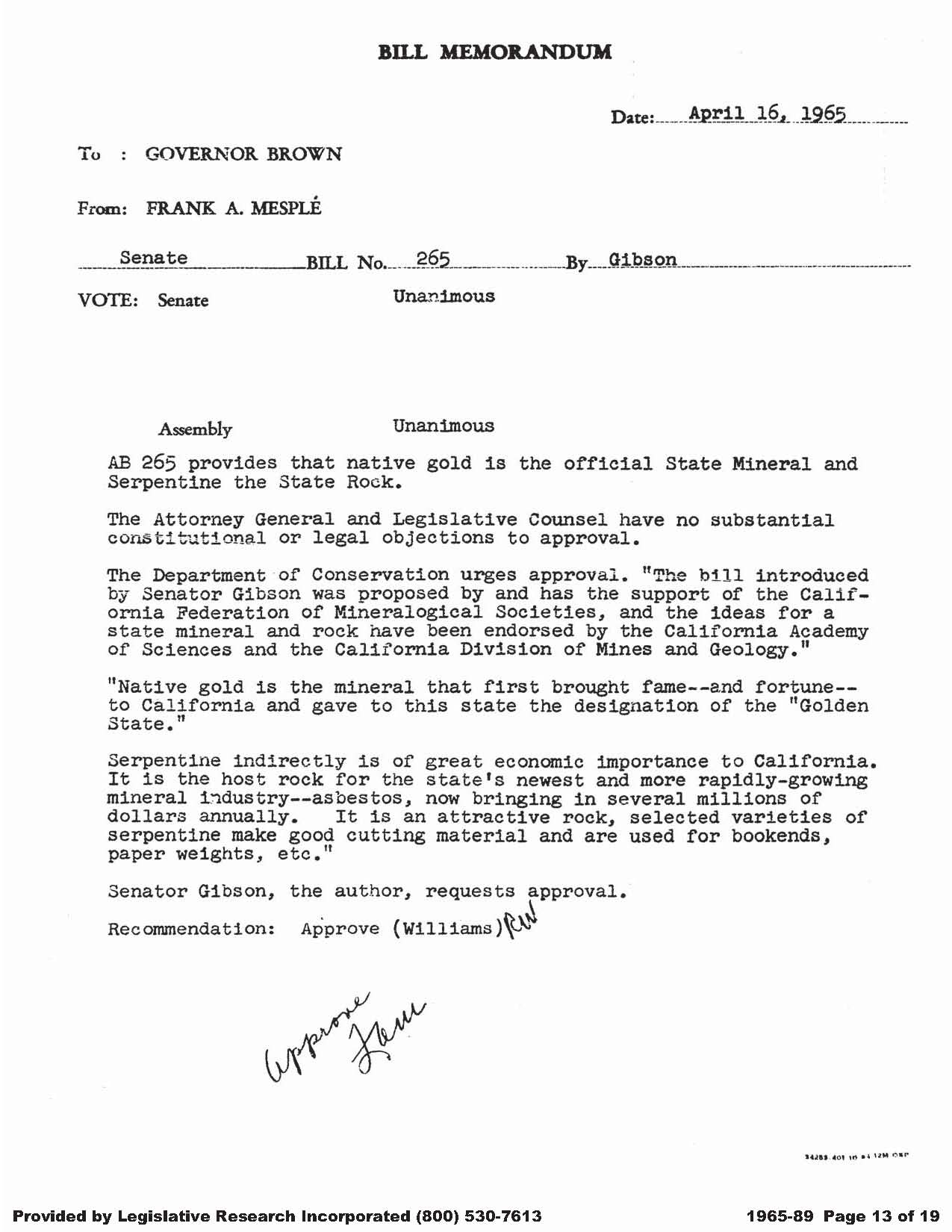
Here is their "smoking gun" evidence. From the memorandum sent to the governor in 1965 (also reproduced above), a government official is urging passage the bill. It is not part of the bill itself. Others have emphasized and italicized the line about asbestos. I am going to italicize the rest:

"The Department of Conservation urges approval. "The bill introduced by Senator Gibson was proposed by and has the support of the California Federation of Mineralogical Societies, and the ideas for a state mineral and rock have been endorsed by the California Academy of Sciences and the California Division of Mines and Geology
....
Serpentine indirectly is of great economic importance to California. It is the host rock for the state's newest and more rapidly-growing mineral industry--asbestos, now bringing in several million dollars annually. It is an attractive rock, selected varieties of serpentine make good cutting material and are used for bookends, paper weights, etc."


That's right, proposed and supported by the California Federation of Mineral Societies. Endorsed by the California Academy of Sciences, and the California Division of Mines and Geology. Asbestos mining can be interpreted in the statement above as a peripheral issue.

Then, there is the complete text of the original law (courtesy of Netstate):

"CHAPTER 89

SEC. 2. Section 425.2 is added to the Government Code to read:

425.2. Serpentine is the official State Rock and lithologic emblem."


Yup. A single line about serpentine. I leave it to you to decide, but if I were a lobbyist trying to promote asbestos mining, I would have tried to make sure that the law actually mentioned the fact. There is nothing in the law that says anything about asbestos.

Even the Senate analysis of SB 624 acknowledges that some doubt exists (the bold text is my emphasis):

"AB 265 (Gibson), Chapter 2, Statues of 1965, established serpentine as the official state rock and lithologic emblem of the state of California. The bill was unanimously passed through the state Senate and signed by Governor Edmund "Pat" Brown possibly in order to encourage the state's asbestos mining industry at the time."

I have dealt elsewhere why the statements in the Senate Bill 624 are inaccurate and misleading. Supporters of this bill constantly refer to the bill's beginnings in 1965 to justify their effort to remove our state rock. It doesn't really matter to me one way or another, because there are so many unique features about serpentine that make it an appropriate symbol, regardless of its origin. But I'm not sure now that their case is so clear-cut.

In the current debate, "lobbyist" is a word used for its negative connotation. So are the words used in Senate Bill 624: deadly, carcinogen, asbestos, toxic, "no safe level of exposure". I want to add some words to the debate that have a positive connotation: rare endemic species, wildflowers, beautiful jade-green rock, Mother Lode history, California's gemstone benitoite (found in serpentine), deep earth processes, ornamental stone. These are what serpentine is to geologists, mineralogists, biologists, environmental scientists, and anyone who is simply interested in a rock that represents a wonderfully unique state.

Thanks to Justin for the catch.

MJC students study serpentine in Del Puerto Canyon, California Coast Ranges

Sunday, August 1, 2010

Serpentine: An Update on the State Rock Debate in California


(Update: I've removed the original first paragraph of this post. I wrote it in response to a post elsewhere that has since been removed. The discourse needs to stay civil if anything is to be accomplished. I've hoped to map out a way to work together as opposed to arguing)

Call this an update about where things stand with Senate Bill 624, sponsored by State Senator Gloria Romero, which would remove serpentine as California’s state rock. Unfortunately I do not have direct knowledge of where any legislators stand on this issue. Please let me know if you hear of any public support or opposition by Assembly members. Assemblyman Wesley Chesbro of the 1st District was quoted as saying “…it’s symbolic and has very little benefit to the public and I think particularly with all of the other things the state is facing, it’s a real question”. He ended up voting for the bill in committee, but those are not the words of a strong supporter. If my understanding of the convoluted history of the bill is accurate, it has only received a total of seven votes, those of the members of the Assembly Natural Resources Committee (Chesbro, Gilmore, Brownley, De Leon, Hill, Huffman, Logue). News reports and media releases saying that the bill unanimously passed the State Senate with the current language are wrong. The bill labeled 624 that passed the Senate was about legal language concerning composting. The language in the original bill was swapped out after the vote (“gutted and amended”), and the serpentine language inserted instead. That should mean that if the bill passes the Assembly, it ought to be returned to the Senate…unless there is something very wrong with the way business is conducted in Sacramento. The Assembly Analysis is not clear on the matter. The Assembly and Senate return to session on August 2, and will be wrapping up business by August 31st. If we are to have any influence on the bill, we must contact our legislators within that time frame. Paper letters are best, phone calls are effective, and e-mails are ok, but less influential. If the bill should somehow pass, messages will need to be sent to the governor. He will have until September 30 to sign or veto the bill.

The controversy that has erupted over the bill in newspapers and websites throughout the state of California and across the nation speaks of a need to have a dialog with all of the interested parties involved with the issue. Geologists, biologists, historians, mineral collectors and teachers have raised objections over the bill, based both on the scientific inaccuracies in the bill itself, and whether there are legal implications that have not been fully explored or vetted by objective legal experts. As an educator who has worked for years teaching about serpentine, I have great concerns about what this bill would do to education and scientific awareness, whether the subject is geology, biology, botany, or public health. For this reason, I am hoping that Senator Romero will simply withdraw this bill from further consideration.

The issue of raising awareness of asbestos and the role it has in causing lung cancer and mesothelioma was the stated reason for the bill. As I read editorials from across the state (see the excellent compilation by Silver Fox at Looking for Detachment, or check my incomplete list below), the only message in the media seems to be that many scientists and teachers object to the bill because of the inaccurate scientific language, and that there are more important problems faced by the state of California. The bill will not save anyone from getting mesothelioma. The bill makes no provision for increasing awareness about asbestos and mesothelioma. In fact, if the bill passes, any "awareness" will evaporate. As I have said in nearly all of my public statements, serpentine is a rock with a rich history that is both fascinating and tragic: there is the role the rock played in the Gold Rush, its role in geological research about the Earth’s mantle and in crustal processes, the many different kinds of unique minerals that have been mined from it, and the many unique endemic plant species that grow on serpentine and nowhere else in the world. Every child doing a project on state symbols in coming decades will discover these facts about serpentine, including the fact that it sometimes contains asbestiform fibers which in industrial settings can cause serious disease. If this bill passes, the learning opportunity will be lost. I would hope that we can find common ground and consensus about how to best educate the public about serpentine and its relationship to the residents of California. An example of an alternate legislative effort might be a call from the state of California to ban the industrial use of asbestos in the United States. This would put the spotlight on the health effects of asbestos, and off of a rock that is basically harmless in a natural setting.

Several years ago Senator Romero found a rather Solomon-like solution to a controversy over another state symbol. The issue was whether Bodie or Calico should represent the state’s history as an official ghost town. Instead of picking one town over another, Senator Romero found a way to designate a state gold ghost town, and a state silver ghost town. Mining has always been a messy business with a checkered history of environmental effects and pollution problems. But she clearly recognized at the time that there was value in understanding the history of mining in the state, in both its positive and negative aspects. I am hoping Senator Romero will adopt a similar insightful stance in the present controversy over the use of the rock serpentinite as a symbol of the uniqueness of California’s geologic landscape.

Andrew Alden, Justin Zzyzx, Silver Fox, Jon Christiansen, Nishanta Rajakaruna, Malcom Ross, Eldridge Moores, and many others have been working hard to publicize this issue. I am hearing that numerous concerned scientists, researchers, and interested citizens are contacting their legislators, and that the issue is becoming well-known among legislative staffers. Your actions are having an effect! As the story fades in the media, the real work begins in the offices of the Senators and Assembly members. They are hearing your concerns (as well as the press releases of those lobbying for the bill’s passage). Keep up the good work!

This is a partial listing of some of the many stories on the issue that have run in newspapers, radio and television across the country, and even internationally:

7/9: Dan Walters: California state-rock bill has serpentine agenda, Sacramento Bee, http://www.sacbee.com/2010/07/09/2878528/dan-walters-california-state-rock.html?pageNum=3&mi_pluck_action=page_nav#Comments_Container

7/12: California Legislature Considers Throwing Out State "Rock", Ronald Bailey, Reason.com, http://reason.com/blog/2010/07/12/california-legislature-conside

7/13: Outcry as State Rock Toppled, Annette Fuentes, The Bay Citizen http://www.baycitizen.org/blogs/pulse-of-the-bay/outcry-state-rock-toppled/#comments

7/13: Romero takes on a deadly rock, Paradise Post editorial, Rick Silva http://www.paradisepost.com/opinion/ci_15499017

7/13: Pasadena Star News (Dan Walters article) http://www.pasadenastarnews.com/ci_15509970

7/14: California May Drop Its Official State Rock, Jennifer Steinhauer, New York Times http://www.nytimes.com/2010/07/14/us/14rock.html?_r=4&src=tptw

7/14: The Buzz: 'Geoblogosphere' atwitter about state rock Sacramento Bee, Fresno Bee, Torey Van Oot http://www.sacbee.com/2010/07/14/2888499/the-buzz-geoblogosphere-atwitter.html

7/15: Calif may dump 'state rock' that contains asbestos: (Trevor Hunnicutt AP), Google
http://www.google.com/hostednews/ap/article/ALeqM5hbdeSCuOvpxz0Tsk9jVInGY3UX1AD9GVD5480
(This Associated Press story ran in dozens of major newspapers across the nation, a few examples below)

MSNBC Associated Press report
CBS news, AP report

Huffington Post

7/16: California State Rock May Lose its Honored Status (Video, KCBA News, Monterey, Santa Cruz) http://www.kcba.com/Global/story.asp?S=12822028

7/16: Californian health lobby sets sights on state rock, Guy Adams, The Independent, UK
http://www.independent.co.uk/news/world/americas/californian-health-lobby-sets-sights-on-state-rock-2027724.html

7/16: Geologists protest bill to remove state rock, Peter Fimrite, San Francisco Chronicle, http://www.sfgate.com/cgi-bin/article.cgi?f=/c/a/2010/07/16/MN3T1EE9KS.DTL

7/17: My Word: Rocky stance on serpentine status as state rock (editorial by Brandon Schwab, Humboldt State geologist, Times Standard of Eureka http://www.times-standard.com/othervoices/ci_15539073

7/17: Political call to 'defrock the rock' New Zealand Herald, Guy Adams of the Independent, UK, http://www.nzherald.co.nz/government/news/article.cfmc_id=49&objectid=10659415&ref=rss

7/17: Robert Rector: A pet rock bill and other pebbles of wisdom Pasadena Star News http://www.pasadenastarnews.com/ci_15539650

7/18: Our Opinion: Between a rock and a hard place, Imperial Valley News, http://www.ivpressonline.com/articles/2010/07/18/our_opinion/ed02_07-18-10.txt

7/20: California May Defrock Its Rock Because It Contains Asbestos, Bonnie Hulkower, Treehugger.com http://www.treehugger.com/files/2010/07/california-may-defrock-rock.php

7/20: California’s Great De-Rocking Debate, editorial, New York Times http://www.nytimes.com/2010/07/21/opinion/21wed4.html

7/21: In Defense of a Rock, Nicholas Neely, High Country News, http://www.hcn.org/blogs/goat/in-defense-of-a-rock?utm_source=SPO&utm_medium=email

7/21: Serpentine: State rock no more? Asbestos may cost "incredibly cool rock" its lofty status Anthony Skeen, The Daily Triplicate, Crescent City http://www.triplicate.com/20100721109621/News/Local-News/Serpentine-State-rock-no-more

7/23: Legislator wants to roll California's official rock, James Gardner, San Francisco Business Times,
http://www.bizjournals.com/sanfrancisco/blog/2010/07/legislator_wants_to_roll_californias_official_rock.html

7/25: Between a rock and a hard place: California’s rock debate, Patt Morrison, Southern California Public Radio, includes podcast) http://www.scpr.org/programs/patt-morrison/2010/07/23/between-a-rock-and-a-hard-place-californias-rock-d/

7/27 The irrational fear of our state rock, David Ropeik, Los Angeles Times, http://www.latimes.com/news/opinion/commentary/la-oe-ropeik-risk-20100727,0,6050134.story

Sunday, July 25, 2010

Fighting For California's State Rock: What's Right With Serpentine?

California's state flower, the Golden Poppy, grows on serpentine soils at Hells Hollow on Highway 49 in California's Mother Lode. Few plants can tolerate the chemical conditions in these soils, so many endemic plants grow there and nowhere else (the poppy is an obvious exception; it is classed as serpentine-tolerant plant, but grows in many environments). This brings us to the other side of the coin. In seeking to remove serpentine as the state rock of California, supporters of the move condemn the rock as somehow evil because it contains a form of chrysotile asbestos at times. In my last post, I outlined the factual errors and inaccuracies that the bill would codify into law. If you have followed Geotripper for any length of time, you know that I prefer to talk about the wonders of geology, and I wish to do so now. There are many good reasons for keeping serpentine (or more properly serpentinite) as the state rock of California. I've gathered these items into a single fact sheet that could help legislators better understand the concerns of not only geologists, but also teachers, biologists, botanists, environmental scientists, mineral enthusiasts, and others who feel that Senate Bill 624 is a bad idea. Pop me a note if you want the word.doc.

Let the California State Assembly know this week if you want to keep our state rock. They may vote as soon as August 2. Calls are great. Letters on paper carry more weight than e-mails. Be cordial, we want to educate people who may not know a great deal about geology and biology!

• Serpentine, or more properly serpentinite, is a rock made up of as many as 20 different minerals. It is found in at least 42 of California’s 58 counties, and makes up a significant part of the Sierra Nevada Mother Lode, the Klamath Mountains, and the California Coast Ranges. It is a relatively common rock in California and rare in most other parts of the country.

• The rock is variable in color, ranging from deep jade-green to black or blue. It often displays polished surfaces due to its mode of emplacement along fault zones. The minerals making up serpentine are complex magnesium iron silicates with varying amounts of heavy metals such as chromium, mercury, nickel, and cobalt.

• Serpentinite is derived from the metamorphism (alteration by addition of heat and water) of peridotite and other ultramafic rocks from the Earth’s mantle. As such, serpentinite provides researchers a window into the deep crustal and mantle processes of the planet.

• Serpentinite is often brought to the Earth’s surface by forces related to subduction zones. Subduction occurs when oceanic crust containing ultramafic rock is driven beneath oceanic or continental crust where it is partially melted to form volcanic rock, like that seen in the Cascades volcanoes like Mt. Shasta; or plutonic rock like the granite seen in the Sierra Nevada, the Peninsular Ranges, or the Mojave Desert.

• Serpentinite and related ultramafic rocks have served as an ore for numerous valuable minerals, including chromite, mercury, magnesite, platinum, nickel, and cobalt. Many of these minerals are exceedingly rare, and most must be imported from foreign sources.

• Serpentine is used as a colorful ornamental stone, in sculpture, in carved jewelry, and in buildings. Jade is sometimes found in association with serpentine, and the world’s only source of California’s state gemstone benitoite is a serpentine deposit in the California Coast Ranges.

• Soils developed on serpentine are rich in heavy metals like chromium, nickel, and cobalt, and depleted in essential nutrients such as nitrogen, potassium, and phosphorus. As a result, plants growing in these soils are highly adapted, and about 10% of California’s endemic species are found in serpentine areas, even though the rock covers only about 1% of the land area of the state.

• Serpentines and related rocks are increasingly viewed as a possible repository for sequestering carbon dioxide (CO2), because these rocks can chemically combine to fix the CO2 in the solid mineral magnesite (magnesium carbonate). Serpentine may thus play an important role in global efforts to control greenhouse emissions and climate change.

• Serpentine was chosen as the state rock of in part to promote a growing asbestos mining industry and to promote serpentine’s use as ornamental stone, but the law itself does not mention these things, and asbestos has not been mined in the state since 2002. The original promoters of serpentine had little knowledge of the educational value of the rock they chose as a state symbol.

For more information about California’s state rock, check out:
http://www.consrv.ca.gov/CGS/information/publications/cgs_notes/note_14/note_14.pdf

http://www.conservation.ca.gov/cgs/information/publications/cgs_notes/note_14/Pages/Index.aspx

Contact Garry Hayes (Geotripper) at hayesg (at) mjc.edu

Fighting For California's State Rock: What's Wrong With Senate Bill 624?


An analysis of factual errors in Senate Bill 624. Legislators in the Assembly need to hear this in the coming week!

Summary: Senate Bill 624 seeks to remove serpentine as the state rock of California. The language of the bill includes statements about serpentine that are inaccurate. Some argue that if enacted into law these statements could be legally actionable. This bill has not received the appropriate and necessary scrutiny that is needed to produce scientifically accurate and binding statements of law. Unless there is a transparent and complete investigation of the implications of the language of the bill, the legislature should consider tabling or voting down Senate Bill 624.

The current state rock, serpentine, is not the cause of mesothelioma in the state of California or anywhere else. Serpentine is an interesting and valuable rock that has an important role in education about California history, geology, biology, and environmental science. Chrysotile asbestos is sometimes found in serpentine. It is human use and abuse of asbestos in its many forms that has exposed people to the dangers of the material.

Statements from the bill are shown in bolded text below.

SECTION 1. The Legislature finds and declares the following:

(b) Serpentine contains the deadly mineral chrysotile asbestos, a known carcinogen, exposure to which increases the risk of the cancer mesothelioma.


This statement makes an improper connection between serpentine and mesothelioma. Exposure to serpentine does not cause mesothelioma. Mesothelioma is caused by exposure to any of the six forms of asbestos, and the vast majority of cases are related to workplace environments, not natural ones. Chrysotile asbestos is sometimes found in serpentine, but serpentine is not asbestos, and as such, should not be branded a known carcinogen in legislation. The use of the word “deadly” in the legislation is inflammatory.

(c) California has the highest rate of mesothelioma deaths in the nation.

This statement is factually and scientifically incorrect. The rate of mesothelioma deaths in California is 11.0 per million residents, according to the Centers for Disease Control (1999-2005). This number is slightly below the national average of 11.7 per million. In states like Maine, Wyoming, West Virginia, Pennsylvania, New Jersey and Washington, the death rate exceeds 20 per million residents. California has the greatest number of deaths, but that is a simple function of having the greatest population of any state.

(d) California should not designate a rock known to be toxic to the health of its residents as the state's official rock.

This statement is factually wrong. Serpentine is not toxic. A mineral that is found in the rock, chrysotile, in its asbestos form, has been shown to be dangerous when improperly utilized. Almost any rock contains ores that can be dangerous, including the ores that produce gold, our state mineral. It is the role of state and national regulatory agencies to identify areas that might contain dangerous minerals, and practices that might expose people to hazards, and regulate those activities. Numerous laws already exist that regulate the exposure of citizens to asbestos materials.

There is an appropriate place for discussing the dangers of asbestos, and how the state can best protect its citizens from dangerous exposure levels. A bill to remove the designation of serpentine as the state rock is not the appropriate venue, and is instead a detriment to proper education about asbestos.

The entire text of SB624 can be found here: http://leginfo.ca.gov/pub/09-10/bill/sen/sb_0601-0650/sb_624_bill_20100623_amended_asm_v96.html

The history, Assembly floor analysis, and current status of SB624 can be found here: http://totalcapitol.com/?bill_id=200920100SB624

The Centers for Disease Control cancer statistics site can be found here: http://wonder.cdc.gov/cancer-v2002.HTML

Today's picture: a yellow flower growing on serpentine soils in Del Puerto Canyon. Someone help me identify it! I'm a geologist, not a botanist!

Sunday, July 18, 2010

California's Unique Serpentinite Landscapes: Eldridge Moores and California's State Rock

Many thanks to Sheril Kirshenbaum at Discover Blogs (the Intersection) for posting this important development in the effort to maintain serpentine as the state rock of California. Eldridge Moores is the past president of the Geological Society of America and one of the most respected researchers on California's tectonic history, including the ophiolite sequences in which serpentine is often formed. His story was a central part of John McPhee's Assembling California, one of the more influential books written about the state's geology. It was also his research that was cited in the State Assembly analysis for Senate Bill 624, so it is important to know that he opposes the effort to remove serpentine as the state rock. He offers some salient points about why serpentine is both an appropriate and unique choice for California (from Kirshenbaum's blog, working Nishanta Rajakaruna, a professor of botany at College of the Atlantic who has been working tirelessly these last few weeks getting the word out on serpentine):

-Serpentine is closely associated with gold deposits in the foothills, with the California Gold Rush, and California’s history;

-Serpentine is formed by hydration of rocks (peridotite) that come from the Earth’s mantle, the layer beneath the Earth’s crust.

-Principally, serpentines and associated rocks are part of rock suites called ophiolites that are fragments of ocean crust and mantle emplaced in continents;

-Ophiolites are widespread in California–in the Coast Ranges, the Klamath Mountains, the Sierra Nevada, along other parts of the western margin of North America, in the Appalachians, and in Latin America, Eurasia, and elsewhere. Thus these rocks are important for a full understanding of the complex evolution of the California landscape and our planet.

-Serpentines are fairly easy to identify, being mostly shiny black or green. Many serpentines are also weak rocks and prone to landslide. Having serpentine as California’s State Rock calls attention to these issues in many places; and provides a “teaching moment.”

-The asbestos in serpentine is mostly the less-harmful form, chrysotile, rather than the more dangerous form – amphibole. The latter forms by different geologic processes from a variety of rock-types;

-Having children possess samples of serpentine should not endanger their health any more than samples of many other rocks;

-Many rare species of plants grow only on serpentines, including special trees, shrubs, and non-woody plants. California is world-famous for these plants: indeed many grow only in California. These plants also provide a “teaching moment”.

-Serpentines and their original mineral, olivine are increasingly viewed as an ideal repository of carbon dioxide (CO2), because they chemically combine to fix the CO2 in the solid mineral magnesite (magnesium carbonate). This possibility is important for the future of California serpentines, for the US’s efforts to control its greenhouse emissions, and provides an additional “teaching moment” for all of us.

-Serpentine plays an important role in small movements (creep) where serpentine is present along active faults, reducing the hazard of large earthquakes.

-“Defrocking” serpentine as the California State Rock is not going to make any of these issues go away. It will, however, make it more difficult to communicate the many issues, both bad and good, to the public in California.


Time is very short; if you are concerned about this issue, a letter to your senator, assemblyperson, and governor is critical (and California teachers, geologists, biologists, historians, environmental scientists, and everyone interested in good science should be!). Please, always be polite, positive and emphasize the educational values of keeping serpentine! It's easy to be angry about something that is important to us, but not well-understood by many others, including legislators. They need to know the issues involved (and there are many).

Today's photo shows ultramafic rock in Del Puerto Canyon that has been partly serpentinized. The locality was a chromite mine that operated during both world wars. Many important ores have been mined from serpentine and associated ultramafic rocks.

Friday, July 16, 2010

California's Unique Serpentinite Landscapes 5: Doing What I Like to Do, and An Invitation!

Two of the strangest days in my life happened this week, awoke one morning to find the serpentine story on the AP wires all across the country, and awoke again on another day to find my hand in a picture on the cover of the San Francisco Chronicle. Geologists, ecologists, and biologists wanted a part in the discussion on whether to remove serpentine as the state rock, and I hope we have a place now. There is a serious need to engage and find a common ground that educates people about the scientific uniqueness of serpentine and the role it plays in California's history, geology and biology. And in public health. But that discussion can't happen if there are political ploys or even a whiff of hidden agendas, and that is what is wrong with the present bill.

To say that being involved in a political firestorm is unfamiliar ground for me is a huge understatement. Like almost every geologist I know, I would rather be on the road with my field class, pounding rocks. That didn't happen this summer because of the state budget crisis, of course. But some great things did happen in the last two days, two quick trips that reminded me of why I love doing what I do. I took a photographer for the Chronicle and a public radio reporter on a geologic tour to the center of the earth. In a manner of speaking, anyway. We drove up Del Puerto Canyon in the Coast Ranges, and quite literally drove through the muds on the ocean floor, through the oceanic crust and into the Earth's mantle. More properly, the mantle had been pushed up, and we drove up the canyon to see what it looks like.

On the way up the canyon, we passed 20,000 feet of layered sedimentary rocks, passed the dig site where California's first dinosaur was discovered, looked at landslides, old mines, and took a close look at California's state rock. It was quiet up there, there was a slight breeze, and it was hot as hell. But it felt good being a teacher.

I know what lung cancer is like. It is a horrific disease, it is a horrible way to die, and it touched my family personally. I want to honor and remember the victims of asbestos-related diseases. But the bill before the state assembly is not the way to do it.

I think there is a better way, and one that educates people, especially our children about the uniqueness of this strange rock that is found across our state. Sure, it has asbestos in it sometimes. It also sometimes contains ores of mercury. And chromium. And magnesite. And it carries a history within it of moving continents, vast ocean basins, and secrets from deep in the earth's interior.

I have no idea if anyone from State Senator Gloria Romero's office has ever read or even knows about my blog (funny thing, in all the papers around the country, but the same number of visitors to the blog!), but I would like to extend an unusual invitation to you, Senator, or any other legislator. Join me, and some biologists, and historians, and let's go to Del Puerto, or one of the other places where serpentinite can be seen. Let's talk about why it is important to the state of California.

Wednesday, July 14, 2010

California's Unique Serpentinite Landscapes 4: What can our state rock tell us about geologic processes on Mars?


It's a teachable moment; our state rock has value and is worth keeping. The following is a study of serpentine/peridotite landscapes as an analog for possible water-forming processes on Mars, of all places. I'm heading up to Del Puerto Canyon in the next few days for pictures. In the meantime, enjoy a shot in Upper Del Puerto from last spring, and see if you can wade through an abstract about research on spring water in the upper canyon:

J.G. Blank, S.J. Green, D. Blake, J.W. Valley, N.T. Kita, A. Treimand and P.F. Dobson,May 2009, An alkaline spring system within the Del Puerto Ophiolite (California, USA): A Mars analog site, Planetary and Space Science Volume 57, Issues 5-6,

Mars appears to have experienced little compositional differentiation of primitive lithosphere, and thus much of the surface of Mars is covered by mafic lavas. On Earth, mafic and ultramafic rocks present in ophiolites, oceanic crust and upper mantle that have been obducted onto land, are therefore good analogs for Mars. The characteristic mineralogy, aqueous geochemistry, and microbial communities of cold-water alkaline springs associated with these mafic and ultramafic rocks represent a particularly compelling analog for potential life-bearing systems. Serpentinization, the reaction of water with mafic minerals such as olivine and pyroxene, yields fluids with unusual chemistry (Mg–OH and Ca–OH waters with pH values up to 12), as well as heat and hydrogen gas that can sustain subsurface, chemosynthetic ecosystems. The recent observation of seeps from pole-facing crater and canyon walls in the higher Martian latitudes supports the hypothesis that even present conditions might allow for a rock-hosted chemosynthetic biosphere in near-surface regions of the Martian crust. The generation of methane within a zone of active serpentinization, through either abiogenic or biogenic processes, could account for the presence of methane detected in the Martian atmosphere. For all of these reasons, studies of terrestrial alkaline springs associated with mafic and ultramafic rocks are particularly timely. This study focuses on the alkaline Adobe Springs, emanating from mafic and ultramafic rocks of the California Coast Range, where a community of novel bacteria is associated with the precipitation of Mg–Ca carbonate cements. The carbonates may serve as a biosignature that could be used in the search for evidence of life on Mars.
Oh, those of you who drink Noah's Spring Water? It comes from a spring in the immediate vicinity. We have to watch out for water trucks sometimes up the canyon.

It is Time for a Rational and Civil Discussion on Serpentinite: A Proposal


My Grandfather was a proud and hardworking man. When the dustbowl overwhelmed so many in Oklahoma, he moved the family to Texas, and in 1943, he brought them to California, in a time when crossing the Mojave desert in summer was still a dangerous journey. They broke down, spent nearly the last of their money to repair the car enroute, but made it to the Central Valley. He and my grandmother picked cotton in Visalia-Tulare for a few years, and eventually built a home in southern California. He tended to speak little, but had a dry humor that leaked out now and then. Sure, he had flaws (we probably all idealize our grandparents), but I remember him as a good and honorable man.

Besides farming an acre or two and running a small chicken ranch, he worked in a tile factory for 20 years. He's in the picture above, along with my grandmother. Almost every day he ran a mixer for dry mineral powders with no breathing apparatus. There very well could have been asbestos mixed in with the materal he worked with. Tiles often did at the time. And he smoked.

In retrospect, it is hardly a surprise that he developed lung cancer. Lung cancer is a horrific disease, and when I saw him for the last time, this proud man was curled in a fetal position, barely conscious, and filled with painkillers. He died a few short weeks later. It's no way to die.

You need to know this about my family heritage before speculating about my motives in arguing against the California Senate Bill 624 that would strip serpentine's status as the state rock. A group involved in this kerfuffle has quoted statements I made in my blog, but that does not mean I agree with their goals. I don't.

It's time to find some common ground. Some of the families affected by mesothelioma and lung cancer caused by exposure to asbestos feel insulted by the history that led to serpentine being established as the state rock in 1965. It must be acknowledged by all of us that supporters at the time emphasized serpentine as a source of asbestos, seen as a lucrative mineable natural resource. This is the history, and I have now seen it brought up a number of times as a defense for the "drop the rock" campaign. But times changed, and so did our understanding of the truly unique nature of serpentine and what it tells us about the earth's interior and history.

There are no longer any asbestos mines operating in California. And I don't know of a single educator who thinks asbestos is a wonder mineral that should be promoted by the state. But serpentine is not asbestos. It is a rock that sometimes contains a form of asbestos (chrysotile, in an asbestiform crystal habit). But for reasons discussed in many places across the geoblogosphere (good examples are here, here and here) serpentine is a unique rock that exemplifies the strange and wonderful geological processes that have formed the Sierra Nevada, the Klamath Mountains, and the Coast Ranges, as well as the unique biomes and endemic species of our state.

This has now become a national issue, and for a short time we have an opportunity to work together to accomplish something that is good:

I am proposing a resolution that could potentially be acceptable to all the parties in this controversy. At the very least, it needs to be a starting point for discussion. The legislature in 1965 made a factual error in the legislation. They made serpentine the state rock. But serpentine is a mineral (really a group of minerals). Serpentinite is the term used for the rock. Let us consider having the legislature correct their mistake by establishing serpentinite as the state rock. In this bill we could recognize the uniqueness of serpentinite, and it's role in the geological development of the state, the role it played as a source of many mineral ores, including chromite, cinnabar, magnesite, and yes, chrysotile asbestos, and the critically important role of serpentine soils in the development of dozens of endemic species. And...we could acknowledge the present state of knowledge concerning the health effects of exposure to the different forms of asbestos.

Why consider this idea? We geologists and educators were taken aback at the way this bill was presented in the legislature, with no input from anyone but a single constituency. The political ploy of passing a bill on anaerobic composting, and then replacing that bill with a totally different one just seems wrong. There is language in the present bill that has possible legal implications. There are denials and accusations. Let's remove the imprecise language so as to eliminate any doubt. Such language in the future needs to be vetted by objective legal experts.

State symbols promote the interests of the state, and provide a great opportunity for education. I explored this idea last year with a series of posts on many of our state symbols, and I enjoyed learning new things about my home state of California.

This is a teachable moment, and one that can lead to positive teaching outcomes for all of us for decades. If the present bill succeeds, there will be publicity (much of it derisive and negative; take a look at the comments in the NY times article) about asbestos for this week or this month. And then? Nothing. If we take this moment, to establish serpentinite as the state rock with a clear message of why, every child who does a project in the years to come about state symbols will learn about a fascinating and unique rock, and they will learn about asbestos at the same time.

I'm just a community college geology instructor who is caught up in what has become a national issue. It's time to talk... I'm not a legislator, I am not a lobbyist, but I am an educator. I don't like to pick fights. I want to resolve conflicts. And I have only words at my disposal.


Tuesday, July 13, 2010

California's Unique Serpentinite Landscapes 3 - Finding Beauty

There is nothing quite like exploring the serpentine belt of the Sierra Nevada foothills in spring time. Few plants can adapt to the nutrient-poor soils, but the ones that can make for a unique endemic community. Indian Paintbrush is a common species across the west, but is also a plant that tolerates serpentine soils well. It can put on a great show in March. This one was blooming near the Pine Tree Mine at Hells Hollow on Highway 49.

Serpentine is California's state rock...and this is a teachable moment.

Monday, July 12, 2010

California's Unique Serpentinite Landscapes 2 - And How Education is a Better Choice than a Press Secretary


A new picture of California's serpentinite landscapes. Today's picture includes some springtime poppies on an outcrop of the state rock at Devils Hollow on Highway 49 north of Mariposa.

I complained the other day about how difficult it is to catch anyone's attention in Sacramento, especially if one is not part of a business with PR people and paid lobbyists. I don't have a public relations manager, but those of us concerned about this very strange legal action to strip serpentine of its status as the state rock do have one tool: education.

I've worked with Jon Christensen, Executive Director of the Bill Lane Center for the American West at Stanford University to produce a press release that discusses the educational aspects of serpentine, and the uniqueness of the rock in regards to the landscape of California. The text follows:

FOR IMMEDIATE RELEASE
July 12, 2010

Contact: Garry Hayes, Professor of Geology, Modesto Junior College, phone: 209-575-6294,hayesg@yosemite.edu
Jon Christensen, Executive Director, Bill Lane Center for the American West, Stanford University, cell phone: 650-759-6534, jonchristensen@stanford.edu

Campaign to Save Our State Rock Erupts on Twitter

California’s state rock — serpentine — is at the center of a growing controversy that erupted among geologists on Twitter and is now spreading to the capitol. A bill quietly passed the state Senate in May to strip serpentine of its status, and will be voted on by the Assembly in early August. While a few commentators tweaked the Legislature for worrying about the status of a rock when the state faces more pressing problems, the bill was hardly controversial until geologists leapt to the state rock’s defense on Twitter.

“Rarely has so much attention been paid to a rock.,” says Garry Hayes, a professor of geology at Modesto Junior College, who has been at the center of the “geoblogosphere” of concerned geologists. “This is a teachable moment.” Hayes is the former president of the National Association of Geoscience Teachers’ Far Western Section. Hayes opposes the move to strip serpentine of its honor. But he acknowledges the concerns of advocates who claim that asbestos fibers found in some forms of serpentine can be hazardous.

Serpentine was named the state rock in 1965. A bill to strip serpentine of its status, SB624, was introduced by state Senator Gloria Romero, who represents East Los Angeles, last year. The bill slipped under the radar of serpentine aficionados because it initially referred to anaerobic digestion, commonly known as composting. But Romero amended the bill after it passed the Senate in May, changing the language to strip serpentine of its status as the state rock.

It was then that word of the move slowly began to spread on social networks. In early July, a conversation erupted on Twitter when Jon Christensen, an environmental historian who is writing a book about serpentine, asked if anyone was organizing to try to save its status as the state rock. “Serpentine has an incredibly deep, rich history in California,” says Christensen, executive director of the Bill Lane Center for the American West at Stanford University. “It is connected to the Gold Rush, earthquakes, plate tectonics, and habitat for California’s iconic spring wildflower displays, as well as endangered species.”

Since then a vigorous debate has erupted online, on blogs, in comments on web sites, and on Twitter, where defenders of serpentine have used the hashtag #CAserpentine to rally support for the state rock and inform the public debate.

Background information on serpentine is available on Garry Hayes’ blog: http://geotripper.blogspot.com/.
The history of SB624 is available at http://www.sen.ca.gov/~newsen/senate.htm.
A good summary of serpentine with links to news and the debate can be found here: http://highway8a.blogspot.com/2010/07/serpentine-group-of-minerals.html.

So...the issue is growing, and hopefully some people will start paying a bit more to seemingly innocuous pieces of legislation. There are other issues at stake in this matter (here is another press release from a legal organization), but the legal issues are beyond my expertise. But underhanded political ploys...they bother me. A lot. Words count. And so does education.

Sunday, July 11, 2010

California's Unique Serpentinite Landscapes 1

Serpentinite (the rock composed of serpentine) is many things to many people. To geologists it is a clue to understanding the deep interior of the Earth, and evidence of complex chemical interactions at depth and at the earth's surface. A wide variety of minerals are associated with serpentine, including the ore minerals of chromite, cinnabar (mercury), magnesite, platinum, nickel, and yes, chrysotile asbestos. To the biologist, serpentine soils represent a unique environment that has given rise to dozens of endemic species found nowhere else on earth. It has become controversial because of a bill in the California legislature to end its status as the state rock (Senate Bill 624). I've covered the reasons and the arguments elsewhere, and in the face of a well-funded drive for the bill from vested interests, and indifference from members of the state Assembly, I have only the platform of the geoblogosphere to make a difference. This week and for the foreseeable future, expect to see pictures of this unique feature of California geology. I'm following the lead of WestCenter and others on the geotwitter feed #CAserpentine.

Today's picture is a field of monkeyflowers in the Red Hills Reserve near the Mother Lode town of Chinese Camp. It was early spring and grass was growing everywhere else, but not on the serpentine.

Wow...If I had a press secretary, would my assemblyperson call me? Update on the serpentine issue in California

The California State Legislature is about to make a mistake that will harm earth science education, and may inadvertently cost the state, counties and individuals millions in unnecessary lawsuits. Through Senate Bill 624, they would remove serpentine as the California state rock. On the face of it, sponsors are saying they are doing this to raise awareness of mesothelioma and lung cancer, due to the fact that some forms of serpentine contain chrysotile asbestos, one of the six forms of asbestos, but not one that is not clearly implicated in causing cancer. On the face of it.

If this is the case, I have two questions:

Why does this bill ALSO include a declarative statement that finds "Serpentine contains the deadly mineral chrysotile asbestos, a known carcinogen, exposure to which increases the risk of the cancer mesothelioma."? Medical researchers and geologists would take issue with the wording. But a lawyer would not. Chrysotile asbestos may be deadly, especially if inhaled in elevated amounts, but chrysotile is not serpentine. It is one component of serpentine, and not the largest component. Read the whole story here, not from the website of advocacy organizations that are big enough to have public relations spokespeople (see below). Call me naive (surprise!) butI am growing to realize that some if them have misleading information (whether by design or ignorance...I don't know...).

2. Why did the sponsor of the bill, State Senator Gloria Romero, use a slick legislative trick to move this bill under the radar? The original bill was about the definitions of anaerobic compost. After the senate unanimously passed the bill, the language was swapped out and replaced by the serpentine language, a completely different bill. Something just reeks here. Something dishonest. A bill that seeks to do what this does should be subject to analysis by geologists, educators, medical researchers, and other experts. It should not have been dictated by the "Asbestos Disease Awareness Organization, an anti-asbestos group whose major sponsors are law firms specializing in asbestos litigation". It needs a public airing.

For that reason, I am grateful that Dan Walters, the political columist for the Sacramento Bee has raised the issue (see the column here). I have a great deal of sympathy for those whose lives have been touched by lung cancer and mesothelioma, but for many reasons, this bill would do more damage to their cause in the long run. I have previously discussed my reasons for thinking so (see my open letter to the governor and state legislature here).

What I find most illuminating in this issue are the comments responding to Walter's article. A press secretary for a litigation organization (comment #4)!
Dan, your contention that CAOC's support of SB 624 has anything to do with widening opportunities for lawsuits is outrageous and wrong. Serpentine was made the state rock in 1965 precisely because of its commercial value as an ore from which chrysolite asbestos could be mined. Luther Gibson and Pearce Young, who introduced the bill, chose serpentine to show the importance of asbestos to the state economy. The Department of Conservation wrote a letter supporting sepentine as the state rock because it would promote the mining and commercial use of asbestos. CAOC didn't initiate the move to remove serpentine from "state rock" status, but we are happy to sign on in support, because symbols are important--as was clearly felt by the asbestos industry in 1965. But whatever the legislature designated as the state rock has nothing to do with lawsuits over the health effects of asbestos, and shame on you for suggesting it does.

J.G. Preston
Press Secretary, Consumer Attorneys of California
A response about events 45 years ago, and not a word about our present-day understanding of the issue. Simple denial. This is all well and good, but the geoblogosphere's own Andrew Alden has a great response (comment #29):

...JGPreston disingenuously says that SB 624 has nothing to do with asbestos lawsuits. Well fine, then, please lobby for removing the false legislative "finding" in the preamble that serpentine rock, in and of itself, is a carcinogen. And please pledge never to harass a landowner, or the state parks system, with a serpentine lawsuit...
The small group of geologists and educators who are trying to raise awareness of this bill (see Twitter hashtag #CAserpentine, and Looking for Detachment for a good compilation of related articles) have nothing to gain by stopping this legislation. But I have the uncomfortable feeling that large amounts of money are at stake. It's one thing if the debate is honest, transparent and on the level, and quite another if they are trying to gain an advantage by subterfuge. Maybe they are and maybe they aren't. But the argument needs to be in the open.

I most appreciated this comment (#31):

I am an epidemiologist and spent many years hiking California's beautiful serpentine grasslands, so I appreciate both sides of this issue.

In its most recent evaluation, the International Agency for Research on Cancer concluded that all forms of asbestos are carcinogenic to humans, including chrysotile. Some studies have shown associations between proximity to serpentine soils, which often contain chrysotile, and mesothelioma. So maybe there is a basis for arguing that serpentinite is a toxic thing.

However, I am far from convinced that those possible toxic harms outweigh the wildlife conservation benefits of the serpentine grasslands, which are havens for many rare native species. I am also uncomfortable with politicians making formal comments on science without having transparent consultation with relevant experts (epidemiologists, toxicologists, ecologists and geologists).

Maybe it is time to revisit the rationale for the rock being the state emblem (and correctly calling it "serpentinite" rather than "serpentine"), but these changes and declaration should be done in a transparent and inclusive way, not as a sneaky amendment to an already-passed bill.

Well said. It's time for some open discussion. My own assemblyman, and others that I have contacted don't return my calls. If I had my own press secretary, would they call??

Friday, July 9, 2010

A Letter to Governor Schwarzenegger and the California Legislature...About Serpentine!?!


I seriously can't believe that with all the crap going on in the California state legislature over the budget, which does in fact have a direct bearing on my employment, my school and my town, that I'm spending time on an issue that shouldn't have come up in the first place, but there it is: a group of people want to remove the designation of serpentine as our state rock. I understand their feelings about asbestos, but they are aiming for the wrong target. Serpentinite is a rock that sometimes has chrysotile asbestos in it. But not always. And chrysotile, while dangerous if it gets into the lungs as small particles, is not the most dangerous form of asbestos fibers. Those from the amphibole group are far more worse. And there are possible legal ramifications in this bill, which I am not qualified to discuss. But I find myself wondering why lawyers are on record supporting this "non-controversial" bill.

In any case, I have been trying for the last week to distill the arguments concerning this bill into a concise narrative that I can convey to the Assembly and to the governor. Yesterday's diary at Daily Kos was getting closer. The senate already passed the bill without a single dissenting vote a few weeks ago (UPDATE 7/10: this gets weirder and weirder. The Senate passed the bill last year, not a few weeks ago, but the bill they passed was about anaerobic compost. Then the entire language of the bill was swapped out in favor of the serpentine business. This is getting so fishy; Dan Walters at the Sacramento Bee is on the issue now, and I think he nails it). The bill is now in front of the Assembly and apparently to be voted on in the next few weeks. If you agree that this is a bad course of action, I would hope that you might consider getting involved. If you are on Twitter, try the hashtag #CAserpentine to see what others are doing. Or check out the geoblogosphere for recent news. I don't want to sound hopeless, but I wonder if these people even care what geologists and educators actually think. We aren't a very large or rich constituency. I guess there is the one way to find out. Here's my argument that I will be sending on paper (??!) this week:


To the Members of the California Senate and Assembly, and Governor Schwarzenegger:

The California legislature is about to strike an unfortunate blow at education. Senate Bill 624 would remove serpentine as the state rock of California, and furthermore would declare the rock to be dangerous to the health of state residents. I am a geology professor at a California community college, and a past president of the Far West Section of the National Association of Geoscience Teachers (NAGT), and I strongly disagree with this legislative effort (the opinions presented below are my own, however, and not of my employer or the NAGT).

The bill and its analysis, contains several factual errors, and instead of being "noncontroversial" as one assemblyperson put it, may open up the state and residents to litigation, although I cannot speak to that issue with any legal expertise. Serpentine is not a “deadly” rock, at least not in the sense of being poisonous. It sometimes contains the fibrous mineral form called chrysotile asbestos, but chrysotile is just one of six different forms of asbestos. It is asbestos derived from the amphibole family of minerals that is proven to cause mesothelioma and lung cancer. Chrysotile may be implicated in some forms of cancer, but the link is not as clear-cut. Many other rocks and minerals can cause serious problems when inhaled as small fragments, including quartz and coal (dangers to the miners of these rocks are well-recognized). State laws have been crafted that deal with exposure to most of these materials. I am concerned that the legislature is making a statement of fact in this legislation without proper review by knowledgeable authorities and experts.

From an educational point of view, serpentine (or more properly, serpentinite) was an excellent choice for the state rock. It is relatively rare across the United States, but quite common in California. The original intent of the designation was to promote asbestos mining, and serpentine sometimes is a host rock for the fibrous mineral. But the educational value of the rock lies elsewhere

The source of the rock is deep in the earth's mantle, beneath the 15-25 mile thick crust, and its presence all over the state of California is a revelation and acknowledgement of the incredible forces that have shaped the state. California has the incredible scenery that it does because of forces of movements along plate boundaries, whether the lateral movements along the San Andreas fault, the vertical churning that occurs along convergent boundaries, where ocean crust is driven underneath the edge of the continent, or the splitting that occurs at the divergent boundary in the far south of the state.

The rock is also quite pretty, to this geologist's eye. It ranges in color from black to intense jade-green. The journey from deep in the crust to the surface along fault zones usually leaves beautiful polished surfaces on the rock.

When ultramafic rocks like serpentine are brought to the surface of the earth, they are far out of chemical equilibrium with the ambient conditions, which means they are easily attacked by oxygen, water and organic acids. Clay is a common product of this process, as well as red or yellow iron oxides. The surface layer resulting from this weathering process is of course soil. We tend to think of soil as a rich surface layer that supports plant life, but some soils lack the necessary nutrients for most kinds of plant growth. This is definitely the case for soils developed on serpentine, which lack nitrates, phosphorus, and potassium. To make things worse, chrome and nickel are actually toxins. Hence, only specialized species can thrive on these rocks. In California, there are many endemic species on serpentine soils found nowhere else on the planet.

These ultramafic rocks are fairly rich in a number of unusual metal ores, including platinum, nickel, magnesium and mercury. One of the most important ores is chromite, which is the only significant source we have for chromium, the metal that puts the "stainless" in stainless steel. We import most of the chromium that we need from foreign sources, but in wartime (especially the two World Wars), the ores were mined domestically, and a number of operations were present in California.

The bill was promoted by cancer and mesothelioma awareness groups. So far as I can tell, no one involved with the bill ever consulted with geologists or teachers.

I do not want to belittle the problem of asbestos, lung cancer, and mesothelioma. These are serious issues, but going after serpentine is misguided, and I believe it will actually hurt the effort to raise awareness of any links between the mineral and disease. The fracas going on today will be over, and in another month no one will remember the issue. But any child studying the state symbols over the coming decades will discover an interesting rock, but also the connection to asbestos and disease.

State Senator Gloria Romero, defending her sponsorship of a bill, was quoted as saying: "This bill is about raising awareness to protect the health of our citizens. Serpentine contains asbestos, a known carcinogen. Toxic materials have no place serving as emblems for the State." This statement is not really logical. Consider some analogies:

California Poppies, our state flower, contain some morphine and codeine, the raw materials for making heroin, an illegal drug. We might as well get rid of poppies as our state flower.

Gold miners, breathing the dust of quartz in the milling and crushing of gold ores, died by the score in the mines during the Gold Rush, the event that led to the establishment of the state. Native American groups could very well argue that the Gold Rush destroyed dozens of cultures and the celebration of gold as the state mineral is an insult to them. We might as well eliminate gold as our state mineral. And the ghost towns of Bodie and Calico should not be celebrated as the official ghost towns of the state, because many people died in the mines, by the logic presented above.

Grizzly bears killed hundreds and hundreds of Native Californians and Mexican-Americans in the early history of the state. We might as well remove the bear as our state mammal. It is extinct anyway.

State symbols are a means for promotion of state interests, and a tool for educating our students. Cancer support groups should be seeing the use of serpentine as our state rock as an opportunity to educate the public about the possible dangers of asbestos.

The state legislature is contemplating throwing the baby out with the bathwater. I strongly urge the State Assembly to reject Senate Bill 624. I urge Governor Schwarzenegger to veto the bill if it is passed.

Respectfully,

Garry F. Hayes
Professor of Geology