Showing posts with label Tule Fog. Show all posts

Tuesday, November 29, 2016

Fog Returning to the Great Valley...Maybe

The fog here in the Great Valley is legendary. The so-called Tule Fogs can last for weeks, hiding the land in an impenetrable mist. People who would panic at the thought of driving with their eyes closed continue to speed through these fog banks where the visibility is measured in feet rather than tens of feet. One such accident in 2007 involved 90 cars and 18 big-rig trucks, with two people killed.

The Tule fog is a radiation fog, caused when heat from the ground radiates into the atmosphere at night, cooling the ground and causing condensation to take place. The fog persists as long as the temperature doesn't rise, and in the Great Valley, ringed is it is by high mountains, the conditions may persist for weeks at a time. Stable motionless air develops an inversion layer that can be difficult to break up unless a large storm blows in.

I was not prepared for the fogs when I made the valley my home nearly 30 years ago. I hated the gloomy days that seemed to never let up for weeks at a time. I had frightening near-misses on the highways. I even got lost a few times in the pre-GPS days, getting disoriented on backroads that were poor in signage. I was known to drop important projects and drive into the Sierra Nevada foothills for the sole purpose of getting into the sunshine. I hated descending back into the soupy mess.

The drought in California has caused a drop in the number of foggy days, since wet ground is a major requirement for forming the hated mist. Global warming plays a role, as warmer conditions are less likely to result in foggy conditions. Temperatures in some parts of the Great Valley are up by 3 to 4 degrees Fahrenheit. According to one report, the number of foggy days in Fresno declined from an average of 37 in 1980 to 22 in 2014. This has been a two-edged sword: besides the reality of the drought itself, the lack of cold wet conditions have caused a drop in agricultural production, as a number of fruit trees like cherries and peaches require the cold dark days to help the trees go dormant in winter.
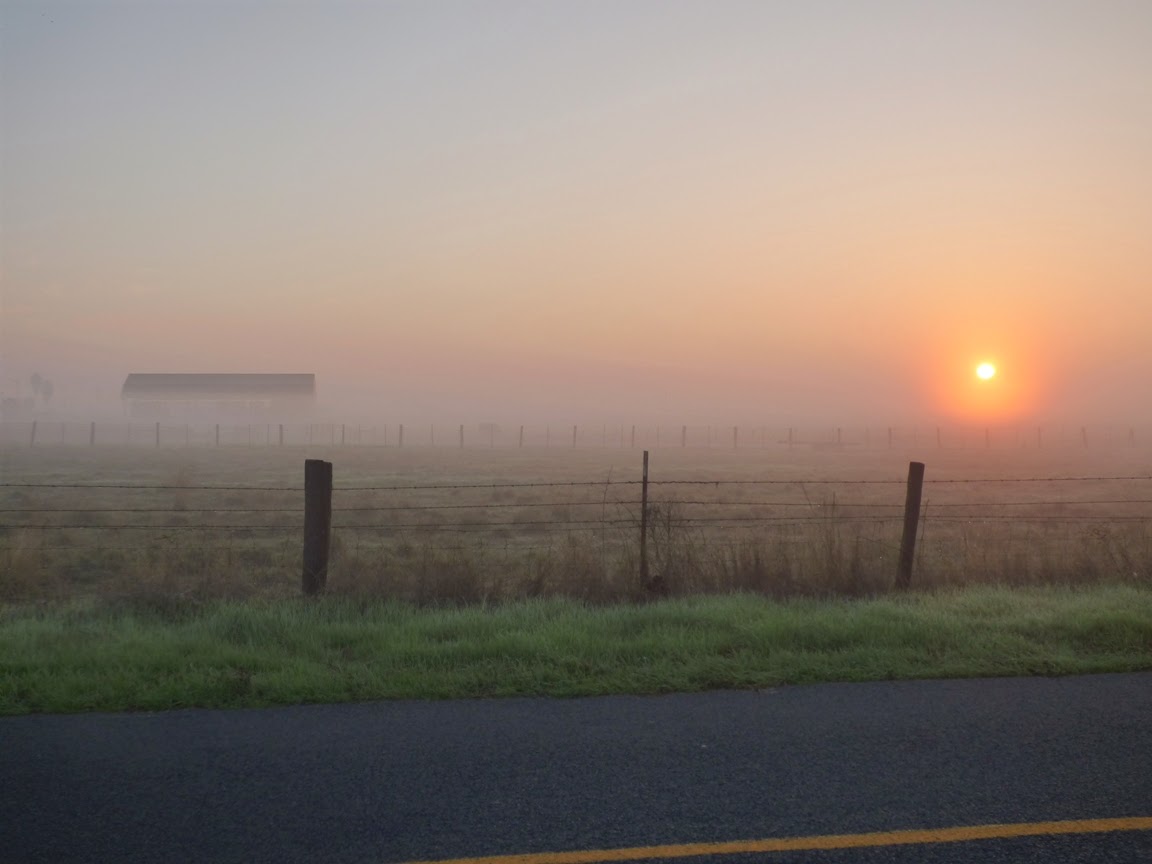
I'm seeing fog on the early mornings when I make my way to work through the pasturelands outside my village. They've added an aura of mystery to the landscape, and haven't yet interfered with my driving, so I'm seeing beauty right now. We just finished a series of storms, and conditions will be stable and calm for the next 10 days or so. We'll see how I feel if and when the fog sets in.

Tuesday, November 25, 2014

Fog Returns to the Great Valley! I hate it, but it's a good thing (tentatively)

Buffalo has apocalyptic lake-effect snow, Minnesota has blizzards, Phoenix has horrific dust storms, Kansas has tornadoes, New Orleans has hurricanes. In the big picture, those of us who live in the Great Valley of California don't have much in the way of weather issues. I have yet this year to put on a jacket in the morning, and I only stopped wearing shorts a few weeks ago because I wore a hole in the pocket. It gets hot in the summer, but only occasionally drops below freezing. We've had two "snowstorms" in 25 years. No wonder so many arctic birds like to winter here.

But we have one issue. When the first rains fall in October or November, the Tule Fogs come. These are thick radiation fogs generated during cold periods when moist ground cools off during the night. The water vapor condenses to water droplets in a dense blanket at ground level. The fog makes life not just miserable, but downright dangerous for drivers. What is it like? Get on a freeway sometime, and imagine driving with your eyes closed. And then imagine that everyone else has their eyes closed too, and that some of them are in a hurry. Some people just don't know enough to slow down and horrible chain reaction accidents result.

The fog sieges can last for weeks. I can remember hungering for sunlight so much that we would drive into the mountains for a few hours of respite from the gloom. The fog sets up under an inversion layer only a few tens or hundreds of feet thick, meaning the sun is shining just a few feet over our heads on the cloud tops, but not on us.

But we've not had many of these weeks-long sieges of late. With the intense drought that is crippling our state, the ground has been dry with no fog forming. Even with the wet years, the long term trend is for fewer foggy days, a decrease of 46% over the last three decades. The cause is in part related to global warming. With warmer average temperatures, the fog doesn't form as often, and with increasingly persistent droughts, the ground is not wet as often.
As I said in the title, I detest the fog, and I am glad any morning when I don't have to deal with a foggy morning commute. But the Tule Fog is important.  The fruit and nut trees that cover our four-hundred-mile long valley require cold temperatures for a few weeks to properly set, and long warm fog-free days don't allow this to happen as frequently. When one considers that the Great Valley provides most of the fruits, nuts, and vegetables grown in the United States, this is a serious issue, and it seems to be rarely discussed among farmers and politicians who "represent" the region. The pols (and some of the farmers) are too busy denying the reality of global warming to recognize that the consequences of warming are already affecting their profit margins.
The fact that the fogs are happening is also to realize that the ground is wet! We've had around two inches of precipitation so far this season. That's almost normal. The storms have been weak ones in our area, with only 0.20 inches in the last three storms, but they have kept coming and a more serious storm is on tap for the holiday weekend. They haven't been enough to put a dent in the drought, but they are an improvement over last year when we didn't reach the 2 inch mark until January. Since droughts may become the new "normal", we'll have to revel in the wet years when they come. We really need a wet year right now after three crippling dry years.

I hate the fog, but I'll tolerate it if it means the drought is ending.

Friday, January 17, 2014

A Picture Tells the Story. We're in Big Trouble Out West.

Source: http://drought.unl.edu/MonitoringTools/NASAGRACEDataAssimilation.aspx

It's a terrifying picture. We have been through 12 of the driest months ever recorded in California, and there is no relief in sight. One can tell we are in trouble when the only part of state not suffering a crippling drought is Death Valley and the Mojave Desert. The rain totals thus far in the Central Valley are at Death Valley levels.

A persistent high pressure belt has been diverting the winter storms north. They are then barreling through the central and eastern United States, causing moronic senators and representatives to bellow about how global warming/climate change is somehow an elaborate hoax designed to hurt their benefactors in the fossil-fuel energy business. If a snowstorm disproves a century of careful research by thousands of climatologists, what are we to make of the worst drought ever in California, and horrific heat waves in Australia and Argentina? It's been in the middle to high sixties here at home these last few weeks. If that makes my friends who are shivering back east a bit resentful, just consider what it's going to be like out here in a few months. Yosemite and my precious Sierra Nevada have already suffered through the worst wildfire ever, and more of the same is in store.

These kinds of climate changes that we are experiencing have been predicted and are happening now. It's not always easy to see the changes on a day to day basis, and sometimes the changes might seem positive. For one, we have not had a single Tule Fog day this entire winter. I hate the foggy sieges that used to last for weeks on end, but if it would mean rain and snow for us in California, I would welcome them today.

If we are moving towards a mega-drought, geologic history gives us a clue about what to expect. Two century-long droughts have already taken place in the last 1,200 years. I've discussed the effects previously in this post:  http://geotripper.blogspot.com/2010/05/fridays-fun-fotos-fluvial-forest.html

These dead trees in the middle of the Walker River in the eastern Sierra Nevada were growing to maturity while the river was largely nonexistent during one of California's horrific megadroughts.

Friday, February 1, 2013

Living in the Shadowlands (for the time being)

"We live in the Shadowlands. The sun is always shining somewhere else. Round a bend in the road. Over the bough of a hill..."

C.S. Lewis (movie quote from "Shadowlands")

This quote from the movie Shadowlands is packed with religious meaning and metaphor concerning the necessity of suffering and the nature of the world we inhabit and the promised paradise to follow. It and the rest of the movie gives one a lot to think about. On the other hand I am neither a movie critic (I liked this one), nor a theologian, so I read the lines above and see instead a literal description of my home in the Great Valley of California. In my two decades in the valley, I have come to see the months from November to February as the shadow months, when a fog siege could come at any time, bringing a veil of darkness and limited visibility over everything for weeks at a time. Driving to work becomes a potential destruction derby. The constantly gray sky even effects the psyche, bringing about depression in many people.

What makes it worse is the knowledge that the sun is close by. It is shining on the cloud tops only a few hundred feet overhead, and on the slopes of the Sierra Nevada foothills only a few short miles to the east. Why is it that we have to spend all these weeks in the shadows and darkness?
To a climatologist, there is no mystery. The Great Valley is surrounded by mountain ranges, and unless a storm system is moving through, the air stagnates. In the cold months of winter, heat from the ground radiates into the atmosphere above, bring air temperatures at ground level below the dew point. Water vapor condenses into microscopic water droplets too small to sink to the ground. The landscape is hidden in ground-hugging clouds. The so-called Tule Fogs of the Great Valley are the stuff of legend. When I was growing up in Southern California, I lived in the delusion that fog was a sort of overcast thing. Things in the distance might be a bit indistinct, but you could see them. The fogs of the Great Valley cause visibility to drop to mere feet. Driving in such conditions is a crapshoot. Most people know to slow down, and even keep the windows down in the freezing weather so they can hear oncoming traffic. Unfortunately there are morons too, and deadly chain reaction accidents are disturbingly common.

Living in a place for decades gives one a perspective on changes, however gradual. It's dawned on me recently that I haven't experienced as many week-long fog sieges like those that plagued my first few years in Modesto. A recent study supports the perception that the fog has not been as pervasive as it once was. The number of foggy days in some areas has decreased by a third (20% versus 30%) in the last thirty years.  Much of the change is no doubt related to global warming, as warmer overnight temperatures mean that the dew point is reached less often. The growing population of the valley no doubt has an effect, since cities give off a great deal of heat. One more factor is the decrease in particulate air pollution, since the water droplets need a bit of dust (condensation nuclei) to coalesce around. Stagnant air basins are a great place for accumulating air pollution, but we have made great efforts to decrease the particulate levels over the decades (we are still the worst in the nation, but progress is progress).

While the lower number of foggy days and cold nights is a welcome change for commuters, it is a problem for many farmers. Many of the fruit trees grown in our valley require a series of cold nights in winter to increase production of fruits in the spring. The lack of cold days is having an effect on crop yields.
As dark and depressing as the fog can be, there are times when it provides a bit of beauty. Driving to work the other day was a shadowy journey through the pasture-lands, but the layers of fog were only a few feet off the ground, giving rise to treetops that seemed to be floating in a gray ocean. The sun peaked out over the distant Sierra Crest, and soon the fog was receding and it was the start of a beautiful sunny day.

Thursday, November 17, 2011

The Beautiful Days of Autumn in the Great Valley

I get it that Californians don't truly understand the concept of autumn. I've never seen the full glorious display of fall colors across the hardwood forests of the eastern United States, so maybe I understand the mild disdain that my eastern friends have when I get excited about the belated arrival of fall here in Modesto.

Just the same, I love it when it finally gets cold enough that our Modesto Ash trees (Fraxinus velutina) start turning. The ash trees are a southwest native that are drought resistant, so they are a nice match to our local climate.
Today was the kind of day that I really appreciate living here. Modesto has less than stellar days sometimes, hot and smoggy summers, and cold dreary foggy winters. For a few wonderful days in November the streets are alive with color, the skies are washed clear by the first rainstorms, and the air smells fresh and clean.
I grabbed my camera and started walking around the blocks near campus, and I enjoyed every moment. Modesto is a totally different looking kind of place for these few days.
The pleasant days won't last for very long, and the tule fogs will soon begin. They can be nasty (try driving with a blindfold on). I remember them being worse in years past, and I don't know if it is because of warming temperatures, or changing patterns of droughts and wet years, but any day without fog is a joy.
Especially this day...

Wednesday, January 5, 2011

Decisions, decisions...

The Tule Fogs have arrived with a vengeance in California's Great Valley (Central Valley). After a series of very wet storms over the last few weeks the ground is saturated with water, but the storms are done with for the moment. This is a relief for anyone in the path of mudflows and flooding, but the stagnant air in the valley results in a temperature inversion with cold dense air below, and relatively drier air at higher levels. As the ground loses heat by infrared radiation, water vapor reaches the dew point and clouds form at ground level. The fog can be dangerously thick, with visibility measured in tens of feet sometimes. Driving in the fog is not unlike driving with cotton balls stuffed behind your sunglasses, and we have had some legendary chain reaction accidents involving dozens of cars on Highway 99 and Interstate 5.

I don't like the fogs very much. I don't like driving in them, and I hate that I am wandering about in the gloom, knowing that the sun is shining brightly just a few hundred feet over my head. School starts on Monday, so I should be getting everything ready; the syllabi are in fact done, and I spent a few hours cleaning up the lab yesterday. I'm kind of ready; there is a lot more I could be doing...but...I chanced on the webcam of the Yosemite Conservancy this morning, and...well...I'll see you all later, I've got one more field excursion to make before the semester starts!