Showing posts with label Global Climate change. Show all posts

Friday, October 2, 2020

Have You Seen This Movie Before? The Disaster of 2020


Scene 1:

A monkey dies an ugly death in a rainforest...

A woman swimming hears a crunching sound and disappears beneath the waves...

A menacing shadow crosses over the lunar surface...

People are enjoying themselves in a quiet park. Then thousands of birds (fly away/attack the crowd)...

A moderate earthquake causes some traffic snarls... 

Giant ice shelf breaks apart and floats away...


Scene 2: 

A scientist, or small scientific team, becomes curious about phenomenon in previous scene. They begin to study and become concerned...

Scene 3:

Scientists try to get attention of government official, often waving sheaves of paper. They have a solution...

Government official says "we'll look into it", sends scientists away...

Government official deals with sheaves of paper, either by putting in a file cabinet, or in a trash can...

Scene 4:

Examples of the phenomena described in scene 1 happen again, only more intense: larger earthquake, bigger meteorite strike, more people disappear, more bird attacks, giant hailstorm, tornadoes in odd places, etc...

Scene 5:

Scientists grow ever more concerned, visit government official with their solution and more sheaves of paper, who waves them off saying "we have all the top people working on it"...

Scene 6:

All hell breaks loose. Depending on phenomenon (and the director), (dozens/ hundreds/ thousands/ millions) of people die from a multitude of special effects. Government official is among the victims...

Scene 7:

Remaining government officials say "How could we have foreseen this phenomena? What can we do?"

Scientist, or group of scientists, devises a desperate solution that "might just work". Often includes nuclear bombs...

Scene 8:

Scientific solution works, and plucky bands of survivors survive. Remaining government officials say "We'll never ignore the scientists ever again."...

The Sequel:

The government ignores the scientists again...


So the thing is, I go to movies to be entertained, knowing that such things will never be part of my reality. Until this year...

As catastrophic unprecedented fires burn all around me here in California, we receive news that a major government official, actually the top government official and many of those around him have been felled by a disease that the scientists have been warning about since January. And the solution they were pressing was as simple as wearing a mask, and keeping six feet away from others. And yet so many people and officials ignored the scientists that now 200,000 people are dead in the United States, and a million are dead across the planet.

I'd like to hear a director yell "cut" about now, but that's not going to happen. We wait to see how this nightmare movie unfolds.

Vote like your life depends on it.

Wednesday, November 29, 2017

Our Children Will Say "Why Didn't You Tell Us?", and We'll Say We Tried: The Government Isn't Just Denying Climate Change.

I'm reposting my blog from January 27 of this year. It is a story that needs to be told again. At the time I wrote it shortly after the inauguration, it could have been described as alarmist...that I wasn't giving the new president a chance. But the reality is that after 10 months, we are being endangered by the actions of this administration. Word comes today from National Public Radio that scientists applying for grants from the National Science Foundation are removing the words "global warming" or "climate change" from their proposals. They are censoring themselves. This is beyond concerning.

The budgets at NASA, NOAA, the National Weather Service, and the National Park Service have been deeply slashed to literally blind us to the effects of climate change. Those who work for these agencies doing climate change research have been marginalized if not outright fired. The appointees to the EPA, the Department of Energy and other agencies are climate change deniers. And yet the effects of climate change continued unabated during the past year. We have seen the amped up hurricanes that devastated Texas, Florida, and Puerto Rico. We saw the worst fires in California history destroy thousands of homes. We have sweltered through unprecedented heat waves.We see entire forests dying from the attacks of bugs that are normally killed in cold winter conditions. The Great Barrier Reef in Australia is dying in front of our eyes. The Arctic ice is at record low levels and declining. Sea level continues to rise. And we are in the process of withdrawing from the Paris Climate Accords, the only country in the world that is doing so.

I am not a major voice in the political debate. My blog reaches hundreds of people, although on a good day it will reach thousands. But we have to stand up to this denial, and I hope that those of you who have followed my blog over the years will make your voice heard. We still have tools, we can still protest, we can still contact those who "represent" us in Congress. In many cases, we still have the right to vote (although that right is seriously threatened as well).

Please read what follows to understand why we must stand up to this administration:

Is Trumpism/Pencism the New Lysenkoism? The Need to Defend Science From "Alternative Facts"
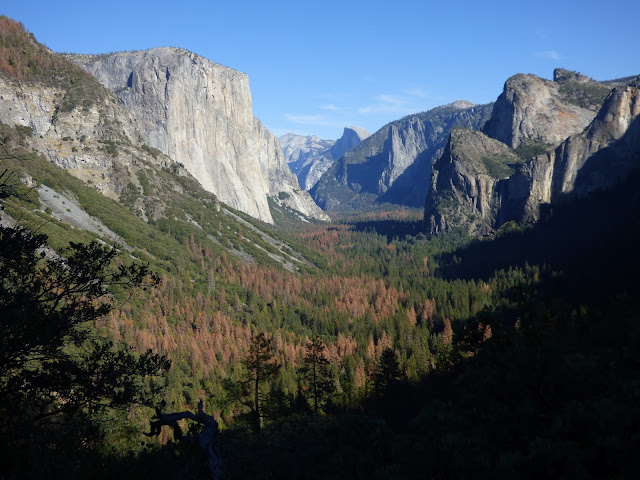
Drought-killed trees in Yosemite Valley, California

Imagine what it must have been like living under communist rule in the Soviet Union during Joseph Stalin's regime. I can't even begin to imagine the unspeakable horrors that led to the deaths of tens of millions of people for a variety of reasons, but events this week have brought to mind a particular episode that is unfamiliar to the public at large, but which had a profound effect on Soviet agriculture. It was no doubt among the reasons for the failure of the totalitarian rule over the Soviet Union. Why? Because they were never really able to feed their own people, especially wheat. The Soviets had plenty of arable land. Why did this happen? There were always profound inefficiencies in the Soviet economy, but the heart of the problem was a single man: Trofim Denisovich Lysenko.
Trofim Denisovich Lysenko, 1898-1976. Source: https://en.wikipedia.org/wiki/Trofim_Lysenko
How could one man do so much damage? It had to do with how science was done in the Soviet Union under communist rule. Scientific research, at least in agriculture, was done from the top down. The government decided what was true, and directed that research must confirm what the government knew was true. If that didn't happen, scientists and researchers faced arrest, re-education, and possible death. And in the Soviet Union, from the 1920s until 1965, Lysenko was in charge of agriculture.

Simply stated, Lysenko didn't accept the theory of evolution by natural selection. He denied Mendelian genetics or even the presence of genes in plants and animals. He instead believed an earlier hypothesis called Lamarkism as well as his own bizarre ideas about inheritance. In essence, he believed that organisms could pass down their experiences to their offspring. A simple model to illustrate this would be an experiment in which dogs had their tails surgically removed, generation after generation. After enough time had passed, puppies would start being born without tails. These were called acquired characteristics. In essence, he insisted that the best strains of cold-weather wheat could be achieved by repeatedly subjecting the seeds of warmer climate strains with cold temperatures. They would then acquire the ability to grow in colder climates.

And so, under his direction, farmers were ordered to grow inferior wheat strains for decades, and the results were no surprise. Production suffered, and over the years the Soviets had to import wheat from other countries, including the United States. The study of DNA, genetics, and natural selection continued unabated in other parts of the world, and agricultural yields ballooned as a result. Yet despite these failures, Lysenko continued as the Director of Genetics for the Academy of Sciences for decades. And he had true power. Under his reign, more than 3,000 geneticists who didn't toe the Lysenko line were arrested, and many of them were executed.
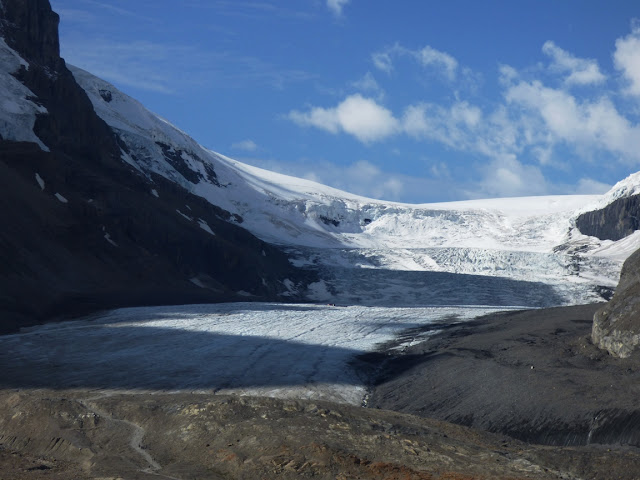
Athabasca Glacier in Jasper National Park in Alberta, Canada. The glacier has been receding for decades

So why are we talking about Lysenko tonight? I can barely keep up with the daily outrages of the new Trump/Pence administration, but one of the most chilling news stories during the transition period and inaugural week has been the attack on science and scientific research. Global warming and climate change have been declared to be false, and Trump officials have taken steps to end government research into this most pressing environmental issue. They have demanded the names of climate researchers at the Environmental Protection Agency, the National Park Service and other departments, suggesting a coming purge (update: this has happened). They announced a gag order on dissemination of the results of research by government experts, even outside of government channels. They have attempted to restrict information flow via the social media. There have been hints of draconian budget cuts in scientific research.
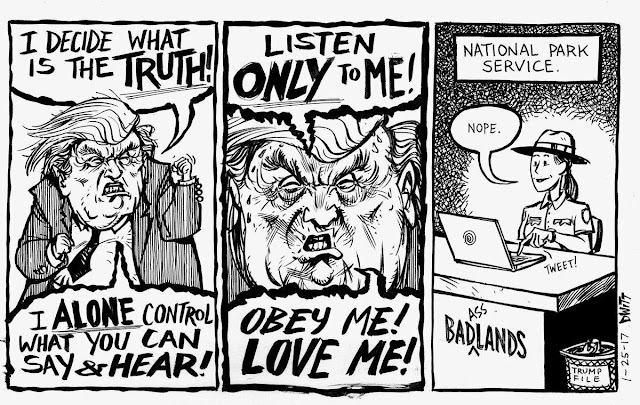
The cause, of course, is not a belief in some other cause of warming. Many of Trump's followers deny that warming is even happening. Because Trump, Pence, and the others in the administration do not believe in global warming, they have decided that it must not be investigated. They are trying to use their position of power to alter the direction of scientific research to conform to their own preconceived beliefs. That runs absolutely counter to the trajectory and goal of scientific exploration, and very much counter to the role of science in America throughout its history. Scientific research and discovery has been a driver that has allowed the American economy to thrive. For a country to promote scientific research that is directed from above towards categorically wrong conclusions is courting disaster, and the implications are worldwide in scope.

I am encouraged at the response of the scientific community. There has been a concerted effort to protect and preserve the research that has been conducted in the past, and researchers are beginning to realize that they will have to become politically active, despite a tendency to avoid it in the past. Resistance has been growing in the social media. To be clear, this is not a Democratic-Republican issue, or a liberal-conservative issue. It is a battle between factual truths and willful ignorance. It is also an economic issue, as the opposition is richly funded by corporations who stand to profit handsomely by denying the existence of global warming. Unfortunately, we will all lose in the end.

I've tended to avoid politics in this blog, but that has to change now. Until the Trump/Pence administration acknowledges the critical role of independent scientific research, they must be challenged at every turn. The stakes are simply too high for Americans and the rest of the world. It doesn't matter what Trump and Pence believe. They may believe warming hasn't happened, but sea level will continue to rise anyway. Coral reefs will continue to die off. Glaciers will continue to melt. Storms will become more intense, as will droughts. The world will get hotter, and each year will decrease our chances to deal effectively with the issue. For Pence and Trump to be willfully ignorant about science is appalling. To ignore the advice and counsel of experts in the many fields of science is absolute folly.
Source: https://www.earthmagazine.org/article/comment-crazy-times-arctic

I fear we have entered into a new age of Lysenkoism. Yes, that is a term. And it would be a tragedy.

Friday, January 27, 2017

Is Trumpism/Pencism the New Lysenkoism? The Need to Defend Science From "Alternative Facts"

Drought-killed trees in Yosemite Valley, California

Imagine what it must have been like living under communist rule in the Soviet Union during Joseph Stalin's regime. I can't even begin to imagine the unspeakable horrors that led to the deaths of tens of millions of people for a variety of reasons, but events this week have brought to mind a particular episode that is unfamiliar to the public at large, but which had a profound effect on Soviet agriculture. It was no doubt among the reasons for the failure of the totalitarian rule over the Soviet Union. Why? Because they were never really able to feed their own people, especially wheat. The Soviets had plenty of arable land. Why did this happen? There were always profound inefficiencies in the Soviet economy, but the heart of the problem was a single man: Trofim Denisovich Lysenko.
Trofim Denisovich Lysenko, 1898-1976. Source: https://en.wikipedia.org/wiki/Trofim_Lysenko
How could one man do so much damage? It had to do with how science was done in the Soviet Union under communist rule. Scientific research, at least in agriculture, was done from the top down. The government decided what was true, and directed that research must confirm what the government knew was true. If that didn't happen, scientists and researchers faced arrest, re-education, and possible death. And in the Soviet Union, from the 1920s until 1965, Lysenko was in charge of agriculture.

Simply stated, Lysenko didn't accept the theory of evolution by natural selection. He denied Mendelian genetics or even the presence of genes in plants and animals. He instead believed an earlier hypothesis called Lamarkism as well as his own bizarre ideas about inheritance. In essence, he believed that organisms could pass down their experiences to their offspring. A simple model to illustrate this would be an experiment in which dogs had their tails surgically removed, generation after generation. After enough time had passed, puppies would start being born without tails. These were called acquired characteristics. In essence, he insisted that the best strains of cold-weather wheat could be achieved by repeatedly subjecting the seeds of warmer climate strains with cold temperatures. They would then acquire the ability to grow in colder climates.

And so, under his direction, farmers were ordered to grow inferior wheat strains for decades, and the results were no surprise. Production suffered, and over the years the Soviets had to import wheat from other countries, including the United States. The study of DNA, genetics, and natural selection continued unabated in other parts of the world, and agricultural yields ballooned as a result. Yet despite these failures, Lysenko continued as the Director of Genetics for the Academy of Sciences for decades. And he had true power. Under his reign, more than 3,000 geneticists who didn't toe the Lysenko line were arrested, and many of them were executed.
Athabasca Glacier in Jasper National Park in Alberta, Canada. The glacier has been receding for decades

So why are we talking about Lysenko tonight? I can barely keep up with the daily outrages of the new Trump/Pence administration, but one of the most chilling news during the transition period and inaugural week has been the attack on science and scientific research. Global warming and climate change have been declared to be false, and Trump officials have taken steps to end government research into this most pressing environmental issue. They have demanded the names of climate researchers at the Environmental Protection Agency, the National Park Service and other departments, suggesting a coming purge. They announced a gag order on dissemination of the results of research by government experts, even outside of government channels. They have attempted to restrict information flow via the social media. There have been hints of draconian budget cuts in scientific research.

The cause, of course, is not a belief in some other cause of warming. Many of Trump's followers deny that warming is even happening. Because Trump, Pence, and the others in the administration do not believe in global warming, they have decided that it must not be investigated. They are trying to use their position of power to alter the direction of scientific research to conform to their own preconceived beliefs. That runs absolutely counter to the trajectory and goal of scientific exploration, and very much counter to the role of science in America throughout its history. Scientific research and discovery has been a driver that has allowed the American economy to thrive. For a country to promote scientific research that is directed from above towards categorically wrong conclusions is courting disaster, and the implications are worldwide in scope.

I am encouraged at the response of the scientific community. There has been a concerted effort to protect and preserve the research that has been conducted in the past, and researchers are beginning to realize that they will have to become politically active, despite a tendency to avoid it in the past. Resistance has been growing in the social media. To be clear, this is not a Democratic-Republican issue, or a liberal-conservative issue. It is a battle between factual truths and willful ignorance. It is also an economic issue, as the opposition is richly funded by corporations who stand to profit handsomely by denying the existence of global warming. Unfortunately, we will all lose in the end.

I've tended to avoid politics in this blog, but that has to change now. Until the Trump/Pence administration acknowledges the critical role of independent scientific research, they must be challenged at every turn. The stakes are simply too high for Americans and the rest of the world. It doesn't matter what Trump and Pence believe. They may believe warming hasn't happened, but sea level will continue to rise anyway. Coral reefs will continue to die off. Glaciers will continue to melt. Storms will become more intense, as will droughts. The world will get hotter, and each year will decrease our chances to deal effectively with the issue. For Pence and Trump to be willfully ignorant about science is appalling. To ignore the advice and counsel of experts in the many fields of science is absolute folly.
Source: https://www.earthmagazine.org/article/comment-crazy-times-arctic

I fear we have entered into a new age of Lysenkoism. Yes, that is a term. And it would be a tragedy.

Thursday, December 8, 2016

We Only Have Education to Guide Us: A Pledge

The glaciers of Glacier National Park, which once numbered more than a hundred, will be gone by 2030 or so.

The recent election has seen the loss of many things, which in terms of science and scientific understanding is truly tragic. The nation didn't vote for it, but representatives of ignorance and unrestrained capitalism managed to eke out an electoral college victory, and now a parade of political appointments are making a mockery of our commitment to clean air, clean water, and responsible stewardship of the land. Decisions about the future of our nation are now in the hands of people who are guided not by science, but by the profit motives of corporations. First and foremost is the abject denial by those who are about to take office in the reality of global warming and climate change.
Corals of the Great Barrier Reef are dying off at an appalling rate because of abnormally warm seas.

In so many ways I despair. But there is always hope, and I will not back off my commitment to the teaching of science and logic in my career.  Those now in power fear an educated electorate, because they used fear and ignorance to gain the power they will now yield. This must not continue.
Intense drought, a predicted aspect of global warming, has killed more than 100 million trees in California, including on the floor of iconic Yosemite Valley

I've been looking for the appropriate words to employ at this moment, and I found them in the Anti-authoritarian Academic Code of Conduct of Rachel Barney, a professor of classics and philosophy at the University of Toronto. They appear below, only slightly edited (because I'm not an administrator). These statements have always been a part of my educational and academic philosophy, but it's good to have a reminder of what we stand for. Consider this a pledge between me and my students, and with society at large.

1. I will not aid in the registering, rounding up or internment of students and colleagues on the basis of their religious beliefs.

2. I will not aid in the marginalization, exclusion or deportation of my undocumented students and colleagues.

3. I will, as my capacities allow, discourage and defend against the bullying and harassment of vulnerable students and colleagues targeted for important aspects of their identity (such as race, gender, religious beliefs, sexual orientation, etc.).
   
4. I will not aid government or law enforcement in activities which violate the U.S. Constitution or other U.S. law.
   
5. I will not aid in government surveillance. I will not inform.
   
6. As a teacher and researcher, I will not be bought or intimidated. I will present the state of research in my field accurately, whether or not it is what the government wants to hear. I will challenge others when they lie.
   
7. I will not be shy about my commitment to academic values: truth, objectivity, free inquiry and rational debate. I will challenge others when they engage in behavior contrary to these values.


8. I will stand with my colleagues at other institutions, and defend their rights and freedoms.
   
9. I will be fair and unbiased in the classroom, in grading and in all my dealings with all my students, including those who disagree with me politically.

Thursday, January 29, 2015

The Sierra Beyond Yosemite: Wait! Is that...a Glacier?

People who visit Yosemite Valley often think about glaciers. Even those with no geologic background quickly become aware of the role of glaciers in forming the valley, but the thoughts are often of the past. It's been 11,000 or 12,000 years since any glaciers have been in the bottom of the valley, and it's been around 800,000 years since glaciers filled Yosemite Valley. The glaciers seem a part of the distant past.
When we reached the crest of the White Mountains on our fall field trip, we could see across the Owens Valley to the highest ridges of the Sierra Nevada. It was late September in one of the driest years ever recorded in California. And yet...there was still ice in the high country. How could any snow still be left after one of the hottest summers on record?

A closer look through the zoom lens told the story. The isolated patches weren't snow at all, they were ice, and the cracks and fractures tell us that the ice has been moving. In other words, these are glaciers!

Glaciers would not seem to be a California phenomenon. Too much sunshine, too many droughts, it just doesn't seem to be the kind of place where snow could accumulate and compress year after year, decade after decade, until the frozen mass starts to slip under the weight of 100-200 feet of ice. Indeed, the permanent snowline would be in excess of 15,000 feet or more, and no peaks in California are that high. But given certain areas with cold "microclimates", glaciers have persisted in the ranges, in the shaded hollows of the highest mountains where the sun almost never shines.

According to the U.S. Geological Survey, there are nearly 500 glaciers in the Sierra Nevada, but none of them is very large, the biggest being only a mile (1.6 km) wide and half a mile (0.8 km) long. The total area covered by glacial ice in the Sierra is only about 19 square miles (50 square km). We were looking at some of the largest remaining glaciers, those that persist beneath the peaks of the Palisades Crest, a group of 14,000 foot mountains on the east boundary of Kings Canyon National Park.

It is known that there was a much warmer period several thousand years ago following the last major ice age, so these are not remnants of those Tioga stage glaciers. Small glaciers like these would have melted completely away. There was a general worldwide cooling event in the 1700s, the so-called Little Ice Age, and it was in those decades that these glaciers accumulated.

If you want to see the remaining glaciers of the Sierra Nevada, make your plans now. Since the early 1900s, the glaciers have been shrinking, and they have already lost 50-80% of the volume that existed at the time of their discovery. Glaciers are one of the most sensitive indicators of global temperature, and most of them are shrinking worldwide (a precious few are expanding, but because of increased precipitation in some areas; their climate is still warming). Many or most of the Sierra glaciers will be gone in a matter of decades. That will lead to some serious changes to the alpine climates of the Sierra, especially as they will no longer be there to provide streamflow during the driest times of the year.

It's been a long time since I was able to visit a glacier in the Sierra (it was back in 1982. It was the biggest of the Palisades glaciers, the one in the picture above, and as I stood at the base of the ice, I was able to see the Sierra's youngest natural lake, a tarn produced as the glacier receded. The lake didn't exist in 1950. It's sad that these small reminders of the awesome power of ice will soon be gone. I hope I have at least one more chance to see them up close.

Wednesday, October 8, 2014

Northern Convergence: Athabasca Glacier, at the Front Line of Climate Change

Athabasca Glacier and Sunwapta Lake in July 2014
Athabasca Glacier in Jasper National Park is one of the few places in the world where one can drive to a glacier. It is also one of the most vivid places to see the global warming in action.

We were in the midst of our Northern Convergence journey through British Columbia and Alberta last July when we pulled up at the visitor center for the Columbia Icefield. Up to this point we had seen a large number of small glaciers tucked away in the high peaks of Yoho and Banff National Parks, and we had seen plentiful evidence of past glaciations at nearly all the localities we had been visiting over the previous six days. But here at Athabasca Glacier, we were confronted with ice. Lots of ice, just a short distance from the end of the road. It was not unlike stepping out of a time machine into the last ice age.
Athabasca Glacier in 1919. Sunwapta Lake does not yet exist.
One of the first issues that we were confronted with is global climate change. The Earth is warming up at an alarming rate, and the warming couldn't be made clearer than the fact that Athabasca Glacier is shrinking. Since the 1800s the glacier has receded more than a mile, forming a new lake, Sunwapta. It was visibly shorter than it was on my last visit in 2005 (see a comparison below).
We took in a brief overview of the glacier from the visitor center complex along the highway. We then crossed the highway and parked at the base of the rocky knob in the photo above.
We started up the trail, which was steep in a few spots, but not overly difficult. 
Looking behind as we climbed the slope we could see Sunwapta Lake, which did not exist prior to a few decades ago. Note the barren flats. There should be trees growing at this altitude, but the rocky debris and till has not had time to develop soils. This is a newly exposed landscape.
A marker along the trail appeared. It's message was rather stark. Only three decades ago, ice covered this spot.
The bedrock marks the passage of the ice in the form of striations (scratch marks from sand particles in the ice), and grooves.
We reached the top of the hill, where the ice existed as recently as 1992. Despite the decline in the size of the glacier, it is still an impressive sight. The ice ranges in thickness from 300 to 1,000 feet (roughly 100 to 300 meters). The crevasses mark the places where the ice is moving over a steep dropoff.
Large lateral moraines line the sides of the glacier. If it were not receding so rapidly, it would also have a terminal moraine around the end.
As we approached the terminus, we could see the swollen river of meltwater emerging from the ice. The river blocked easy access to the ice. There were a few boards to make a rudimentary bridge, but sternly worded signs warned of the dangers of actually going out onto the ice itself. Death, you know, from falling into crevasses and through thin ice (and yes, it happens).
Compare this photo to a shot from the same spot in 2005, below
The entire area covered by the river water had been covered at the time of my visit in 2005. Getting on the ice was easier, even encouraged, at the time. Not anymore.
Athabasca Glacier terminus in 2005
Much of the snout of the glacier was covered with dirt, boulders and debris exposed as the glacier melts.
The glacier is "fed" by the Columbia Icefield, a vast expanse of ice covering 125 square miles (325 square kilometers) between some of the highest peaks of the Canadian Rockies. Six major glaciers flow from the huge mass of ice coating the high divide. Meltwater from the glaciers flows to the both the Pacific and Atlantic Oceans, as well as Hudson Bay and to the Arctic Ocean (thanks, Howard, for the correction). The icefield lies east of a gap in the Columbia Mountains that allows Pacific storms to drop prodigious amounts of snow each year, around 30 feet (ten meters).
In some places the chunks of ice simple fall off the cliffs into the cirques below. I saw one of these icefalls on my earlier visit, and was watching closely this time around, but no dice this year.

At the rate that the glacier is receding, it will probably be gone by the end of the century. There can hardly be a starker piece of evidence that the Earth's climate is warming. It is as plain as the nose on  one's face, unless you are a politician whose re-election depends on funding from lobbying groups who are paying you to be blind.

We returned to our vehicles and drove down the Icefields Parkway to a new destination: the High Plains of Alberta. We were on the trail to find some dinosaurs...more later.

Wednesday, August 6, 2014

Whither Go the Redwoods? Smoke in the Temperate Rainforest

Our long journey through western Canada and the Pacific Northwest ended a few days ago, but we lingered in Oregon and Northern California for a few days to visit family, and frankly, to avoid the heat wave that seemed to engulf the southwest and interior valleys. Our route took us down the Oregon coast and into California at Crescent City and Fortuna, and then into the incredible Redwood forest.

Something was off...

The sunlight just wasn't "right". It was as if someone had put a dimmer switch on. Everything looked the way it was supposed to, but there was sort of an orange-brown glow. The shadows were bluish. We had heard vague reports about fires burning across the west, but we couldn't see any obvious smoke plumes. But the smoke was there.

The forest was stunningly beautiful, though. We had a long road ahead of us that day, but we couldn't help but linger through the early afternoon. The Coast Redwood (Sequoia sempervirens) is an ancient species with a heritage that extends back into the era of the dinosaurs. They were once widespread across the northern hemisphere, but the ice ages restricted their range and now they exist only in a narrow coastal strip from the Big Sur coast to the Oregon border region.

The trees require moist temperate conditions, with plentiful winter rains, and summer coastal fogs. As we wandered through the coastal temperate rainforest, we noticed something disquieting: it wasn't moist. It was very dry.

The understory was green, and the shade was cool, but there was none of the dampness that I associate with these forests. My perceptions were confirmed when we stopped in at the visitor center for Humboldt Redwoods State Park. The rainfall for the 2013-2014 water year was an astounding 27.96 inches. In the Central Valley where I live, that much precipitation would be astounding, but here in the rainforest, it's scary. A display offered the rain totals for the last 70 years, and in all that time, only once before has the yearly total been less than 40 inches.

Once.

The average yearly rainfall is around 60 inches, and four times the totals have exceeded 100. But this year is the second driest ever at Humboldt, and in most of the state it is the driest year ever recorded. We are in the grip of a horrific drought, and there are no signs that it is going to break soon.

We are witnessing and living through huge changes in the climate regime we tend to regard as stable and constant. Glaciers worldwide are receding, snowfall totals in our Sierra are declining. We are unaware on a daily basis unless there is an unusual heatwave or extended drought like the one we are experiencing now. But the changes are happening. The summer fogs are not as common as they once were. Temperatures are warming. Sea level is rising.

And the fires are burning. In places the climate has changed so much that when the vegetation returns, it will be different than what was burned away. Wildlife species are moving uphill to escape warming conditions, and some are disappearing because they can no longer move upwards.
It may be that in a few decades or centuries, California's state tree will only be able to grow in Oregon or Washington. We've cut down 96% of the original old growth Redwood forests, and now climate change may very well take care of the rest. 

I'm praying for a break in the drought this year. But I'm also hoping that those who govern us will finally come to terms with the huge threats that global climate change presents. Money still does all the talking in politics, and the money says to protect the status quo. We need people of vision, not political hacks who look out for their financial benefactors. I'm hoping, but I'm not hopeful.
Common Buckeye (Junonia coenia) at Humboldt Redwoods

There are lots of beings who depend on us. There are the animals and plants, of course, but there are also our children and grandchildren. What world will we leave to them?