Showing posts with label Sequoiadendron gigantea. Show all posts

Tuesday, September 18, 2018

Here's a Pretty Puzzle...What are These Trees Doing Here? An Evening at Calaveras Big Trees


When the trees were discovered by people of European descent in the 1850s, few believed the stories of their immense size. There were of legends and tall tales emerging from the explorations of the American West, but trees that towered 300 feet high with diameters of 35 feet just seemed beyond the pale. Eventually promoters stripped the bark off one of the really big ones, took the pieces to an exhibition back east and reconstructed the tree. Many still considered it a hoax anyway.
The poor tree that was stripped still stands today, a dead snag in the Sequoia Grove at Calaveras Big Trees State Park in the northern Sierra Nevada along Highway 4. I didn't get images of that tree, but there were plenty of other living ones to enjoy. We were there the other day on a lark. We had a couple of hours to see the sinking sun and lengthening shadows in the forest before a late dinner in Angels Camp.
The Sequoia Trees (Sequoiadendron gigantea) are an enigma. They exist today only in a series of 65 individual groves scattered across mainly the southern Sierra Nevada. They are relatives of the Coast Redwoods, and the Dawn Redwood of China, a tree that existed in a single grove which was only scientifically described in the 1940s. Yet the trees have existed since the age of the dinosaurs and were once distributed widely across the northern hemisphere. Their Sierra home is their last refuge. About half the original Sequoia trees were cut down prior to receiving protection, but because the wood was brittle and tended to shatter, they only found use as grape stakes and the like. Nearly all the remaining trees are protected, either in Sequoia/Kings Canyon National Park, Yosemite National Park, or Giant Sequoia National Monument.
Aside from human attack, they are not easily killed. Their bark is thick and lacks easily burnable sap so most wildfires don't hurt them (high burning "crown" fires are an important exception). The bark is thick, keeping them safe from insect attack. The trees are thought capable of living more than 3,000 years. Their greatest liability is a shallow root system that lacks a large taproot, so they can topple on uneven slopes or during intense windstorms.
The cool mystery about these trees is the one of their biogeography. How did they get to where they are today, and how did they survive when most of their closest relatives did not? Calaveras Big Trees is an even greater mystery, along with a small grove in Placer County consisting of a mere six mature trees. Looking at the map below, one can see their isolation from the others of their species, more than fifty miles of deep gorges and canyons.

At least one part of the explanation is clear. They migrated over the Sierra Nevada crest. Every time I say that I envision the gigantic trees walking like some of Tolkien's Ents, but it is better to see them as propagating along pathways where seeds could thrive and grow. This would be impossible with the present day Sierra, given the crest topping out at elevations over 10,000 feet. But the Sierra Nevada is a young mountain range, and it's probably only been a few million years since the range rose and tilted to the west (opinions on this scenario, it should be noted, vary). The trees that once thrived across Nevada had an uninterrupted slope towards the west. As the mountains continued to rise, they cut off the precipitation into Nevada's Basin and Range Province, turning the region into the semi-arid and desert environment that it is today.
Perhaps the main factor in the decline of the Sequoia trees across the hemisphere was the Pleistocene Ice Ages. A dozen times or more the ice advanced and receded across the northern parts of the continents and in the high mountains. The habitat for the trees was simply erased across much of the former range and the trees couldn't propagate quickly enough to escape the ice. In the Sierra Nevada, however, the unique geography, the westward tilted block of rock, probably saved the trees. When conditions grew colder, the seeds could propagate in soils lower on the westward slopes, and when the ice receded, they could propagate uphill.
Still, one has to wonder what the Calaveras grove is doing here, fifty miles north of their relatives in Yosemite National Park (who are in turn fifty miles north of the bulk of the Sequoia groves). And those six mature trees in Placer County? How have they survived? For the record, there were historically eight trees, but two fell in 1862. It's a pleasant mystery to contemplate as one wanders through the two beautiful groves at Calaveras.

Tuesday, October 20, 2015

A Series of Fortunate Events: Chasing Away the Ghosts of Nelder Grove

Not much can kill them. And once they've been killed, it takes a long time for them to go away. There's one in the picture above, can you see it? No, this isn't a post about zombies, it's a story about Giant Sequoia trees (Sequoiadendron gigantea), a tree with a geologic story. The dead tree in the picture above fell several hundred years ago! Despite the high level of precipitation in this forest environment, the wood is practically indestructible.
Two weeks ago we took a walk through Nelder Sequoia Grove, a collection of about 100 mature Sequoia trees just south of Yosemite National Park. I was investigating the grove as an alternative stop on our geology field studies trip last weekend, and it was a bit gloomy that day in the forest. It was actually snowing in the high country, and we worried a little about getting rained on. And the fact that the grove had been logged added a bit to the oppressive feeling of the day.
We arrived a week later, and it was a totally different feeling in the grove. The sun was shining, and the forest was serene rather than gloomy. A grove of Giant Sequoia trees is never a bunch of trees. It's a land of giants with little trees in between.
It's true that 277 of the trees that once lived here fell to the logger's saw, but 100 of them live on, and there are some young trees that will eventually replace those that were lost. Threats still exist of a different kind, threats that we all face. Global warming is changing the climate conditions in the groves, with hotter summers and thinner winter snowpacks. On the day we visited, the trees exuded a sense of permanence, sort of a feeling that they've faced challenges in the past, and they've survived. They'll survive this too, but maybe with a little help from us.
Species related to the Sequoia once existed across the northern hemisphere, The Coast Redwoods of northern California are related, as is the rare Dawn Redwood of China (discovered in the 1940s in a single grove, they are now grown as ornamentals worldwide). Climate change, including the ice ages, probably led to their extinction in most parts of the world. The Sierra Nevada is a tilted block of granitic rock, and the trees survived the drastic climate changes by propagating up and down the slopes of the range. They exist today in 68 or so groves, mostly in the southern Sierra Nevada near Sequoia and Kings Canyon National Parks. There are only four small groves in or near Yosemite National Park, including Nelder Grove, just south of the park boundary. Just three groves exist to the north of Yosemite, at Calaveras Big Trees State Park, and as a small grove of six mature trees in Plumas County.
From the Save the Redwoods League
The Sequoia trees of Nelder Grove are kind of scattered, but a visit to the grove is an exercise in solitude. It's a powerful contrast to the crowded trails of Mariposa Grove and the other groves in Yosemite National Park (Mariposa Grove is presently closed as the park service works to reconfigure visitor access to the trees, in a matter that will be more wilderness-like). If you have the time to follow the winding 9 miles of road (two miles are gravel, but accessible to normal cars), it is well worth a visit.

Monday, May 11, 2015

An Invasion of Ents? No, Just the Biggest Living Things on the Planet

Giant Ent toes. Or Imperial Walkers. Run for your lives!
There are things in Yosemite National Park other than Yosemite Valley. One of the gems (out of a great many) is the Mariposa Grove, a forest of about 500 gigantic Sequoia Trees near the south entrance of the park. A visit to the grove is a delight, as I found out yesterday. I've been there a few times, but on this occasion we spent several hours wandering through the trees, having sworn ourselves to a leisurely pace, a bizarre concept with which I am unfamiliar. It turns out this will be our last visit (and everyone else) to the grove for at least two years. They are shutting it down so they can do right by the wonderful trees.
Until last year, there was a tram that offered tours of the grove (for a price, of course), so a paved road wound through the forest. There is a large parking lot within the forest, a small store (now permanently closed), and that staple of parks and monuments: pit toilets. The problem is that the trees have shallow root systems that are generally less than six feet deep, but which spread widely about the tree. The constant pressure of vehicles and feet damages the root systems. We have been slowly loving the trees to death.

When finished, the grove will be a different place. Parking will be moved to the edge of the grove, and trams will provide free access from an even larger parking lot two miles away. The grove will be traversed by footpaths only, including an ADA access trail to the largest tree in the grove, the Grizzly Giant. There will be flush toilets at the parking area. If these changes work like similar actions that have been taken in other national parks, visitors will have a much different experience, including better chances to observe wildlife in the groves.
The cars are tree-killers
There is a bit of confusion about the Giant Sequoias (Sequoiadendron gigantea), because California has two gigantic tree species. The other tree is the Coast Redwood (Sequoia sempervirens), which grows in a narrow coastal corridor between Big Sur and the Oregon state line. The Coast Redwood grows to immense heights (nearly 400 feet), but is usually slimmer. The tallest Sequoia trees usually don't exceed 300 feet (the tallest is 311 feet), but the trunk is more robust to a high level, so the shorter trees have the greater bulk, making them the largest living thing on the planet. The state legislature didn't know the difference (a big red tree is a tree, right?), so they made the "native redwood" into the official state tree without defining which of the trees they meant. The attorney general of the state eventually got involved, making a final ruling declaring both species to be the state tree. Both tree species live for thousands of years, but neither is the oldest living thing in existence. That honor goes to the Bristlecone Pine which is found in several western states. The oldest, a recently discovered 5,000 year old survivor, is also a California resident.
The trees have a geological story. They once thrived across the northern hemisphere, and in North America fossils of the trees are preserved in Yellowstone and Petrified Forest National Parks (the direct ancestors are preserved in Nevada). The petrified trees in Yellowstone are several tens of millions of years old, but the trees in Petrified Forest are several hundred million years old! Ancestors to the Sequoia date at least to the Jurassic Period, so the trees were witness to the evolution of the dinosaurs and their extinction. Climate change seems to have been the tree's nemesis, and the Pleistocene ice ages probably eliminated them from most of their former range. The trees were able to survive in the Sierra Nevada in part because they could propagate downslope and upslope in response to the advancing and receding glaciers (see this National Park Service article for the details on the origin and distribution of the Sequoia trees).
Not much can kill the trees, as they are resistant to fires, insects, and disease. Their main enemies are humans, gravity, and geology. Humans cut them down of course, for a while, but their wood is useless for most purposes. They made pencils and grape stakes out of them. The logging was put to an end, but in protecting the groves wildfires were suppressed, allowing big Sugar Pines to grow among the Sequoias. Fires can't burn through the bark of the Sequoia trees very well, but the Sugar Pines go up in flames easily, allowing the fires to "crown", burning away the foliage of the Sequoias and killing them. Fires have always been part of the ecology of the trees, as the small ground fires burned away invasive saplings of other trees, and cleared the duff from the forest floor, allowing the Sequoia seeds to germinate properly.

Most trees die by toppling over, in the occasional violent windstorm, or because erosion has undercut part of their root system. The fallen trees take centuries to decay away, as the Fallen Giant in the picture above illustrates. It fell long before the grove was discovered by European settlers.
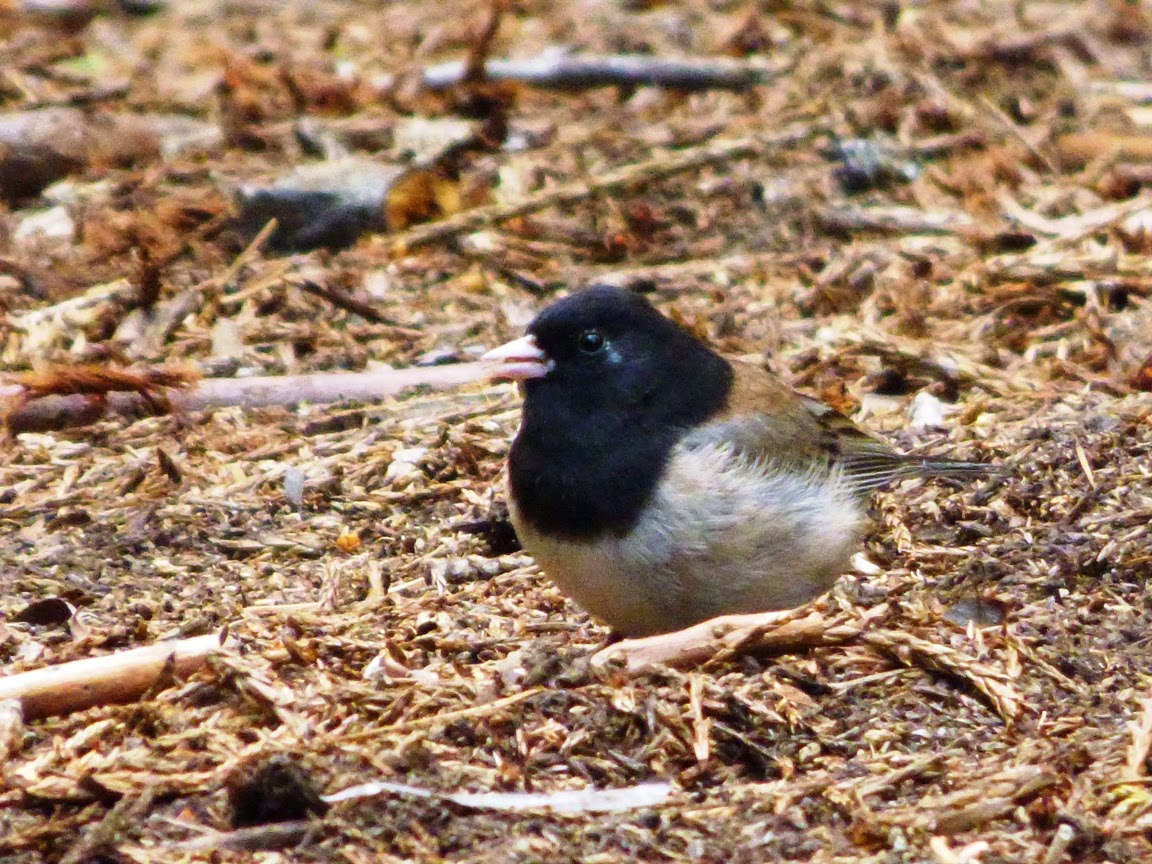
We saw several forest species on our stroll through the Sequoia grove, including Juncos (above), and the White-headed Woodpecker, a purely western species. It's found only in California, Nevada, and the Pacific Northwest. There were the requisite rodents, the squirrels and chipmunks, and the ever present deer. The deer are dangerous; they've killed more people in Yosemite National Park than the Black Bears (bears: 0 / deer 1).
There was also some kind of creature at the base of the big tree in the picture below...
Walking through a Sequoia grove is like walking back in time. One can imagine Velociraptors hunting prey in the shadows of these forests. Or, if you will, Imperial Storm Troopers looking for Luke Skywalker ("A long time ago in a galaxy far away").
Perhaps the most eloquent reminder of the antiquity of these incredible trees was a discovery made by my colleague at Modesto Junior College. During the Jurassic period, there was an ancestral Sierra Nevada, a mountain range that would have resembled today's Andes in South America, with high mountain ridges and active volcanoes. Rivers flowed through the mountains and onto the coastal plains, and dinosaurs wandered through forests of Sequoia-related species of trees. Some trees would occasionally fall into the rivers, and woody debris would be carried into the adjacent sea. Some of the needles and stems would be preserved as fossils that would later be uplifted and exposed by erosion in the foothills of the modern Sierra Nevada. And a twig of Sequoia needles is what my colleague Noah found in 2013 as we searched for fossils in the Foothills Terrane of the Sierra Nevada Mother Lode. A tree that was once widespread across the northern hemisphere now exists only along the California Coast, and in a few dozen scattered groves in the Sierra Nevada.
You can read the whole story of our little fossil adventure here: http://geotripper.blogspot.com/2013/02/hunting-for-fossils-in-sierra.html.

And if your plans this summer include Yosemite, try and visit the Mariposa grove before they shut it down. If you are too late, you can still hike to the smaller Tuolumne and Merced groves in the western part of Yosemite, or you can visit spectacular groves in Sequoia and Kings Canyon National Parks to the south, or Calaveras Big Tree State Park on Highway 4 to the north. There are a few other groves tucked away in the national forests that lie between the other parks.