Showing posts with label Sentinel Rock. Show all posts

Sunday, October 30, 2022

How It Was Today: Fall in Yosemite Valley

How it ended...

How it began...
I woke up late this morning. Mrs. Geotripper was finishing breakfast and asked if I'd like "to go up the river a little ways and find some fall colors". I had lots of grading to get through, so obviously I said yes, and around 11 or so we jumped in the car and headed up the Tuolumne River to see what we would find. There wasn't much, at least not in terms of fall color. So we went a little farther...
We followed Highway 132 up past Coulterville and on to Greeley Hill at a bit above 3,000 feet. Still not much in the way of fall color. So we went a bit farther up the hill and found ourselves at the Yosemite National Park entrance station at Big Oak Flat at 4,000 feet. We finally found a bit of color, although not at the intensity that a few more days of cold weather might bring. 
And we had made it this far, and Yosemite Valley was only 15 miles away. How could we pass it up? 
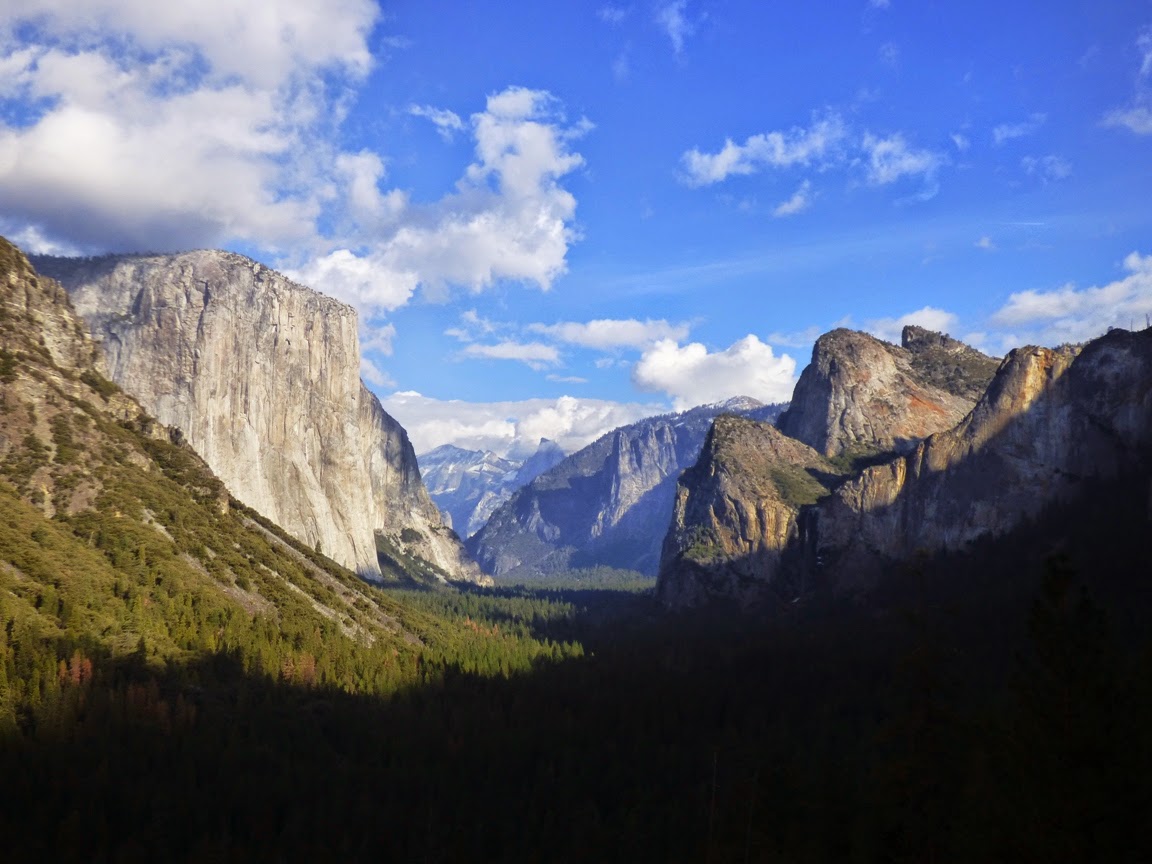
So on we went into the awesome gorge of the Merced River and into the valley itself. There was the first look at the distant cliffs of El Capitan (left), Half Dome (center), and Sentinel Rock and Dome (right).
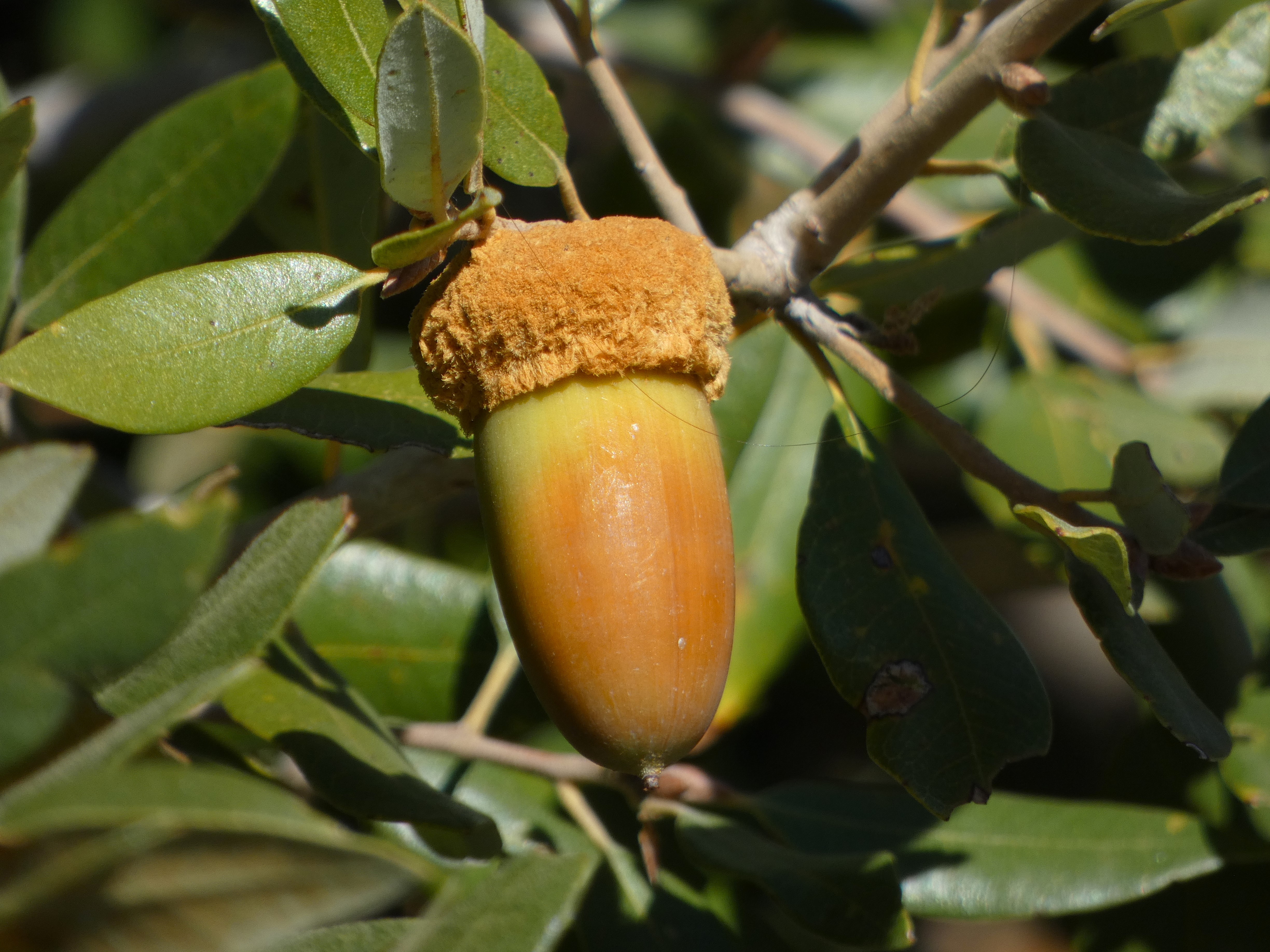
Closer at hand were a lot of ripening acorns. The bears and woodpeckers will be happy.
We reached the valley floor and started our tour of Yosemite's greatest hits. We were surprised to find some wispy curtains of water flowing over Bridalveil Falls. The 620 foot-high waterfall is a classic example of a glacial hanging valley. The main trunk glacier flowing through Yosemite Valley was able to erode a much deeper trough than the small glacier in Bridalveil Creek, so the floor of the creek was left hanging high above the main valley floor.
It was not a cold day, mostly in the sixties, but the sun was intense. It brought out what colors there were in the oaks and dogwood trees.
We didn't see a great many varieties of birds, but there were some Acorn Woodpeckers busy collecting acorns and hiding them in tree "granaries". Such trees can have tens of thousands of drilled holes that can hold a single acorn each. The birds live in loose family groups who search for and guard their food supplies.
Yosemite Valley is not a 'typical' glacially-carved valley. Most such valleys have a U-shaped profile, and are relatively straight. Yosemite Valley is characterized instead by bold cliffs that extend out into the valley with dark recesses in-between. This is the result of having eight distinct intrusions of granitic rock, ranging in composition from 'true' granite to granodiorite, tonalite, and diorite. They differ from each other in the proportions of the minerals quartz, potassium feldspar, and plagioclase. They also vary in the amount of dark minerals they contain including biotite mica, hornblende, and a little augite. They also vary in their pattern of fracturing (jointing), and this is expressed in differing vulnerability to erosion by ice, water, and mass wasting (landsliding and rock falls).
Sentinel Dome (above) is a good example. It is composed of fairly resistant Sentinel granodiorite, but it is jointed and thus forms a somewhat narrow high cliff that looms over the valley.
Yosemite Point on the other hand is composed mostly of unjointed El Capitan granite and forms a wide bold cliff. Sometimes people sort of 'miss' this incredible cliff because much of the time there is a stunning waterfall pouring off the west flank of the precipice (the dark mark on the left side in the picture below). That waterfall is only fifth or seventh highest waterfall in the world, and is known by the moniker of Yosemite Falls, measuring in at 2,425 feet. It wasn't actually dry today, but one needed binoculars to see the small trickle at the top of the cliff.
The autumn season is one of the best times to view Half Dome from the middle of Sentinel Bridge. The Merced River is flowing at a low ebb and the still waters make for memorable reflections. Half Dome is another example of an unjointed monolith of granitic rock called the Half Dome granodiorite. It is the youngest of the igneous intrusions exposed in the valley, with an age of about 84 million years. The Sentinel granodiorite is about 88 million years, and the El Capitan granite around 103 million years. These dates fall within the Cretaceous period, which means that when these molten masses were intruding the crust, there were dinosaurs wandering the surface four or five miles above. The dinosaurs would have experienced occasional volcanic eruptions when some of the intruding magma escaped to the surface.

In the years since, erosion has removed the miles of overlying rock and dumped it into the Central Valley or the waters off the coast of ancient California. The region seems to have been eroded to a low elevation landscape that was later uplifted to form the modern Sierra Nevada.
We wandered around Cook's Meadow and stopped into the store at Curry Village to replenish my t-shirt collection. The sun was starting to get low, so we made our way west to our favorite evening viewpoint, Valley View.
Valley View is almost a secret to Yosemite visitors because it has a small parking lot (maybe room for ten cars) at a blind curve so that if you are in the right-hand lane you might miss it. Since the road is one-way at that point, you would have to repeat a five mile loop to get back. The small parking lot is a blessing because it limits the size of the crowd. It's a quiet spot to enjoy the fading light on the cliffs of El Capitan and the Cathedral Rocks. The river usually flows slowly here making for memorable reflections of the cliffs above. We enjoyed the few moments of peace, and then headed home.
And that's the way it was today...
 

Friday, March 25, 2022

A Tale of Two Pullouts: Yosemite Valley From a Different Angle

El Capitan and the Merced River from the east

I know that I am truly privileged living as I do only a two-hour drive from one of the most sublime places on Earth, Yosemite Valley and the Sierra Nevada. We head up there two or three times a year, sometimes with students in tow, and sometimes on our own, so in 30+ years we've been there at least 100 times.

And I never get tired of it.

Part of the allure is seeing the seasonal changes. Winter provides the coating of snow, while fall provides the changing colors of foliage. Spring offers surging waterfalls and wild river flows. Summer provides...well...crowds, but also nice moments in places we learn of where the crowds can be avoided. We have favorite meadows and lakes for instance where people rarely stop. No matter when or where we visit, there always seems to be something new or different.

The Cathedral Spires are tucked away on the east side of the Cathedral Rocks at Bridalveil Falls
I know how it is if one gets to see Yosemite Valley for the first, and maybe only time. I've had that experience at so many other places around the world. The time available may be very limited, one may be part of a tightly controlled tour, and no one wants to miss any of the most famous views or hikes. And so it is that there is the required stop at Tunnel View, Bridalveil Falls, Cook's Meadow for the view of Yosemite Falls, and maybe Ahwahnee Meadow for a view of Half Dome. The walk to Lower Yosemite Falls, or Nevada Falls. And the Visitor Center. It makes for a full day, and a fulfilling day too. One of the most spectacular days you might ever experience.

And I never get tired of it. I'm perfectly happy to hit those same spots on my 101st trip to the valley. The season, the time of day, and the weather all conspire to make each stop a unique experience of wonder. But sometimes there are changes of a different nature, and that makes some trips really memorable. That is what today's collection of views is about.
Sentinel Rock rises above the south side of Yosemite Valley across from Yosemite Falls
Since the time that Yosemite Valley became a park, suppression of all forest fires has been the official policy. It was not however the natural condition of the parkland, nor was it the normal condition of the valley floor over the last few thousand years when it was managed by the original inhabitants of the region. 

The Ahwahnechee people, with roots among the Miwok and Paiute peoples of both sides of the Sierra, depended in large part on the acorns of the Black Oak and grazing animals like deer or bighorn in Yosemite Valley. It was in their best interest over the centuries to allow fires to burn through the valley floor and hold the quick-growing conifers at bay. When the park administrators put an end to the fires, the pine and cedar trees choked out meadows (only 65 acres of the original 750 acres of meadows remain) and grew into impenetrable thickets, blocking views of the canyon walls above.

What's worse is that choking off small fires can cause a buildup of fuel in the forest that could only lead to much worse fires than usual. This was always a danger, but it is far more hazardous today in a time of warming climate and extended droughts. Every Californian is fully aware of how wildfires in the state have morphed into monstrous events without parallel in written history.

The National Park Service has come around in their fire philosophy, especially after extensive fires a few decades ago in Yellowstone and Mesa Verde National Parks. They have instituted new policies of prescribed fires and selective tree removal to make the parks safer, but also to enhance the experiences of park visitors. In what way? The views.
The distinctive profile of the Three Brothers is the result of parallel jointing, or fractures in the granite that occur as the rocks are exposed by erosion
There are the parking lots that attract the majority of park visitors, but on the roads that loop around the valley there are many small pullouts, enough for perhaps three or four cars. In years past there seemed no real purpose for them, as they were surrounded by thick forest and offered no views or trailheads. On our visit a week ago, I found that two of those previously uninteresting pullouts had had the forest thinned out, and that they now possessed some outrageously spectacular views! The familiar iconic cliffs were there, but from angles I had never really seen before. In particular there was the long vertical cliff extending east from El Capitan, a view of the rarely seen Cathedral Spires (as opposed to the Cathedral Rocks at Bridalveil Falls), the vertical pillar of Sentinel Rock (often missed by people staring at Yosemite Falls), and the Three Brothers, which have never really had a designated viewpoint and are usually hidden by the tall trees. Upper Yosemite Fall was visible as well, perhaps farther away, but how many of you Yosemite veterans can recall seeing the falls with not a single other person in sight?
Yosemite Falls from a pullout west of Swinging Bridge
We had a leisurely lunch at the pullouts and wandered about taking pictures, and only two or three cars pulled off the road, and no one else actually got out. Except for the noise of passing traffic on a crowded Sunday afternoon, we literally had the best of Yosemite Valley to ourselves.
Prescribed fire in Yosemite Valley, with Half Dome and Clouds Rest in the distance.
We stayed at the park through Monday morning, and when we stopped by Tunnel View we witnessed another chapter in the new fire/forest regime: the ignition of a prescribed fire. It was done in March because the ground was still damp enough to prevent the uncontrolled spread of the fire. If you are on Facebook and would like to know more about forest management in Yosemite, check out (1) Yosemite Fire and Aviation | Facebook.


Thursday, May 10, 2018

The Sentinels of Yosemite Valley: Giving Them a Bit of Respect

Let's consider for a moment that this is anyplace else in the world. You look up and see a waterfall that is 1,920 feet high, falling in six major steps. In what place in the world would this not be a notable feature with a state or national park designation? In what place would there not be thousands of people visiting every day, snapping pictures and oohing and aahing?
There are no parking lots and viewpoint for this waterfall. As a rule people barely notice that it exists. If that seems astounding, then take this as evidence of the extraordinary nature of Yosemite Valley. 2,000 foot high waterfalls disappear into the scenery. The name of this particular one is Sentinel Falls.
I admit that part of the reason Sentinel Falls is not as celebrated as some is that it is seasonal, flowing principally in the spring season. It's usually dry by the beginning of summer when most tourists visit the valley. But when it is flowing, it is spectacular.
Sentinel Rock suffers the same kind of locational insignificance. In any other part of the world, a 3,000 foot high sheer cliff would elicit awe and wonder. In Yosemite Valley there are so many dramatic cliffs that Sentinel gets lost because people are trying to get a glimpse of Yosemite Falls on the north rim of the valley. Sentinel Rock and the adjacent Sentinel Falls are on the south side of Yosemite Valley, almost directly across from Yosemite Falls. Yosemite is the waterfall that catches their attention.
That's not to suggest that Yosemite Falls doesn't deserve the adulation it receives. The waterfall is 2,425 feet tall, somewhere around the fifth to seventh highest in the world. It always has more water than Sentinel does, and in many ways it is more dramatic. But when I was taking pictures of Sentinel last week in the rainstorm, I was the only person standing in my little corner of the floor of Yosemite Valley. I didn't have to share my moment with throngs of tourists all staring at the same feature and snapping the same pictures from the same angle. It was just me and a quiet moment in an often crowded and hectic place.

Sunday, November 13, 2016

Two Kinds of Falls Today in Yosemite Valley

There are two kinds of falls right now in Yosemite Valley. One comes from the time of year, and the other is a little bit unusual, the result of some powerful storms a few weeks ago.
Fall in California is not like fall in other places. It may start in the high country in late September, but it can take until mid-November at the lower elevations, for instance in the Great Valley or Bay Area (our most intense colors in town have yet to materialize). And even though fall started weeks ago in places like Yosemite Valley, there are still enough leaves hanging on to provide a colorful treat to visitors this weekend.
The other wondrous fall is that of the waterfalls in the valley. They are often still dry at this point in the year, as few storms have usually occurred this early. But the intense storms of two weeks ago are still draining over the brink of the valley walls. I wrote about the waterfalls two weeks ago when we visited in the midst of the storms, but I wasn't expecting to see them still going after all this time. It was a beautiful sight.
So enjoy some beautiful colors! In the picture above, Upper Yosemite Falls peeks out between the trees near Yosemite Lodge.
Sentinel Dome is a striking tower of granitic rock that is sometimes missed because it is on the valley wall opposite of Yosemite Falls.
Coming from the northwest entrance on Highway 120, the first view of the valley includes Half Dome and the top of El Capitan.
Yosemite Falls remains one of the most awesome sights on the planet. It drops a half mile over a sheer cliff and through a maze of granite clefts. To see the falls flowing while fall colors remain (barely) on the trees is a special treat.
Fall colors come in small spaces as well. We walked through the fen at Happy Isles and saw all kinds of color in the low shrubs and ferns. Water always flows here from springs in the rock debris at the base of the nearby cliff.
I had one other special treat today by taking a few moments to walk up the Inspiration Point Trail above Tunnel View. I got 200-300 feet above the parking area, and away from the noise of traffic and tourists. From my quiet vantage point, I had a glorious view of the entire valley. The only sad note is that what looks like fall color in the valley is not. The reddish patches in the forest are dead conifer trees, victims of California's ongoing five year drought. Without sufficient water, the trees don't have enough sap to fight off the borer beetles. It's just one more sign of the profound effect global warming is having on our world.

Saturday, January 17, 2015

The Way it Was This Week: Winter in the Valley of the Ah-wah-nee


Is there a more beautiful place than this, the Ah-wah-nee, or the Yosemite as some chose to call it years ago? I'm sure that everyone who explores the outdoors has "that place", the spot that represents the highest attainment of their personal concept of beauty in nature. In my life so far, there is no place more beautiful than this.


It isn't just the scenery, which of course is spectacular. It the privilege of coming back time after time, seeing the valley and park in all seasons and all conditions. I've driven through snowstorms, rainstorms, floods, and heatwaves to reach the valley, during every month of the year. I'm guessing I've made the journey 80 or 90 times in the quarter century that I've lived in the adjacent San Joaquin Valley. I've never had a disappointing trip. There is always something new, and there are the old familiar places as well. And much more remains to be explored.
As is clear from the last couple of posts, I was in Yosemite again over the weekend, a sort of last hurrah before beginning the new semester. Despite the lack of snow in the dead of winter, it was a serenely beautiful place. And...very uncrowded. There was some kind of big athletic competition taking place last Sunday or something. The Sentinel Bridge parking area is usually packed with vehicles. Here's how it was on Sunday:

It's a rarely fulfilled desire, the dream to have the most beautiful place in the world to myself. It's just a little selfish too, but hey, I wasn't keeping anyone else from visiting that day. Most seasons it is quite hard to imagine Yosemite Valley as a wilderness. It hasn't been a wilderness for nearly two centuries. But on Sunday, here and there, it was possible to envision the wildness.

After a long dry spell, Yosemite Falls began to flow again a few weeks ago after our December storms. I hope we will have some more storms soon. After a record-setting December, January has been dry. How dry? Zilch, not a drop of rain in the San Joaquin Valley, and none in the 10 day forecast. It is a bit worrisome. Three years of record-setting drought, and this year has the makings of a fourth.

We don't usually stop at the Swinging Bridge Picnic Area, as it is usually packed with people, but not Sunday. It offered wonderful views of Upper Yosemite Falls, and one of Yosemite's less familiar peaks, North Dome (above). I'm pretty sure that if Half Dome didn't exist, or Yosemite Falls, or El Capitan, or Sentinel Rock, or Cathedral Rocks, well then, I am sure that North Dome would be one of the most famous landmarks in Yosemite Valley.
Late in the day we found ourselves in the meadow below El Capitan looking for the free-climbers as they worked their way up the cliff. The few people who were still there were looking up so intently that it took a few moments for anyone to notice that a coyote was standing among us.

I took a moment to look at the oft-ignored cliff across from El Capitan, the wall of spires between Cathedral Rocks and Sentinel Rock. The names are less familiar to most park visitors, Crocker Point, Stanford Point, Taft Fissures, and again, in any other setting, these peaks and cliffs would be the focus of a national park, rather than the relatively unknown cliffs that they are. If the panorama shot below seems a bit less sharp, it's because it was done with my smart phone rather than my usual camera.
It was a beautiful day in a beautiful place. I'm anxious to return.

Where is your most beautiful place?

Sunday, January 11, 2015

Land of Shadows and Reflections: A Winter Day at Yosemite

Yosemite is simply a magical place. No matter when one visits, something incredible is to be seen. I'm always hard put to select my favorite time of year, but usually the answer ends up along the lines of "whenever I happen to be there" (though crowded, hot, and dry August is probably my least favorite).
On a whim, Mrs. Geotripper and I decided to go visit the valley today (and believe me when I say I never take it for granted that I can go to Yosemite on a whim). After a smashing start to the water year, it's been dry for several weeks, so we weren't expecting snow and neither were we expecting to see waterfalls. Yosemite and Bridalveil falls were doing okay, but the lesser-known smaller falls like Sentinel, Ribbon and Silver Strand were dry or nearly so. But we weren't disappointed at all. The air was crisp and transparent, and the winter light brought out contrasts that are sometimes missing at other times of the year (like the smog of summer caused by hundreds of campfires).
So, today's photographs offer up some of the beauty of shadows and reflections. The first picture is of course Upper Yosemite Falls reflected in the Merced River at Swinging Bridge. We don't stop there often because most times of the year the parking lot is more than full and people are everywhere. Today it was the busiest spot we saw, but on this winter's day (with football playoffs going on) that meant maybe one or two dozen people spread out along the river and picnic area. Looking west we could see the Cathedral Rocks in shadow (the second picture). Sentinel Rock towered over us (the third shot).
A bit later we had circled the valley and stopped at Sentinel Bridge, which to my great surprise and delight had but a single car in the parking lot! We quite literally had the meadow, usually one of the single most crowded spots in Yosemite Valley, to ourselves. We spent a peaceful hour wandering the meadow and taking pictures of the Cathedral Rocks again, and reflections in the Merced River.
Many people like spring in Yosemite. The meadows are turning green, the waterfalls are booming, and the Merced River swells to fill the meadows. The dogwoods are blooming. Some people like fall the best, as the dogwood, oak, and cottonwood trees are aflame with yellow, orange, and red. Some people like summer, because that's the only chance they have to see the place, and the high country (Tuolumne Meadows and Glacier Point) is available. Winter is a special time, especially when new snowfall graces the valley floor.

But what about the dry days of winter after the snow has melted away, and all the deciduous trees are barren of leaves and the falls are barely trickling? All I can say is that of all my visits over the years, this quick excursion was one of my favorites. It isn't often that one has a place like Yosemite to one's self, and there was more than enough beauty to go around.
More pictures to come!