It's July 4th! I hope you are enjoying your barbecues, the fireworks (if your towns aren't burning up in the wildfires), and the baseball games. The day celebrates our declaration of independence from Great Britain, and it means a lot of things to different people. The Declaration itself meant we were about to fight a war, and that is part of the meaning of independence, but what means even more to me is that a country was established with the intention of doing things differently than had ever been done before.
There was the concept of individual freedoms and rights, which through a long tortured history of more than two centuries have finally been granted to most, but not yet all of our citizens. We've fought wars to protect the freedoms of others, most notably the Second World War. We've led the world in technological advancements, including the first moon landing. There are many things to be proud of as Americans.
I hope you will give a moment's thought today to one of our greatest ideas of all: the idea of preserving the best of our natural wonders in a system of national parks and monuments. Before President Lincoln set aside Yosemite Valley in 1864 as a protected reserve, and before the establishment of Yellowstone National Park in 1872, no country had really given any thought to preserving the most spectacular landscapes within their borders.
But we did. We set aside somewhere around 160 national parks and monuments for ourselves and for future generations. We decided to preserve and protect these lands from the kinds of economic development that would spoil the essential nature of these landscapes. The idea has caught on, and now national parks and world heritage sites can be found across the planet.
Many of the parks are set aside because they are the ultimate expression of geological processes. Think of the geysers and volcanism at Yellowstone, the Colorado River and two billion years of sediments at Grand Canyon, the glacial valleys and granite outcrops of Yosemite. I take my students out there because these parks are among the best places to appreciate the long geologic history of our continent; we know that year to year, the outcrops that tell the story will not disappear under pavement or shopping centers.
There are many reasons that one can have pride for one's country. The national park system is one of the reasons I am proud of the United States of America. Our national parks have problems, and they are perennially underfunded, but they are there, and will be for a long time. They deserve our love, support and respect. Happy 4th of July!
Showing posts with label National Parks. Show all posts
Wednesday, July 4, 2012
Thursday, May 17, 2012
Name That Park! A Thursday Quiz
Many of you know that I love blogging because it takes me so many places, and I love talking about them. One thing I have tried to do is to get away from the best-known parks, or get to the lesser-known parts of the famous parks. I am on the final stages of a reconnaissance
trip checking out the route of a proposed July 21-27 trip with the AAPG (although anyone is invited to join us). I came across some nice new localities, and I thought I would challenge some of my geography-expert readers to a bit of test. Name these parks and monuments! Some parks may be represented more than once. The parks are located on the Colorado Plateau. No prizes if you get them all, other than the realization that you must have an encyclopedia for a mind. A few clues are offered here and there....
1) The arch above is formed in the Entrada sandstone of Jurassic age.
2) The folks who manage the ruins above claim them to be the single most visited archaeological site in the United States.
3) The layers are topsy-turvy because they were trapped into a monocline
8) The unmistakable clue is the color of the road.
9) Basalt lava flows in a park not usually associated with volcanism.
1) The arch above is formed in the Entrada sandstone of Jurassic age.
2) The folks who manage the ruins above claim them to be the single most visited archaeological site in the United States.
3) The layers are topsy-turvy because they were trapped into a monocline
4)The rocks above may actually be parts of two or three parks.
5) What are those white cliffs in the distance?
6) Note that the high cliff on the right is the same rock as the lower cliff on the left, only offset. This park has its faults...
7) The spires could be called hoodoos, but they aren't, usually.
9) Basalt lava flows in a park not usually associated with volcanism.
10) A slot canyon carved into the Navajo Sandstone.
Happy hunting!
Friday, May 20, 2011
Taking Granite for Granted? Quick, Name a National Park in California!
Quick, name a national park in California...Which ones appeared first in your mind? Yosemite? Sequoia? Maybe Death Valley? There are a few others, depending where you live, so Channel Islands, Redwood, or Lassen Volcanic might have been a first response. But who among you thought first of Joshua Tree National Park?
As a native-born and bred Southern California, I am guilty of ignoring the treasure that existed in my backyard. National monuments often get short shrift as part of our nation's national park system, and I am not totally sure why. Many people don't even know the difference, but somehow assume that monuments are somehow a second-tier series of parks, places that are almost as good as national parks, but not quite. Under law, national monuments are the equivalent of national parks, but monuments are declared by Presidents under the terms of the National Antiquities Act, and national parks can only be established by Congress. What this has meant in practice is that Congress has often been reticent about establishing national parks, given the many pressures exerted by special interest groups and lobbyists. Presidents, acting as a representative of all the people in the country, have recognized the national value and significance of these sites, and have declared them to be national monuments to provide protection of the resource.
Often, when a national monument has been in existence for a few years or decades, Congress finally comes around and establishes the monument as a national park. This is true even for some of our most iconic parks; both Grand Canyon and Zion were first declared national monuments before Congress acted in 1919 to make them national parks. There are numerous other examples.
So, why am I talking about national monuments? Joshua Tree is a national park. It turns out, though, that Joshua Tree followed a similar arc of many other park areas around the country. It was established as a national monument by FDR in the 1930s, and still was a monument when I was growing up in SoCal in the 60s and 70s. And I was guilty of thinking of monuments as second-class parks. When I dreamed of traveling, my heart was up in the Sierra Nevada somewhere, and I really didn't get to know Joshua Tree all that well, my trips being mostly confined to a handful of scout camping trips. I remembered a lot of big boulders, joshua trees, and vicious jumping cholla.
Joshua Tree achieved status as a national park in 1994, along with Death Valley, another longtime national monument. And I was by then living elsewhere. These last few years I have been working to rediscover some of these places of my youth that I took for granted. So I made a trip out there last week to check things out and found out that I was also taking the park for granite, too.
What did I learn? The first thing was an eye-popper...having thought the park was made entirely of granitic boulders, I didn't know about the rich variety of other rocks found there, and how they relate to each other. The picture above is one of the starkest examples. Click on it and enjoy a unique panorama; you are looking at a scene from miles within the crust of the earth. This is the roof of a granitic magma chamber, where it was intruding into the surrounding older rocks. Yosemite is famous for its exposures of granitic rock, but you can't see stuff like this in the Sierra. Once I saw this exposure, I knew we were in for an interesting day! More to follow...
Thursday, October 8, 2009
Ollie Hopnoodle's Haven of Bliss and America's Greatest Idea


A favorite seasonal tradition for many people is a viewing of the movie "A Christmas Story", the adventure of Ralphie and his quest for a Red Ryder BB gun. Most people are unaware of a second film in the adventures of Ralphie that came out as a 1988 Disney TV movie: "Ollie Hopnoodle's Haven of Bliss". Jean Shepherd once again narrated the adventures based on his childhood in 1940's Indiana, with Ralphie's first summer job, and the family's traditional yearly vacation to a lake in Michigan, the Haven of Bliss resort. It has yet to be released on DVD, but if you get a chance, check it out. It's hilarious, and even touching at times.
Ollie Hopnoodle came to mind last week when I was watching Ken Burn's wonderful documentary "The National Parks: America's Greatest Idea". As America's relationship to the national park system evolved, families who hit the road in the summertime began to "collect" parks in a sense, visiting as many as they could over the years. It could be a tremendous undertaking, given that most Americans lived in the east, and most of the parks were in far-flung locations in the west. Others come back to parks they love the most, year after year, in much the same way that Ralphie's family returned to Haven of Bliss. In another wonderful park movie, "Yosemite: Fate of Heaven", a family is interviewed about their yearly sojourn to the tent cabins of Curry Village. They have been there so many times that they can describe the relative merits of the view from one cabin over another.
This was on my mind last weekend as I made my estimated 75th trip to Yosemite National Park. I was thinking of the relative merits of learning a place in depth, or of seeing as many of the wonderful places of the world as one can with the limited time we all have for such ventures (the idea of seeing as many places as possible resulted in a fairly wild geoblogosphere meme and accretionary wedge last year). I tend towards the "collector of many places" school; I want to see as much of the world as I can before I'm done. Yet I also feel a certain frustration when I am on a once-in-a-lifetime tour: trying to take the pictures of things I may see only once, without the chance to linger and get to know them well.
In contrast, I live only a two hour drive from Yosemite National Park, and believe me, I never take it for granted. It is a true gift to be able to suddenly decide to run up to the park for a day or a weekend. We enjoy the sights everyone else seeks out, but we spend part of every trip trying to find something new, something we have never seen before. Sometimes that takes the form of pulling out the camera at a place that I would guess has been photographed 100 million times or more, and finding some new angle, some new feature that doesn't show up in the travel magazines. Other times it means hiking a new trail, or following a new road. It's not on the park map, and not widely known, but there is a perfectly accessible old fire lookout in the west part of the park that commands an incredible view from the Central Valley to the crest of the Sierra Nevada.
It boils down to the idea that one life just isn't enough. Every trip not taken is a loss and a waste, whether it is to a famous park half-way around the world, or a familiar non-descript lake in the midwest, hidden deep in a beautiful forest. Get out and enjoy your world, and take your kids with you! Electronic games can wait until you are sitting in the back row at school or stuck in another department meeting.
What do you think?
Today's pictures seem familiar enough, but I had never seen Half Dome in such stormy weather conditions, and the valley looks different from Tunnel View if you climb the hill and use some vegetation for framing.
Update: fellow geoblogger Callan Bentley was in Yosemite the same weekend as I was, but we ended passing each other on the highway! His photojournal can be found here.
Thursday, October 1, 2009
Time Beyond Imagining: The End of the Story, or the Beginning?

Picking up from the ecologic trauma of my previous post, there was, in fact, a significant addition to the collection of animals living in the Colorado Plateau region in the last 10,000 years or so. It was different than any creature that existed in the region over the last 2 billion years, in that instead of living within and being adapted to the ecosystem, this creature sought to change the ecosystem to meet its own needs and desires. I am referring to humans, of course.The first humans were hunters and nomads who made spears and atlatls to bring down large game. According to the anthropologists I know who still speak to me (they argue a lot about this stuff; it's nice to know how civil we geologists always are) they either brought about the extinction of the megafauna, or had nothing to do with the extinction. Call us the suspects or the unindicted co-conspirators in the affair, or the totally innocent bystanders. But the fact is, our cousins and forebears got to see these animals and lived among them. Some of the oldest artifacts ever found in Grand Canyon National Park are split-twig figurines of large mammals, dating to three or four thousand years ago. Even more intriguing are two petroglyphs from Utah that seem to represent a mammoth or a mastodon. They are controversial, with some saying that the rock art does not show the necessary antiquity to be the real work of an eyewitness to these extinct elephant relatives, but in any case, humans were witnesses to one of the great extinctions in the geologic history of the world, and the Colorado Plateau. And they may have caused it.
I paint with very broad strokes here, but we humans have a history of coming into a new region, using the resources, and living beyond our means until the resources are gone. Then, some kind of tragedy depopulates a region (famine, disease, invasion), so we move on and start again somewhere else.
The Colorado Plateau was first occupied by hunters and nomads who left little sign of their passing, aside from stone tools and simple shelters. Around 2,000 years ago, people began planting the food they consumed, and started building more substantial shelters and pithouses. The climate favored agriculture, and over the centuries they added new crops, including maize. The population of the plateau country expanded to levels similar to the population living there today, but by 1200 AD, something was going very wrong. A decades-long drought disrupted food supplies, and soil erosion was rampant. The architecture of their dwellings changed to a more defensive orientation, including entire villages built in high alcoves in the sandstone. By 1300 AD, pretty much the entire region had been depopulated.
Over the next few centuries, other bands of people arrived, the Navajo, the Utes, the Apache, and they lived and thrived until the region was invaded by waves of Europeans and then Americans. It seemed that everyone who arrived now was looking for something of value, be it gold, or beaver pelts, or grasslands for grazing, or coal for mining. Sometimes they found nothing and left again. If they did find something of value, they mined or grazed or hunted until the resource was exhausted, and the region would be once again abandoned.
And that is why I feel lucky to be living in an extraordinary time. Some time in the last century, there was a small group of individuals who saw a value in the land of the Colorado Plateau that was not related to money. They fought for the preservation of the best parts of the plateau country as national parks and monuments, set aside for the people of the country as a place of recreation and introspection. It was a new idea, and it was not without problems. The earliest parks were seen by their creators as tourist gold mines, and to draw tourists all manner of hotels, railroads, roads and other "improvements" were constructed. Predators were mercilessly killed off to build up deer herds. Powerful enemies were lined up to fight the establishment of every one of our national treasures, and they fought on even after parks were formed, using war and depression as an excuse to exploit valuable park resources. But through it all, the parks were preserved for the most part in a condition resembling their primeval state. They were preserved for the purpose of learning and for research.
The Ken Burns documentary "The National Parks: America's Best Idea" wraps up tonight on PBS stations. It is a stunning piece of work that explores the human journey that resulted in our national park system, an American idea that is now emulated around the world. It has been a revelation to see the story laid out in chronological order, with all the mistakes and misjudgements by people we see as park pioneers and heroes. And still, we have a park system that the American people, and indeed the world can be proud of. It is, as special unique landscapes open to all people, the best embodiment of the American ideal that all people are created equal. If you missed the first five episodes, they can be watched in their entirety on the website linked above.
And with this post I have reached the end of my chronicle on the geology of the Colorado Plateau! A project I thought would last for a month or so and include maybe a dozen posts grew into something much larger. I have no idea how many of you have followed along from the start, but I will put the posts together into a chronological unit very soon if you want to or dare to catch up. I hope you have enjoyed this journey as much as I have had writing it. I also want to thank the many people who commented and offered new information as we journeyed along.
Oh,gee... now I have to think of something new to write about!
Monday, September 28, 2009
America's Greatest Idea: the National Parks

Labels:
America's Greatest Idea,
Ken Burns,
National Parks
Sunday, September 27, 2009
No Child Left Inside! Our National Parks

- Devilstower, over at Dailykos.com, has a great post today about Little Giants , wondering what would happen if the estimated 5,000 to 7,000 tigers in the United States were all released at once.
- I had a great meeting with 60 fifth-graders in my lab this week, introducing them to the world of the geologist.
- I led a field studies class last week to the Cascades, studying the role of volcanism in three different national parks and monuments: Lassen Volcanic, Crater Lake and Lava Beds.
- Ken Burns and PBS are offering a six part documentary on "America's Best Idea", the story of the National Parks of America.
America's national parks are indeed one of the greatest ideas ever conceived by a society. The choice of overrunning a landscape and stripping it of resources to the point of ruination is a story that has been repeated over and over in human history. The idea that we might actually preserve a portion of our land in some condition approaching the primeval, for the benefit of all of its citizens, was an extraordinary leap that advanced civilization. If nothing else, the parks give us a focus point to understand how much we truly have changed our lands, and how far removed from our heritage we truly are. I am eagerly awaiting the Ken Burns documentary; the bits and pieces I've seen already are encouraging. Be sure to check it out.
My journey over the last week drove home the point of just how geological our national parks are. While acknowledging the historical nature of many parks in the system, such as Civil War battlefields and the like, most people think of places like Yosemite, Yellowstone or the Grand Canyon when they think of national parks. Although many people think of the national park experience as seeing wildlife, the bears, the moose, the buffalo, the deer and chipmunks, it is the rock that makes a place like the Grand Canyon or Yosemite Valley, it is the volcanism that has built the Hawaii Volcanoes, Haleakala, Rainier, Crater Lake, and Yellowstone, it is the movement of ice that sculpted the Grand Tetons, Glacier or the North Cascades. To truly understand a national park is to have an education, a true hands-on education, in geology. And yet: as Lee Alison of Arizona Geology points out, there are only 20 geologists employed in the Geologic Resources in the national park system, compared to 800 biologists.
The power of the national parks to move us is rooted in the common experience that many Americans have had while visiting our national parks, sometimes as adults, but especially as children. How many of us have that memory of playing in a river, camping out in the dark listening for the snuffling of bears, hiking a steep trail, or even conquering our first mountain? I remember as a young child climbing to the top of some small hill in Sequoia National Park on the Heather Lake trail, and giving it a name; I also remember the terror of being lost in a campground, having tried to find my own way to the bathroom in the dark as a five-year old. Terror at the time, and yet one of my most cherished memories, along with my first face to face meeting with a bear at Seqouia.
My visit with the fifth-graders this week was a startling reminder of something I already knew. Too many, way too many kids are not getting even a chance to experience their heritage as Americans. I live less than a two hour drive from one of the crown jewels of the national park system, Yosemite National Park, and almost none of these kids have been there! There are many reasons, of course, perfectly logical reasons. Even a twenty dollar entrance fee is too much for many struggling families, not to mention the cost of gasoline (we have 17% unemployment in our county right now). There is less and less of a cultural appreciation for simple forms of recreation: electronic games are very alluring to the short-term attention span of so many of our kids. And our kids, fed on a steady diet of junk food, and lacking any kind of exercise in their schools, just aren't healthy enough to appreciate hiking a trail or running away from a bear or snake.
And yet: these kids were excited just to see images of their national heritage. And I swear their eyes lit up when they came to the realization that these experiences were out there, and they could take part in them if they chose to. They could see an erupting volcano if they chose to. They could find a dinosaur bone in the ground. They want to see and experience these places, if we found a way to get them there.
It is we as a society who are robbing the youth of our country of their heritage. Every time we cut the budgets of our schools to the bare minimum of math and English classes, we take away the most valuable part of education. English is probably important, but what use is it if these kids have nothing to write about? An education is all about experience, not just knowledge.
And what about the Devilstower blog entry on little giants? In the last twelve thousand years, our continent has lost a huge part of our ecosystem: the megafauna. The North American continent once played host to mammoths, mastodons, giant elk, bison, camels, horses, sloths, and many other huge creatures. Most of them are gone, although, as Devilstower points out, some survived much longer by evolving into smaller forms (dwarf mammoths survived on the Channel Islands off California thousands of years longer than their bigger mainland relatives). What's left? The bison and elk and grizzly bears of places like Yellowstone National Park. For now, these creatures are managed as if they were in a zoo rather than part of an ecosystem, but there is a growing recognition that if we are going to choose to have these grand animals in our care, we have to see our land not as a few isolated protected havens like Yellowstone, but as a continuous habitat extending beyond park boundaries where these large animals and humans can coexist. It is a contentious topic to be sure: look at the controversy over the de-listing of the wolf from the Endangered Species Act.
One more note on the topic: this month's Accretionary Wedge, hosted by Tuff Cookie at Magma Cum Laude, is based on the following question: What kind of Earth Science outreach have you participated in? Have you hosted a geology day at your department, given a field trip, gone to your child's/niece's/nephew's/cousin's school to do a demonstration, or sponsored an event for Earth Science Week? To this I would add: You don't sponsor outreach? What do you plan on doing to change that?
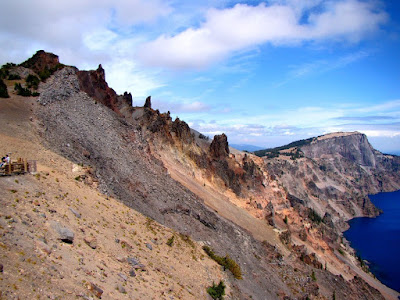
Our pictures today? The west rim of the Crater Lake caldera, showing Llao Rock, and a black bear in Sequoia National Park. Something that every child should have a chance to see.
Subscribe to:
Posts (Atom)


