Showing posts with label Eureka quake. Show all posts
Tuesday, March 11, 2014
California's 6.9 Magnitude as Recorded at Modesto Junior College
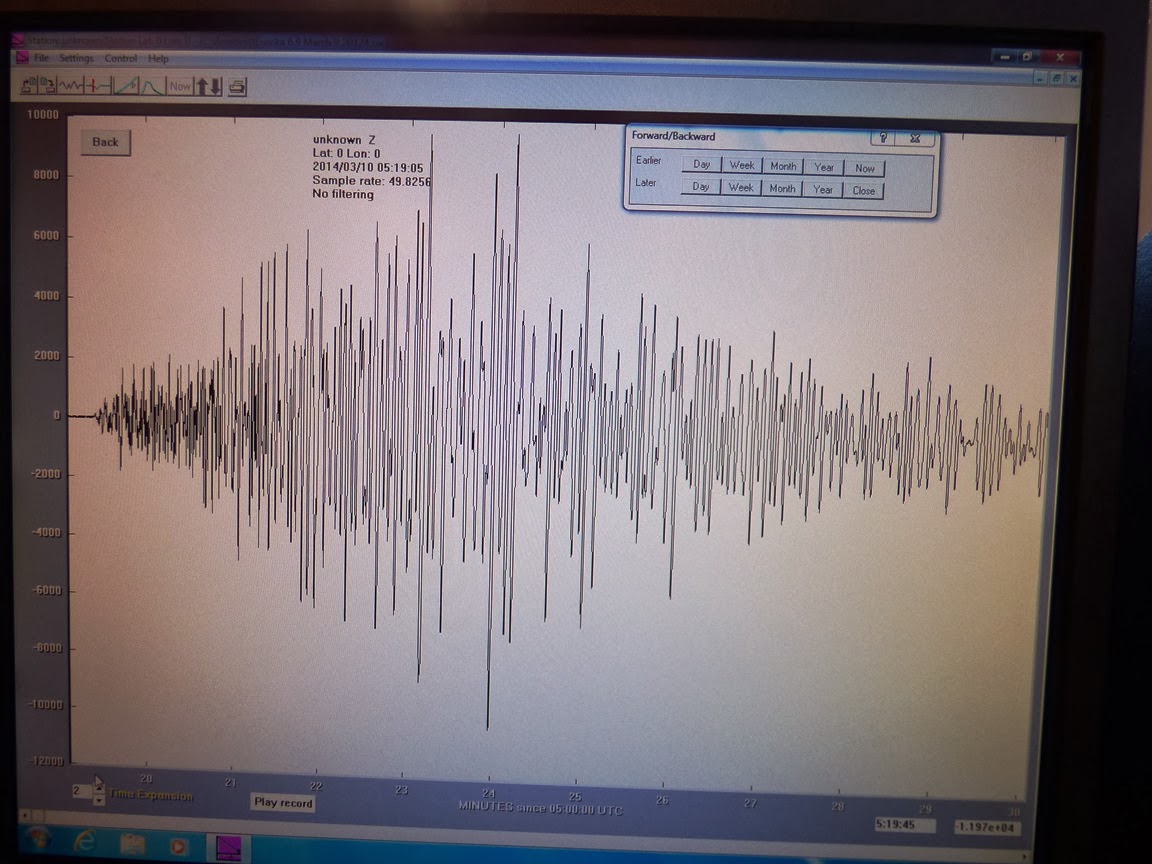
Here is California's 6.9 magnitude earthquake from last Sunday as recorded on our rather simple seismometer situated on the West Campus of Modesto Junior College. The unit is up on the third floor of the new Science Community Center, which is not ideal from a recording standpoint (the building is subject to all kinds of vibrations), but it's wonderful as an educational tool. We have one of the monitors up against a window where students can check for earthquake activity (and of course jump up and down to make their own earthquakes). The activity across the bottom of the record is the vibration of students walking by on Monday morning. This is the first major seismic event that we've recorded since installing the unit.
The horizontal lines on the monitor represent one hour increments, so the whole screen covers about 24 hours. The quake happened at 10:18 PM local time, and the shaking lasted for a good fifteen minutes. This doesn't mean that people were being shaken the whole time, because the actual humanly perceived shaking lasted only about 15 seconds. Instead, the ground continued to reverberate more slowly, so the movement was imperceptible. The waves would have continued all over the world and through the planet as well. They would have been detectable on a seismometer in India or Africa.
Here is the isolated and expanded version of the event. It covers about eleven minutes of the shaking:
Tuesday, January 12, 2010
A Tale of Three Quakes
There have been a number of earthquakes in the last week, some benign, and one an unfolding tragedy. I want to use my lab recordings of three quakes to make a point about the magnitude scale. The first recording, above, was a little 4.1 shaker on January 7 in the San Jose area, about 50 miles from my lab in Modesto. It just barely reached the threshold to be recorded on my unit. No damage was recorded.
The more serious California quake was the 6.5 magnitude event offshore of Eureka and Ferndale in Northern California. The magnitude scale is exponential, in that the energy release increases by a factor of about 30 for every number on the scale. A magnitude 6 quake is 30 times more powerful than a magnitude 5, and 900 times (30x30) more powerful than a 4. Therefore, the Eureka event was over a thousand times more powerful than the San Jose event. This shows on the seismograph record above: the recording was offscale for nearly 10 minutes, and waves recorded for over an hour (about four minutes are recorded on each screen shot). This was despite the fact that the quake was several hundred miles away from the seismometer. Eureka and the other communities suffered some minor damage, but few injuries have been reported.
Today's 7.0 magnitude quake in Haiti is a far more serious matter. It was several times larger than the Eureka event, and was centered beneath a crowded urban center where architecture standards are far less stringent. Preliminary reports are not sounding good, and prayers are probably in order for the people who live there. It's not like bad things haven't been happening to Haitians over the years. Even though the event was thousands of miles from my lab seismometer, it still was nearly off-scale, and the shaking lasted more than an hour.It was a striking introduction to geology for my students, who were sitting down for their very first laboratory section today when the waves arrived from the Haiti event.
The recording unit is a simple lab seismometer that I got from Ward's Scientific about 15 years ago for around $3,000. It has done a fine job of catching most of the significant events (magnitude 7) around the planet, and most of the magnitude 4 and 5 events in California.
Labels:
Eureka quake,
Haiti quake,
San Jose quake,
seismometer.
Subscribe to:
Posts (Atom)

