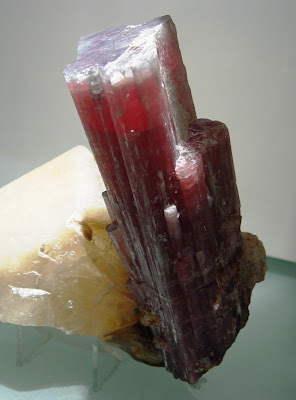
Off on another trip this weekend, to the Spring Conference of the National Association of Geoscience Teachers, Far Western Section, hosted this year by Palomar College and CSU San Marcos. We will be participating in a number of field trip choices along the southern California coast, and up in the Peninsular Ranges. The highlight for me will be a tour of a working tourmaline mine in the Pala area.
Tourmaline is a beautiful complex silicate gemstone. The highly variable composition results in a rainbow of colors, sometimes in a single stone. One of the more famous is the "watermelon" stone that is green on the outside and bright pink on the inside. It often occurs in trigonal prismatic crystals. The tourmaline occurs in pegmatite veins associated with batholithic rocks of the Peninsular Ranges. During the early part of the last century, the stone was highly desired in China, although demand dropped off later on in the 1920's. Some of the gemstones are nothing short of spectacular, weighing several pounds, and reaching a foot in length.
The National Association of Geoscience Teachers is a great organization to meet with other geology teachers, and to see some really wonderful parts of the western United States. During NAGT conferences I have had the opportunity to walk around the deepest parts of open-pit gold mines, explore active lava flows, search for fossil fish in old lake beds, and to visit some of the most beautiful places I can imagine. We are always looking to add new members...the Far West Section, covering California, Nevada, and Hawaii has two conferences every year, and offers an extensive collection of geological road guides from past conferences. Our Fall 2008 will be hosted by CSU Chico, and will have trips exploring the northern Coast Ranges and the Lassen Peak region. Other sections around the country have similar programs available. The national NAGT publishes the Journal of Geoscience Education, and has extensive web resources available.
Check it out! The Far West Section website can be found at
http://nagt-fws.org/ and the national website is at
http://www.nagt.org/
 I've noticed some deskcrops on the geoblogosphere of late, and since I missed one of the early Accretionary Wedges on the topic, I want to "show and tell" some of my deskcrops too. Geologists are notable hoarders and collecters of shiny objects (not unlike crows and packrats), and our desks and workspaces get cluttered quickly. My most treasured single item is a highly crystalline sample of azurite, one of the ores of copper. I'm a sucker for deep blue...
 Decades ago in a different job, I was tasked with cleaning out a bunch of old senior exercises in a basement storage area, and a lot of rocks got tossed. This one caught my eye, though, because of the color. The pink crystals are the gemstone tourmaline, and the lavender flakey crystals are a form of lithium-bearing mica called lepidolite. My best guess is that it came from one of the mines in the San Diego region of southern California.
 Some deskcrops are not eye-catchers, but have special significance. These bladed crystals are samples of anorthoclase, from the pool of lava on at the summit of Mt. Erebus in Antarctica. It was collected by a researcher who spoke at our campus a few years ago, and was kind enough to donate the samples to the department.
 It was kind of hard to choose my favorite deskcrops! The photo above is about a fifth of the total space on my desk, and the rest is similar to this. Books? Not so much. That's what bookcases are for.

