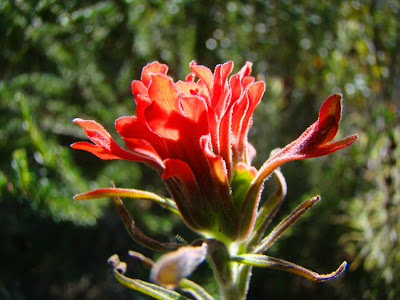
We learn about geology for many reasons. If you have ever visited this blog before, you know we learn geology because it is just plain fascinating. But sometimes we learn geology because lives are at stake...
It has been a week that will long seared into our collective memories as we watched a tragedy unfold in real time in Sendai, Japan. An earthquake of magnitude 8.9-9.0 struck about 80 miles offshore, with a horrific tsunami that did incalculable damage along the coast of the island. It then spread throughout the Pacific Basin, and the effects of the quake became worldwide in scope. Whether one realizes it or not, every human being on the planet was touched by the shaking. Not in some metaphysical new-age sense, but literally. The waves were detectable for hours on seismometers worldwide, meaning we were all rising and falling whether we were aware of it or not. We were all part of this story.
Many will watch an event like this unfold and try to find some meaning. In one sense, there was no meaning; this was something the Earth does. Subduction zones have been active on this planet for billions of years, and will continue to be active for billions more. The oceanic lithosphere shifted a few tens of feet deeper into the mantle, where it will eventually be melted or distorted beyond recognition. The materials disappearing from the surface today will eventually reappear, as part of a volcanic eruption, or as a fault sliver along some plate boundary in some future era. Events like this are common beyond measure; the Earth has experienced millions upon millions of huge earthquakes like this one, and though life is extinguished in some areas, life in general goes on. This quake meant nothing in the long run.
On the other hand, there was much about this tragedy that has meaning. With our brief life spans measured in decades, we will rarely experience such events in our personal lives. I could never wish such tragedy on anyone, but we also learn that living on this planet means that we are sometimes exposed to extreme deadly events. If not an earthquake, then a volcanic eruption. If not an eruption, a deadly flood. If not a flood, then a searing heat wave, or freezing blizzard. No one is totally safe or immune from these events, and most of the time we are not really aware that they can happen to us at all. They come as a total surprise.
In earlier centuries, such events elicited cosmic and supernatural explanations. It was the capricious nature of the gods that caused these terrible punishments. These people must have done something wrong to deserve such horrific retribution. If we couldn't think of an explanation, we made one up. I would love to say we have somehow moved on from this kind of thinking, but charlatans like Pat Robertson and others remind us constantly that ignorance and hate are alive and well in our society and across the world.
Why is geology important? Geology provides us with a new mythology of the world, one that based on a better understanding of the processes of our planet. We don't just see an earthquake happen on the surface and jump to the conclusion that the giant turtle that underlies our bit of land has taken a few steps. Instead we explored new pathways to knowledge that revealed that the earth itself is releasing energy to space, and that one of the ways that this happens is through the movement of lithospheric plates. Do we know the absolute truth? No, we don't. That's why we seek to learn more. We can now predict
where earthquakes are likely to happen, but we cannot tell when, at least not well enough to save lives and property. If we are to live at the limits of sustainability on this planet, we need to know all we can about it.
Why is education important? Everyone has a right to know what geologic hazards may affect their lives. It should be a fundamental human right. It's not, but we can make the effort to make sure that people know what can happen, and help them to prepare for it. I live on a plate boundary, and a major earthquake is likely to strike close to my home. But I know from personal observation that people in California are shockingly unprepared for a major seismic event. Few have an emergency kit in their home, or a plan for what to do in the event of a major quake. Few people know the location of the legendary San Andreas fault, and even fewer can name any of the dozens of other active faults that exist in our state. We see the unfolding disaster of self-destructing nuclear power stations in Japan, and are mostly unaware that we have nuclear power plants along the California coast (there were even plans to build a nuclear plant directly on the San Andreas fault at Bodega Bay in the 1960s). We can't
make people learn these things, but we've got to try, and we have to give our teachers and educators and media specialists adequate tools to do so. Recession or not, cutting back on education at all levels is a foolish idea.
Seers and psychics have always sought to see the future. They have used tea leaves or chicken entrails, and consumed hallucinatory drugs to achieve visions. Earth scientists use seismometers and supercomputers to model future activity along fault zones (and consume lots of coffee). They also make predictions in many other fields, including climatology, hydrology, and volcanology. Our society is living, as I said before, at the very limits of sustainability. We need to know when the quakes will happen. But even more importantly, we need to use the tools at our disposal to understand the changes that are happening in our climate. We need to fully understand the behaviour of ocean currents and cycles. We need to have a clear understanding of how much coal, gas and oil is left, and how the continued use of these fuel sources affects the climate. Recession or not, cutting back on basic research is a foolish idea.
Why the flower at the beginning of this post? I wasn't sure at first. I was in the field yesterday with my students, looking at California's Mother Lode. It's early for wildflowers, but a few were visible here and there. This was a beautiful Indian Paintbrush that seemed to be glowing in the sunlight. It occurred to me that the best flower displays in the Sierra foothills actually take place in the aftermath of forest fires. A disaster wipes out the old trees and tangled underbrush, but life springs back, and sometimes there is beauty. I guess I am hoping that some good can come of this disaster; that we might make some smart choices about where to go from here...
POSTSCRIPT: After posting this, it occurred to me that I forget to mention one more atrocity: media coverage. The cable and network news have abrogated their responsibility to produce responsible journalistic coverage in favor of spectacle and high ratings. They long ago let go their science advisors, and their news readers (and that's all they are anymore) have little or no education in the earth sciences. They have very little knowledge or expertise in geology, seismology, or climatology, and they continually make the same factual mistakes every time there is a new earthquake or other natural disaster. FOX, MSNBC, and CNN: your science coverage is an embarrassment to journalism.
 The other day I provided a few screen shots of the seismic record that we captured in Modesto of the Sendai Earthquake in Japan. As I noted in that post, our seismometer is an old teaching model with deeply outmoded computer software, and all I was able to show were some screen shots. Well, I loaded the program on an older computer in the department, transferred the earthquake data to a floppy disk (remember those??), transferred the data onto a third computer where I could transfer the data to a CD-ROM, and finally was able to send the output to a printer. So today I offer the complete record. It's kind of astounding. The top picture is the initial minutes of the quake. You can see the amplitude of the waves rapidly increasing until they were off-scale. The notations on the left are the elapsed minutes, four minutes to the inch.


