Showing posts with label Lunar eclipse. Show all posts

Tuesday, March 3, 2026

I Got Up at 3am So You Wouldn't Have To: The Last Lunar Eclipse Before 2029


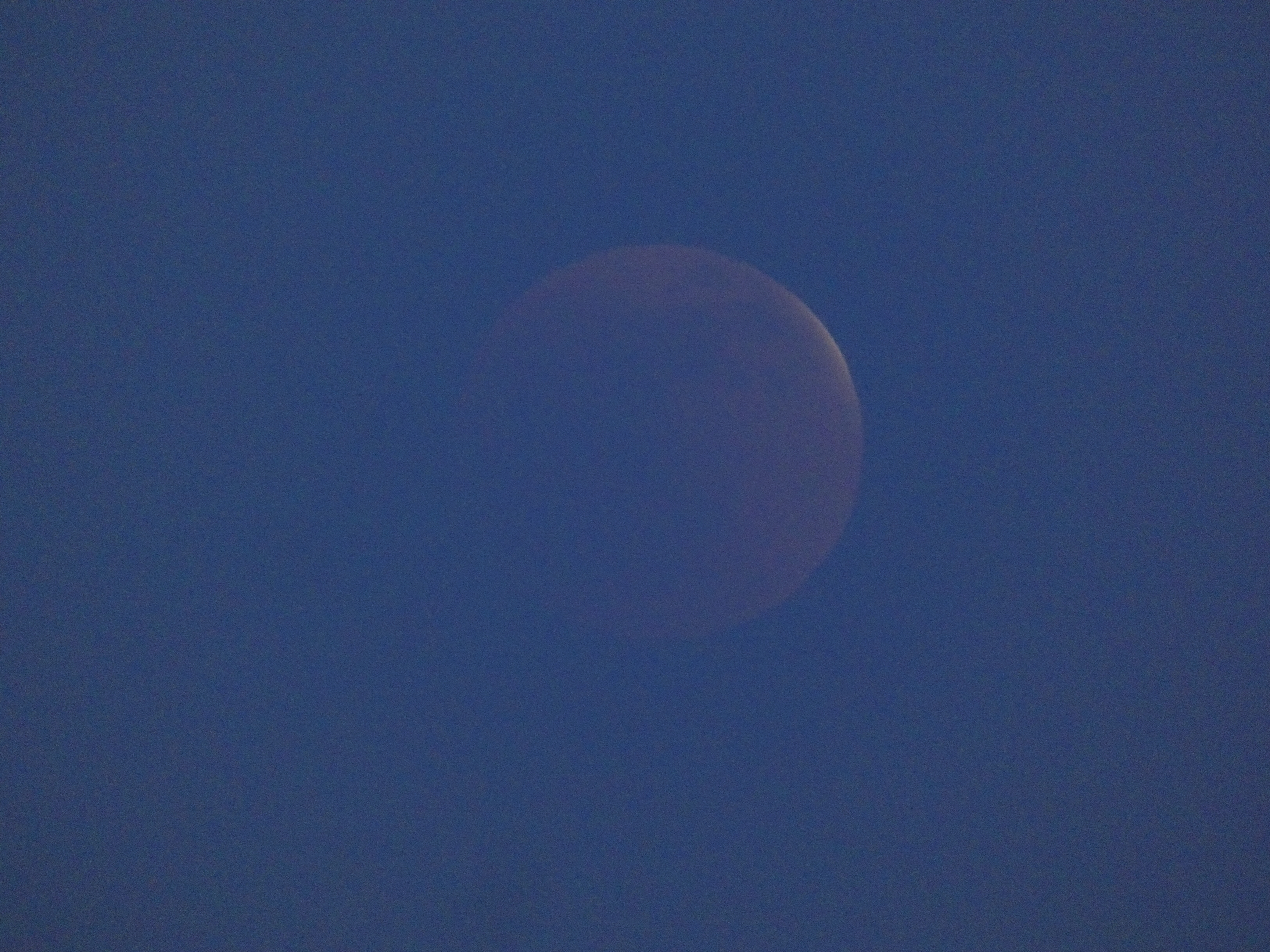
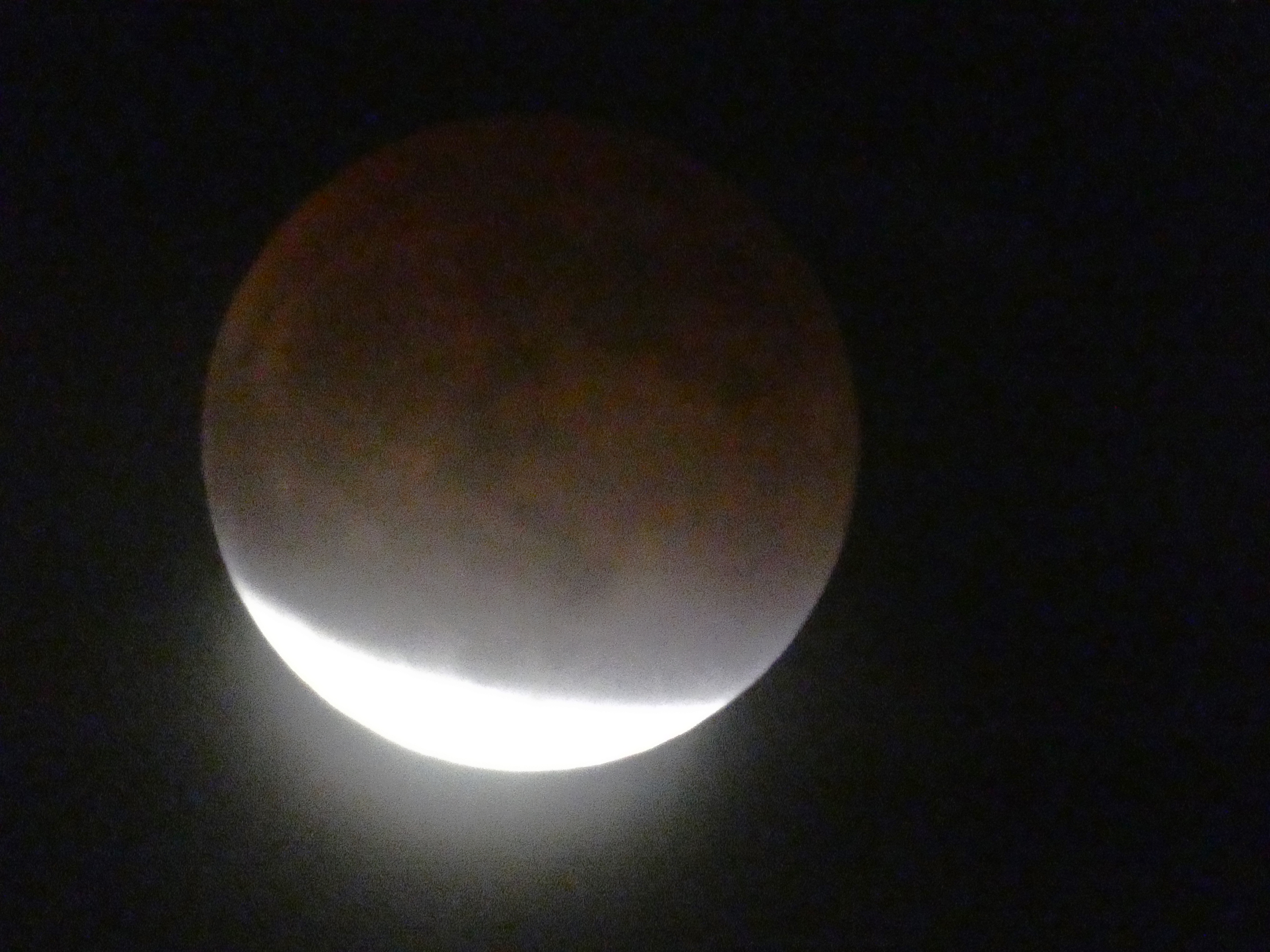
I didn't really feel like it, but lunar eclipses are dramatic, and this was the last one to take place until 2029, so I got up a few times between 2am and 4am to snap a few shots of the event
Lunar eclipses happen when the Earth moves in-between the Sun and the Moon, and casts a shadow across the face of the Moon. The shadow is spherical, by the way, so flat-earthers can re-examine their belief system.
The darkened portion of the lunar disk is much darker than the lit portion, and was hard to focus on with my limited photographic equipment.
The red color is due to the red edge of the visible light spectrum being bent through the Earth's atmosphere. It could be kind of cool to see a lunar eclipse from the Moon itself. I assume the Earth would have a red ring around it.
I would have stayed up longer, but my camera (based on previous experience) probably wouldn't focus right, and I had to work today.
One cool aspect of lunar eclipses is that many more stars appear during totality. My phone couldn't focus so much on the Moon, but did show how many stars were visible near the Moon that wouldn't otherwise be visible.


Friday, March 14, 2025

The First Lunar Eclipse of 2025


Interesting skies once again! Tonight was a lunar eclipse. The timing was great, with totality being reached before midnight here in the Pacific Time Zone. But we are in the midst of a powerful Pacific storm, and I thought I wouldn't have a chance because of the cloud cover.
A lunar eclipse occurs when the Earth ends up passing between the Sun and the Moon, and thus casting a shadow across the Moon's face. Lunar eclipses last longer than Solar eclipses because the Earth casts a much larger shadow, and it takes longer for the Moon to pass through it. 
The most interesting part of a Lunar eclipse is during totality when the darkened Moon picks up a faint red glow (the "Blood Moon"). Numerous stars are usually visible at that time, being normally invisible when the Moon is full and bright.
Clouds moved in and I figured the Blood Moon view was not going to happen and I came in the house and started writing up the post. I took one more trip outdoors and was treated to the total eclipse. I could have hoped for a better shot, but no one here is complaining as the next storm moves in.


Monday, May 16, 2022

How it Was: Lunar Eclipse of May 2022

This evening's lunar eclipse was visible all across North America, and it was spectacular! I hope you were able to see it, but if you didn't, here is some sense of what it was like.

Out here in California the eclipse was already underway at sunset, and most of the Moon was already in the Earth's shadow. It was kind of strange to see a "crescent" Moon rising in the east as the sun set in the west.

The sliver of the sunlit lunar surface grew smaller and smaller, and the Moon seemed to disappear in the deepening dusk. The darkened face of the Moon was actually glowing with red light refracted through the Earth's atmosphere, but it took a few moments for the sky to grow dark enough to see it.
The red of the Blood Moon became visible, and then I had a bit of a surprise. It is hard to see stars in the immediate vicinity of the full moon because it is so bright. But if you look in the picture below, look at the 10:30 position of the disk, and there is a star emerging from behind the Moon! I've never seen this happen before.
A few moments more, and the moon had moved away from the star, and several others were visible as welll.
It wasn't easy holding the camera still enough to catch the stars as well. I guess I should just use a tripod, but what's life without challenges? I only deleted 30 or 40 shaky shots...
This was an unusually long period of totality for a lunar eclipse. After around an hour, the bottom edge of the Moon began to glow brighter as the orb moved closer to the edge of the Earth's shadow.
And then just like that the Sun began to shine on the lunar surface again. 
The red disk disappeared and the stars dimmed and disappeared once again.
And then it was over, and our bright full Moon had returned. And that is how it was! Thanks to our friends Jeanne and Barry for a nice evening with a porch overlooking the Tuolumne River and a perfect moonrise!


Wednesday, May 26, 2021

The Eclipse of the Blood Flower Supermoon

The Moon passed through the shadow of the Earth very early this morning. There hasn't been an eclipse like this in two years, and it was more remarkable because the Moon was at nearly the closest approach it ever makes, so it appeared a bit larger than normal. How much larger? My camera has a 120x zoom, and a more distant Moon will just fill the screen. The picture below shows how it looked last night before the eclipse began.

I got up at 3:00 AM just so you wouldn't have to! At that point, the shadow was already covering part of the Moon.
I didn't want to stay up all night, so I looked 45 minutes later to check on the progress.
By 4:20 AM, totality was reached and the very dim Moon was glowing red, the result of the red part of the sun's spectrum being refracted through the Earth's atmosphere. 
At this point the Moon was far dimmer and stars were visible nearby. It's the first time I've been able to photograph stars and the Moon in the same picture.
By 4:30, the Moon was beginning to emerge from the shadows, so I took one last shot, and went back to bed. I had a class to teach in the morning!


Sunday, January 20, 2019

The Super Blood Wolf Moon Eclipse from under a Rainstorm


By all rights none of these pictures should exist. It was one of the astronomical events of the year, the...um..."Super-duper Blood Red Wolf Full Moon and Eclipse Extravaganza", or something like that. But unfortunately we had an 80% chance of rain for most of the evening in our area so I didn't expect to see any of it.
And yet...I couldn't help going outside every few minutes on the off chance that a break in the storm might occur. About the time of totality I could see clearing off to the west, and the opening was moving east at an excruciatingly slow pace. But I finally saw a patch of light through the clouds, and then there it was.
So tonight's post documents only a small portion of the celestial event, but I felt privileged to see just this much. After about 15-20 minutes the next wave of clouds moved over and blocked out the moon once again.
If there is any consolation, I got a somewhat interesting video of the clouds moving across the moon, accompanied by narration from Zoey the cat, who couldn't understand why I wasn't picking her up. The jerkiness in the middle of the video resulted from the kitty claws digging into my leg as she hopped up into my lap.

The

Wednesday, January 31, 2018

Standing in the Cold Fog So You Don't Have To: The Superduper Blue Blood Moon Lunar Eclipse of 2018

That's the chance you take living in our Great Valley in Central California. The Tule Fogs are a way of life, and this is their time of year. If you want to be guaranteed an atmospheric/astronomical show it just can't be. But still I had to try. I took some pictures of the "Supermoon" yesterday evening in the hopes that I would see the eclipse in the early hours of the morning. Either the fog would be there or it wouldn't.
I got semi-lucky. There most certainly was fog, but it was mostly thick on the ground and the moon was still visible above. These shots may not be quite as sharp as they would be on a clear night, but they work.
There are three oddities happening at once, although two of them can be said to be kind of arbitrary...
First, there's the Blue Moon. That's one of the arbitrary ones. The lunar cycle is 29.53 days, but some of our months have 30 or 31 days, so there can be two full moons in a month. This is the second full moon of January, hence the "blue moon". The term originally had to do with 13 lunar cycles in a full year, with one season having an extra full moon.
Then there is the "supermoon". This is sort of arbitrary, being not an astronomical term, but more a modern astrological term. It refers to the full moon happening when the moon is closest to earth, therefore producing a slightly larger disk (14% greater than a "micromoon") with the additional light (30% more) that reflects from the Moon's surface. Astronomers would prefer to call this the perigee syzygy.
It is the lunar eclipse that is the best part of the evening's festivities. The Moon is passing through the Earth's shadow, causing it to darken considerably and seem to glow red as a result of light refracting through the Earth's atmosphere (the "Blood Moon"). I haven't seen an article that mentions this, but I imagine if we were on the Moon right now there would be a red ring around the edges of the Earth's sphere.
There hasn't been a combination of a "supermoon", a Blue Moon, and a lunar eclipse since 1866, so I guess it is special that way, but I find any lunar eclipse to be special. There is speculation that the slightly closer approach of the Moon has an influence on the occurrence of great earthquakes and the like, but the difference in the gravitational attraction is negligible, and statistical analysis doesn't bear this out.  I guess we'll see what happens around the world today, but remember that dozens of earthquakes happen every single day, so a magnitude 5 or 6 quake somewhere is not that remarkable.
In any case, I lucked out with the fog and was able to capture the beginning of the lunar eclipse, but there won't be any shots of its end because the fog has thickened. Thus I am up at 5:00 AM blogging, which is most certainly not my usual habit! I guess there is a certain symmetry that I just finished with a month long reminiscence of ten years of geoblogging with an article on the solar eclipse of last August, and I start the eleventh year of blogging with a lunar eclipse. In any case, enjoy, and if you are up and skies are clear, go take a look!

Saturday, January 27, 2018

A Look Back at Ten Years of Geotripping: Dealing with the Dangerous Rays of Death

One of the greatest thrills of digital cameras is how easily they allow the documentation of celestial events. A 60x zoom is telescope grade, and yet is available on cameras costing less than $400. My history with digital cameras began 18 years ago, and their versatility has allowed me to document a large number of astronomical and meteorological phenomena. 2017 was a culmination as I was able to be in place to witness the total eclipse of the sun in August. But leading up to that day, I had put together a post of the what were to me the most fascinating sky events of my life so far. That post appeared on August 3 of last year...

Dealing with the Dangerous Rays of Death: Singular Solar Events I've Seen

Do you ever look at the sun?

Some advice: DON'T LOOK AT THE SUN! You can destroy your eyes!

Good, now that we have that out of the way, what is this post all about? The sun has been on my mind the last few days. I'm preparing for the final adventure of the summer, and it has a lot to do with the sun, most specifically, the only eclipse to cross the lower 48 states since 1979, the first to cross the country in 99 years, and the last to cross the American West until 2045. I got to thinking about the singular events that I've seen over the years that involve the sun in some way or another.

The sun. A diameter of about 860,000 miles, more than 100 times the diameter of the Earth. About 93,000,000 miles away from Earth. Big enough to hold 330,000 Earths. Containing 99.86% of the mass of the Solar System. The source of energy that makes life possible on Earth.

The most obvious moments that we might pay attention to the sun are during sunrise and sunset. Every one is different and unique. At those times, the sun is at eye level, and the thickness (and dirtiness) of the atmosphere provide a bit of protection for viewing with the unprotected eye. As the sun passes across the horizon, light is split into bright colors of the spectrum, providing a beautiful spectacle. I've probably taken thousands of sunset and sunrise pictures over the years, but here are two of my favorites, a sunset in Newport California a few years ago (above), and sunrise over Lake Rotorua in New Zealand in 2004 (below). To this day I cannot keep straight my internal compass; I couldn't help but think the sun was rising in the west (it wasn't). Lake Rotorua is one of the world's rare geothermal regions with geysers. Hot springs in the lake account for the steam rising off the water.


A difficult phenomena to see related to sunsets is the green flash. It is a sudden flash of greenish light above the sun at the moment of sunset, and it is said to last only a second or so. As the sun dips into the horizon, the layers of the atmosphere will cause some of the sunlight to be refracted, with red and orange on the lower parts of the disk along with green (and rarely blue) across the top.
It takes some very specific circumstances to see the flash, a clear view to a distant horizon, most often along coastlines. I have relatives on the coast of Oregon, so I've had a fair number of chances to try and capture the moment. I may even have succeeded once or twice.
Rainbows are one of the most familiar optical effects associated with the sun. Most everyone has seen them, so it takes some unique circumstances to really set one apart from others. My favorite moment came with a monsoonal storm on the North Rim of the Grand Canyon last year. I was looking down at a rainbow in the depths of the canyon.
Rainbows involve the splitting of white light from the sun into its component colors of the spectrum. Caves and deep slot canyons provide another sort of splitting, that of the sun's energy into a more or less pinhole of light. I was exploring a lava tube in the Mojave National Preserve a few years back. It was dark inside, but there were a few small skylights, and the early afternoon sun came bursting through like a blast from alien phaser.
One of the more famous places to see beams of light from the sun is in Antelope Canyon, Arizona. A deep slot canyon, Antelope is one of the most popular tourist stops on the Navajo Nation. The sandstone canyon is more than 100 feet deep, and only a few feet wide at the top. One can actually jump across if it were allowed. Tours are offered all day, but one pays a premium around noon for the obvious reason that it's when the sun sends beams of light into the depths of the canyon.
The effect is truly spectacular, although one should be aware that as lonely as these pictures seem, I was shoulder to shoulder with other photographers snapping like crazy.

Another fascinating phenomena occurs when the Moon passes into the Earth's shadow, a lunar eclipse. They are not rare, happening around two times a year, and they can be seen simultaneously across the globe (as long as the moon is visible in the sky). 
Lunar eclipses are fascinating to watch, and it is surprising to realize just how much of the sun's light is reflected from the moon. At totality, the moon practically disappears except for some refracted light around the edge of the Earth. Hundreds of stars become visible that weren't there moments earlier.

In a ridiculous age when science has to convince some people that the Earth is not actually flat, a lunar eclipse can help. The Earth casts a circular shadow across the surface of the Moon.
And then there is the opposite number, those events that result from the Moon passing in front of the Sun, a Solar eclipse. Although the Sun is many times larger than the Moon, the Moon is much closer to the earth, and is thus big enough to blot out the sun entirely. Solar eclipses are rarer than Lunar eclipses, and total solar eclipses are rarer still. I've been able to photograph a number of partial Solar eclipses over the years. For me, it is a clumsy affair, trying to hold a filter over the lens while keeping the Sun in the frame, but I've surrendered to the use of a tripod a few times to make it work.

The picture above is one of my favorites because of the huge sunspots that were present during the Moon's transit across the disc of the Sun. If the eclipse occurs when the Moon is farther from the Earth (it has an elliptical orbit), an annular eclipse can occur, in which the Moon doesn't cover the entire disc of the sun. I caught the picture below in 2012.
And then there are the transits of the planets. These happen when a planet crosses the disk of the Sun. Only two planets can do this, Mercury and Venus, because they are the only planets with orbits that are closer to the Sun than Earth. I've witnessed two of them.
A transit of the planet Mercury took place in May of 2016. I almost missed it because of cloud cover, but they cleared enough for a couple of shots. There was a sunspot as well. In the picture below, the top arrow points to a sunspot. The lower arrow points to Mercury. It is a small planet, only barely bigger than the Moon, and it orbits much closer to the Sun. Such transits are only visible by binocular or telescope (with filters, of course).
Zooming in made Mercury a bit clearer (below). Transits of Mercury are not overly rare, occurring in 1999, 2003, 2006, and 2016. Another will take place in November of 2019, but then we will need to wait until 2032 to see another.
The rarest Sun-related event I've ever seen is a transit of the planet Venus. The one I witnessed happened in 2012 (below). Previous transits had been in 1874, 1882, and 2004. The next will not happen until 2117 (in December, if you are planning on watching).

The big event of all things Solar is of course a total Solar eclipse. As noted above, it's been decades since one took place in the lower 48 states, and next won't cross my neck of the woods until 2045. I'll be almost 90 years old if I make it that far. I've had the privilege of witnessing one, though, in 1991. It crossed the south end of Baja California at San Jose del Cabo. A small expedition from MJC drove the length of the Baja Peninsula to see the event, one of the great adventures of my life. I didn't get pictures at the time, as the best technology I had was a Kodak Instamatic. The pictures below are from Dr. William Luebke, MJC's retired astronomy professor.
There is nothing quite like the few moments of totality. The sky goes dark, stars and planets become visible, and the ambient temperature plummets (it was summer when we were there, and the temperature dropped from over 100 degrees to 80 or less; it was a relief). The corona of the sun becomes visible, and there may be solar prominences visible as well. We had more than four minutes of totality, more than usual.

It's going to be a zoo in Oregon in a few weeks, as literally millions of people are converging on the region to have a look at this rare event. We will be staying about an hour's drive from the path of totality, so I have no idea if we'll be able to even get to the dark zone through the gridlocked traffic. If we do, I'll be busy getting pictures to share, and if we don't...well...we'll always have Baja.