Showing posts with label Lontra canadensis. Show all posts

Friday, July 3, 2020

Hopes for the Healing of a River: Northern River Otters on the Tuolumne


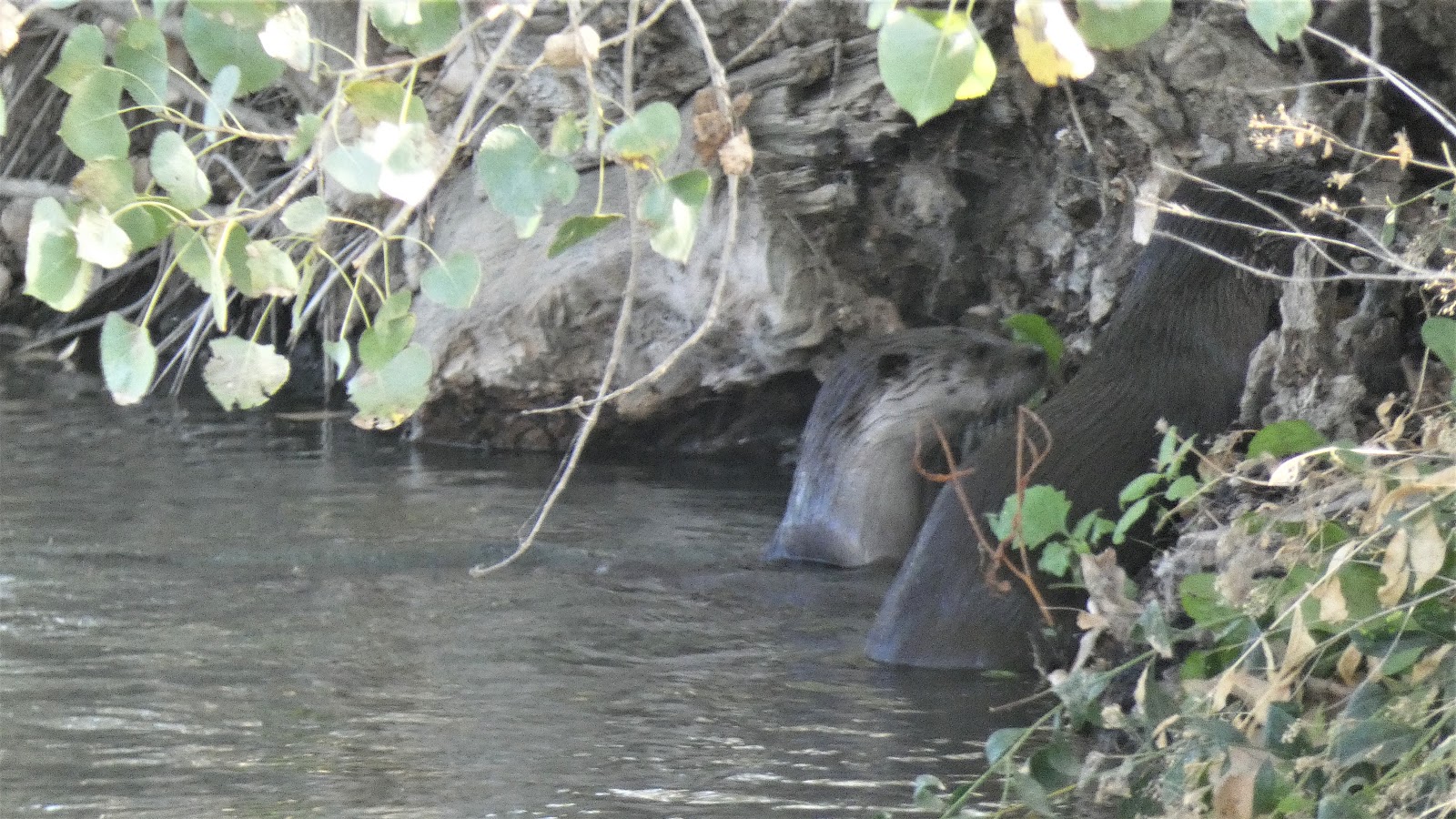
I had the delightful privilege of watching a River Otter family hanging out along the Tuolumne River the other day. There were three of them, two adults and a juvenile. It's the most time I've ever seen any of them out of the water. It's a good sign that recovery is possible in a river system despite the abuses we've heaped on our wonderful gift of nature.

The Gold Rush of 1848 was catastrophic to the Tuolumne. Miners dug up river vegetation and processed literally all the river gravels for the elusive metal. Gold dredges did incalculable damage to stretches of the rivers in the Great Valley by ripping out the riparian vegetation and destroying the soils along the river floodplain. Underground mines brought minerals to the surface that oxidized to form acids and other toxins. Mercury used in the gold recovery process leaked into river waters. In the twentieth century we built massive dams that altered the water quality and flow levels. These have wreaked havoc with what remains of the natural ecosystem.

One of the bellwethers of the health of a river system is the presence or absence of apex predators and other native species. The predators cannot thrive if their prey species are not present, whether from pollution, drought or other cause. I'm always looking for signs that the native species are present and hopefully thriving. In the last few years I've run across bobcats, foxes, raccoons, beavers (gnawed trees, anyway), hawks and ospreys and Northern River Otters (Lontra canadensis). There was even a report recently of a Mountain Lion downstream in Modesto.

There used to be an even more diverse group of predators and prey species along this river. In historic times there were California Grizzly Bears, Black Bears, and Gray Wolves, along with the California Condor. In prehistoric times, the tally included Sabertooth cats, Dire Wolves, and several other rather scary beasts. The river was populated by gigantic tusked salmon up to nine feet in length.


Geologically, our river otters were a relatively late addition to the river ecosystems of North America. Their family evolved more than 30 million years ago, and spread throughout the Old World and migrated into the Americas, including the Giant Otter of South America. But the Northern River Otter fossil record only goes back to the beginning of the ice ages about 1.9 million years ago. They are related to European species, and probably came across the Bering Land Strait when sea levels were lower (although being an aquatic species, they could have swam the relatively short distance between Russia and Alaska).

The current range of the otter ends in our region. It's their frontier. According to the River Otter Ecology Project, there have been sightings on the Tuolumne River, and just one or two in the Merced River one drainage to the south (some otters were spotted in Yosemite Valley for the first time in decades recently). I'm hoping they will be able to spread farther south into the San Joaquin River drainage. I have seen them on the valley floor in the San Luis National Wildlife Refuge in a slough of the San Joaquin.

The otters cooperated long enough that I was able to get some video too. Enjoy!


Sunday, November 3, 2019

A Bit of "Where's Waldo the River Otter?" at the San Luis National Wildlife Refuge

There are things in my life that are more thrilling than spotting River Otters (Lontra Canadensis), but there are not many of them. I spend a lot of time on the Tuolumne River where it flows through my town, and also at the local national wildlife refuges, including the Merced, the San Luis, and the San Joaquin. I'm usually searching for birds, but a bit of my attention is always watching for rarely seen mammals like beavers, foxes, and especially River Otters.
We were on the eastern leg of the San Luis NWR Waterfowl Auto-Tour when I spotted what I thought were four ducks bunched together. But they didn't look right, and after a moment I realized that it was a family of River Otters playing on the banks of the irrigation canal. We played a brief game of hide and seek (I mostly hid behind the car), and they eventually swam away downstream (down-canal?).

Most of the time I forget that I have a fully functional video with my camera, but I thought of video first this time around and got a short shot of the family swimming away together. Then I snapped pictures as I could in the dim shadows where they were hiding. What I noticed later is that in each picture of an individual, there was actually a second otter photo-bombing the shot. Can you find the extra otter in each picture?

River Otters in California took a real beating over the centuries of European occupation in California, with trapping and destruction of their habitat by gold mining, damming, and urbanization causing a drastic drop in their population and range. With efforts at reclaiming the river environments in the Bay Area and Central Valley, they have begun to spread out again. A pair of otters was even seen in Yosemite Valley a year or two ago.

I've seen otters on a number of occasions on the Tuolumne River, but this was my first sighting at the San Luis refuge, which is part of the San Joaquin River drainage. The river had been decimated by reservoir construction decades ago and the river was dry for many tens of miles in the San Joaquin Valley, but recent agreements have resulted in a new river, with the potential of even the return of the salmon. The otters will surely follow!

Thursday, January 3, 2019

Another Surprise from the Tuolumne River: River Otters!


This year just gets better and better (I have a futile hope that this trend continues for the entire year...). Yesterday I get the best look ever at a Bobcat on the Tuolumne River, and then today, another marvelous sight: River Otters up close and personal.

I see River Otters once in awhile during my walks along the Tuolumne River Parkway Trail in Waterford, but they've always been pretty far away, and I characteristically see a nose and eyes sticking out of the water. Today I was along part of the Don Pedro irrigation infrastructure near La Grange looking for a rare bird that's been reported in the area. I was on a highway bridge and looking down I saw ripples along the bank and immediately figured it was some ducks hiding in the brush, but then I saw whiskers. I started snapping pictures, which were all practically unusable except for the one above. I then remembered to turn on the video and I got a pretty nice, if short, bit of one of the otters exploring the bank.
The picture above is a screen capture from the video, actually.

River Otters have a decent future as California rivers get cleaner and flows become more generous as planners start to see rivers in the context of an entire ecosystem that we are part of, instead of as a faucet solely for agricultural interests. A pair of River Otters was even seen in Yosemite Valley recently for the first time in decades. It is such a pleasure to see these playful animals in the wild.

Saturday, July 7, 2018

River Otter on the Tuolumne


I am quite lucky to have the Tuolumne River in my backyard. The river rises in the highest regions of Yosemite National Park, flows through incredible and largely unknown gorges that rival the Grand Canyon in depth. Water is trapped in a series of reservoirs including Hetch Hetchy and Don Pedro, and at that point the river could have been cut off the way the San Joaquin River was destroyed. But water agreements have kept a minimum flow, so the river flows onto the floor of the Great Valley and maintains a continuous riparian habitat all the way to the Sacramento Delta. The river bed has been severely altered, first by the gold miners, and later by quarry operators and farmers. But portions are in the process of healing, and in places the stream is starting to resemble its earlier incarnation as a wild river.

I saw River Otters (Lontra canadensis) for the first time just two or three years ago, and I'll see them two or three times a year when I stroll along the river trail. This morning the water level was low and river transparent, so I saw what I thought was an immense fish maybe three feet long deep in the water. I turned on the camera to get video and hit the wrong button, but then the "fish" surfaced and I realized I was watching an Otter. I got the video going correctly and got some of the best "footage" so far.

River Otters are making a comeback in the rivers and streams of the San Joaquin and Sacramento Rivers and across the Bay Area. I'm so glad some of them have made it here to my little corner of the river! For more information on otter sightings and ecology, check out the River Otter Ecology Project.

Sunday, December 31, 2017

Birds Aren't the Only Thing to See at a Great Valley Wildlife Refuge

River Otter at the Sacramento National Wildlife Refuge
California's Great Valley (called by some less proud people the Central Valley) is the most agriculturally productive place on the planet, producing something like a quarter of the nation's nuts, fruits and vegetables on about 2 percent of the land. The agricultural and accompanying urban development has altered 95% of the original savanna landscape. Prior to the arrival of the Europeans in the 1800s the valley was a vast prairie/grassland that stretched for 400 miles, broken up here and there by a vast network of rivers and wetland marshes fed by numerous streams flowing from the Sierra Nevada.
Raccoon at the Sacramento National Wildlife Refuge
For several million years the valley was the wintering ground for millions, maybe billions of migratory birds that spent their summers breeding in the Arctic. The arrival of humans and their alteration of the landscape disrupted this intricate ecosystem. The birds continued to migrate in reduced numbers and with their natural food sources gone, they started going after the crops being grown by farmers. This became an untenable situation, and there were those who advocating shooting the birds to extinction, but cooler heads prevailed, and work began on establishing a chain of national and state bird refuges at strategic locations up and down the valley. These refuges provide us an idea of the primeval appearance of the valley.
Deer at the Sacramento National Wildlife Refuge
It turns out of course that birds weren't the only creatures displaced by human development. The original valley was a savanna with multitudes of grazing animals and their predators. There were elk, deer, and pronghorns, along with wolves, coyotes, foxes, bobcats, mountain lions, and bears. Prior to 12,000 years ago, there were mammoths, mastodons, giant sloths, saber-tooth cats, and giant short-faced bears. To a degree, the refuges that were originally meant for birds also provide shelter for the remnants of this incredible ecosystem. In my travels, I've seen the elk and deer pictured in this post along with river otters, raccoons, foxes, and coyotes.
Tule Elk at the San Luis National Wildlife Refuge

Today's post was prompted by my sighting yesterday of three River Otters crossing a road at the Sacramento National Wildlife Refuge. They were moving so fast that by the time I was able to raise my camera, only one was left, and I got but a single shot.

Saturday, August 20, 2016

River Otters Swimming in the Tuolumne River, Part II


Here's the second video I captured of the River Otters in the Tuolumne River this evening (the first was in the previous post). There seems to be a momma and two pups. Meanwhile, Mrs. Geotripper was capturing pictures of me acting like a kid, chasing otters (if you are worried, I was actually pretty far away from them).

River Otters Swimming in the Tuolumne River


I've had a real treat of a day. I took my usual morning stroll along the Tuolumne River, catching some decent shots of a Black-chinned Hummingbird, and the back end of a Raccoon (that's not a great picture, but it was the first raccoon I've seen on this stretch of river). Then, totally on a whim, Mrs. Geotripper and I decided to catch the sunset from a high point on the Tuolumne Parkway Trail where the river emerges onto the floor of the Great Valley. We saw some kind of movement in the water, and I realized I was seeing River Otters (Lontra canadensis). My impression is that it was a mother with two pups. It was only the second time I've ever seen them, and this time I thought to catch some video. Enjoy! I'll post a second video in a few moments.

Monday, July 25, 2016

A First (for me): River Otters along the Tuolumne River Parkway Trail

There's a wonderful thing about life and the animal world. No matter how old you are, you can still have the excitement of seeing something for the first time. The planet is so diverse and mysterious that you will never see it all, and so there is always a surprise waiting around the next corner. Even if it is in your own backyard!
If you have followed my blog for any length of time, you know that I have been extolling the pleasures of having a wonderful river in our town, and the new trail that has been constructed along the water. The Tuolumne River begins high in the Sierra Nevada in Yosemite National Park flowing through stupendously deep gorges before gliding into the Great Valley of California. It flows through the valley, joining the San Joaquin River and finally ends in San Francisco Bay. I live right where the river exits the Sierra Nevada foothills.

The new trail follows the river for two miles, and I walk it every chance I get, trying to document the bird species living along the river (45 so far, but I know there are many more). I've also seen various mammals and reptiles, including a Gray Fox, and a Red Fox. But up until now I've never seen a River Otter (Lontra canadensis). And I've really wanted to see one. I love otters in general (I've seen quite a few Sea Otters), and find great pleasure with their playful attitude towards life, and it drove me slightly crazy knowing that they make the Tuolumne River their home. News was made earlier this year when some otters were seen in Yosemite Valley (on the Merced River) for the first time in decades. So I've been watching for birds, but I always kept an eye on the water as well.
This morning I was at the sewage treatment center outfall (it's not as bad as it sounds, really), hoping to see a Western Kingfisher that I had seen a few days earlier. I saw it, but was distracted by a disturbance in the water just across the river. There was some kind of creature moving through the water. It took a while to get a good look, but eventually I captured a few fuzzy shots of a pair of otters cavorting in the water. It was a great moment! But I'll get better pictures next time...