Showing posts with label Aleutian Cackling Goose. Show all posts

Wednesday, December 30, 2020

A Reminder of What Once Was: An Evening at the San Joaquin River National Wildlife Refuge

What is it like to see ten thousand birds take to the sky all at once? Do you have to live on the African Savanna to find out? Sometimes one has to merely look in one's backyard (so to speak) to rediscover the extraordinary nature of where one lives. For instance, my home is in California's Great Valley (called by some the Central Valley). The valley is sometimes derided as a boring place to live, an endlessly flat expanse of agribusiness farms and poorly planned urban centers, and there is certainly a truth to that idea. A full 95% of the valley has been altered by humans from the original prairies and wetlands.

But the other 5%? Astounding at times.

The valley was once an expanse of open prairies, riparian corridors, and vast shallow lakes. A diverse fauna grazed the flatlands, Tule Elk, deer, antelope, horses, camels, bison, mammoths, mastodons, and giant ground sloths. They were preyed upon by a fearful assemblage of carnivores: Saber-toothed Cats, Jaguars, American Lions, Dire Wolves, Coyotes, Black Bears, Grizzly Bears, and huge Short-faced Bears (nothing else was short about them; they stood 12 feet tall). Much of the megafauna disappeared around 10,000 years ago for reasons that are still debated, but the valley still supported a healthy ecosystem when the European colonizers arrived and started changing things.
The valley supported millions upon millions of migratory birds. The valley for a variety of reasons has some of the mildest winter weather in North America, and arctic species for millennia utilized the wetlands for a winter home. Agricultural development deeply altered the available habitat and the birds suffered for it, but a string of wildlife refuges were established decades ago to help them survive. I'd love to say it was for preserving the natural habitat, but it was often to provide the birds a place where they wouldn't destroy crops, and to provide hunters a dependable target. But still, the refuges are islands of relative safety for the birds, and many species have thrived. 

The Aleutian Cackling Goose was once thought to be a subspecies of the similar Canada Goose, but they are now considered a distinct species. They were decimated by changes in their winter refuge, but also in their breeding grounds in the Aleutian Islands, were introduced foxes had exterminated most of them. By 1936 they were thought to be extinct. In 1962 a few hundred were found on an isolated island, and they received protection under the Endangered Species Act in 1973. Since then their numbers have rebounded, with a population today of nearly 200,000. And a very large percentage of them spend their winters only eight miles west of the biggest shopping center in my town.
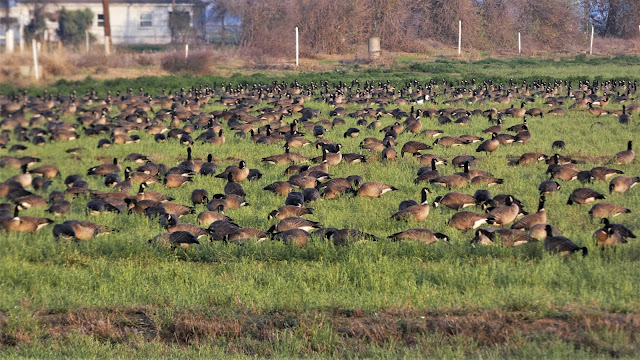
We had a package to pick up at that shopping center today, so Mrs. Geotripper and I decided to run out to the viewing platform on Beckwith Road west of town. The platform overlooks the fields of the San Joaquin River National Wildlife Refuge. I have visited the spot dozens of times in the last six years, but I had never seen so many birds as were there this afternoon. I made a rough estimate of 4,000 Aleutian Cackling Geese, as well as around 12,000 of the white Snow and Ross's Geese. And as we watched, a large percentage of the geese took flight, which I caught in the video at the top of the post. It was an astounding sight.

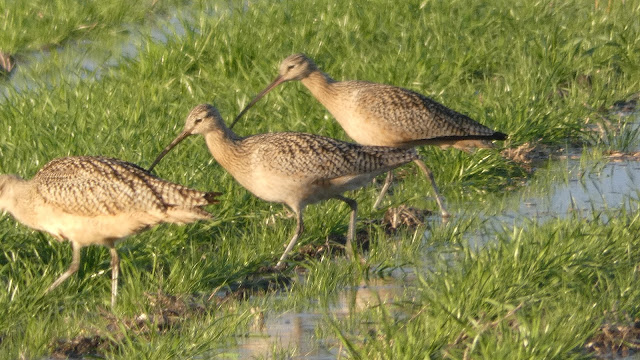
It's not just geese that call the Great Valley their home. There are a large number of other strange and exotic birds that can be found here. This evening we saw some other interesting species. There was a flock of 200 or 300 Long-billed Curlews in a field north of the road. They have impossibly long beaks for exploring the mud for worms and bugs.
There was also a flock of around a hundred White-faced Ibises. They look very dark from a distance, but closer observations reveals a colorful iridescence. The white face only shows up in breeding season. They are unique to the Americas, and apparently evolved from the far more widely distributed Glossy Ibises.
Photo by Mrs. Geotripper

I've lived in the Great Valley now for more than thirty years, and I've long extolled the fascinating geological story of the valley, including the extensive fossil record, but I was appallingly ignorant of the fascinating species that still call the valley home today. I had never seen the tens of thousands of geese take flight all at once until around six years ago. I now look forward to the privilege with the approach of every winter season.


Wednesday, December 14, 2016

A California "Snow" Storm: A Winter Miracle in the Great Valley


People don't usually hear a great many good reasons to visit Modesto and environs. Forbes and others often put our Great Valley towns on the "worst places to live", but I think they really miss something when they do this sort of "expose". We grow most of the nation's food supply for one thing, so folks could be a little more appreciative of what we do. But it's really something else that few people are aware of, even those of us who live here. It's the magic of the season, the fact that we are a winter wonderland. The "snow" has nothing to do with precipitation, though, it has to do with millions of refugees from the snowbound northlands. They are Snow Geese. And Ross's Geese. And White-fronted and Aleutian Cackling geese. And thousands of Sandhill Cranes as well. In winter, the Great Valley becomes an American version of Africa's Serengeti Plain.
Snow Goose at the San Joaquin River National Wildlife Refuge

Hundreds of years ago, before the European invasion, the valley was home to tens of millions of migratory birds, but with settlement and development, 95% of their original grassland and river flood plain home disappeared. The birds could have been wiped out entirely, but a few visionary people worked to preserve a bit of the original valley habitat in an effort to save as many birds as possible. The result was a string of federal, state and non-profit run wildlife refuges that form a pathway down the 400 mile length of the valley. The birds will take refuge from October to March, when they begin making their way back north for breeding in the Arctic.
Aleutian Cackllng Goose (Branta hutchinsii) at the San Joaquin River National Wildlife Refuge. Several decades ago, there were only 600 of them left. Today there are around 200,000 because of conservation efforts in both Alaska and at the San Joaquin refuge (their primary winter home)
A great many people right here in the Modesto area are unaware of the Christmastime miracle that takes place each year. It's not hard to see incredible things just a short drive out of town. Only eight miles west of the biggest shopping mall in the region, on Beckwith Road, the San Joaquin River National Wildlife Refuge offers a viewing platform where one can see tens of thousands of migratory geese all at once. The best times are early in the morning and in the afternoon close to sundown. I took the video below at about 4:15 this afternoon during a short break from final exams at the college. Even with the YouTube compression, you can see tens of thousands of geese taking wing. You can hear the cacophony, but there is nothing like seeing and hearing it in person. The ground literally vibrates as the birds take to the air.


The spectacle is amazing, If you live here and you've never seen it, check it out right now! If you are from the Bay Area and are rushing to the Sierras for a ski day, take a short detour. It's worth your time. And if you are a birder, we are a winter paradise. More than 300 bird species have been documented in our area, and many of them can be seen during the winter season when the pickings are poor in other places (a lot of those disappearing birds come here!).

Wednesday, November 4, 2015

Fixing What We Broke: A Few Scenes From America's Serengeti Plain


I live in California's Great Valley, also known as the Central Valley. It's one of the most important agricultural regions on Earth, in that it produces around a quarter of the nation's produce. It's an extraordinary geological province, 400 miles of almost perfect flatness. When I moved to the valley nearly thirty years ago, I thought I was moving to a boring place, featureless, and bereft of the kinds of terrain that makes a geologist's heart go pit-a-pat. I was wrong...
I must admit that an exploration of the valley can be a bit monotonous. Traveling Highway 99 or Interstate 5 involves hundreds of miles of featureless fields and orchards, interrupted now and then by towns whose cultural attractions consist of gas stations and fast food restaurants (don't get me wrong, some of our towns have fascinating cultures, but you may have to work to find them at times).

The valley environment ranges from oak woodlands in the north through semiarid prairie in the middle reaches to barren desert to the south. The land is actually well-watered, as the adjacent Sierra Nevada feeds numerous rivers that flow into the valley. The rivers have been mostly diverted for use in irrigation, but about 30% of the water continues on to the sea. About 95% of the land surface in the valley has been converted to agricultural and urban development.
What has enriched my life in recent years is seeing the valley the way our migrant birds see it: a series of "wilderness" islands that allow me to imagine the valley as it once was, America's version of the Serengeti Plains. The prairies and wetlands once supported millions of grazing animals and migrating bird species (along with the year-round resident species). Most of these "islands" are part of the National Wildlife Refuge system, while others are preserves administered by a variety of federal, state and private organizations. These refuges allow the preservation and survival of the remnants of the incredible ecosystem that once existed here. It took a long time to recognize what we were doing to these animals as we took away more and more of their habitat to grow our food, but now there is a movement towards rehabilitating some of the wetland environments. We are trying to undo the damage we've caused over the last century and a half.
I was reminded of these efforts this afternoon when I drove over to a viewing area at the San Joaquin National Wildlife Refuge, one of the main centers of the efforts to rebuild the wetlands (something like 400,000 trees have been planted in riparian habitats that had been converted to farmlands, later abandoned). I saw an astounding sight.
There were perhaps tens of thousands of Aleutian Cackling Geese (Branta hutchinsii leucopareia) gathered in a plowed cornfield (planted by the refuge employees to provide food for the birds). The birds are closely related to the Canada Goose, but are considered a separate species based on DNA analysis. The species had gone into a steep decline due to hunting, the introduction of foxes on the island where they bred, and loss of winter habitat in the Central Valley. They were actually thought to be extinct for twenty four years, as none were seen after 1938, but a group of several hundred were found on some isolated islands in 1962. They were listed officially as an endangered species in 1967.
Aggressive efforts began to protect the birds from extinction, and in fifty years, the results have been successful enough that the bird has been removed from endangered status. From a population of less than 1,000 birds, there are now more than 120,000. And I was looking at a large percentage of the entire population of these birds at the San Joaquin National Wildlife Refuge this afternoon. It was stunning.
The birds certainly still face problems. They are crowded onto relatively limited lands, and drought years can limit the amount of maize and wheat that can be planted on their behalf. The drought also limits that available wetlands that they prefer for roosting. But still for a few moments this afternoon, I was reminded how the valley used to support millions of geese and cranes. It may still do so again. It's possible to share the bounty of our valley with the original inhabitants.

I imagine some people would think I was exaggerating a bit when I said there were thousands, maybe tens of thousands of birds at the refuge this afternoon. I certainly couldn't fit them all into a single picture, so I invite you to see a video I took, sweeping across the crowd next to the road. Enjoy!


More on the recovery of the Aleutian Cackling Goose can be read here: http://www2.humboldt.edu/wildlife/faculty/black/pdf/Minietal2011_AleutiansWildfowl.pdf

Saturday, November 8, 2014

A Different Canada Goose, the Cackling Kind: Evolution on the Continent

Isolation brings about evolutionary change, and the Canada Goose clan has been doing some changing over the last few thousand years, especially in Hawaii, but also here in California. Today's blog is cross-posted from my new birding blog, Geotripper's California Birds.
If you've ever been accosted by a Canada Goose at the local park, pictures like these might give you the shivers. If one of them can deliver a nasty bite, just imagine what a few thousand of them can do. But take heart, these scenes are no nightmare. They aren't even Canada Geese. The birds occupying this field in the San Joaquin National Wildlife Refuge west of Modesto are Aleutian Cackling Geese (Branta hutchinsii). It's true, though, that before 2005 they were Canada Geese. Allow me to explain.
The Canada Goose lives in many environments, and in some cases particular flocks broke away and colonized different islands or territories (see yesterday's post for an extreme example). The presence or lack of food sources or differences in the nature of predators favored certain traits (size and behavior, for instance) in the young. The geese who summered on the Aleutian Islands were long recognized as a smaller subspecies of the Canada Goose, but recent DNA analysis has led researchers to consider these birds an entirely different species. And so these birds are not Canada Geese, they are the much smaller Aleutian Cackling Geese, which are genetically distinct from the Canada Goose.
The Cackling Geese winter by the tens of thousands in the wildlife refuge a few miles west of my home. It is a stunning sight to see so many of the birds in one place. From the observation deck on Beckwith Road, one can see and hear thousands of birds taking off and landing, and in general making a racket (cackling, as it were). They have been encouraged to stay here instead of nearby agricultural fields through the planting of corn and other food plants. In April they will pick up and leave, headed north to breed in the Arctic.
The refuge is also home to thousands of lesser Sandhill Cranes. We could just make out a flock of them in the far distance. Snow Geese also winter in the area. There were five of them among the thousands of Cackling Geese yesterday, looking mildly confused. They usually arrive in large numbers in late November or early December.
"George, are you SURE this is the right place? Shouldn't you have asked directions in Oregon?"
As we were standing and watching the flocks there was a tremendous BOOM, and thousands of the geese immediately took flight. A huge dust plume over to the west revealed where the explosion had come from. And why.

It was a huge net. Several dozen of the birds had been trapped and for the next few minutes we could see Fish and Wildlife employees tagging them.

As usual, the picture quality from YouTube sucks (the compression process I suppose), but you can get a sense of the cacophony of sound from the flying geese from the short video below.